
On October 13, ModelBest released a new generation of on-device multimodal large model series, MiniCPM-V 4.7. The company says the 35B-A3B version is the first open-source MoE model that can run smoothly on phones without capability loss. The hard facts are as follows:
- Versions: two lines, 35B-A3B and 1B; 35B-A3B is the first MoE model in the series
- Scale: 35 billion total parameters, only 3 billion activated per inference
- Memory: about 3GB measured on iPhone 17 Pro Max
- Speed: 13+ tokens/s decoding on iPhone 17 Pro Max; over 15 tokens/s on iPad Pro
- Weights: open source, including GGUF, BNB, AWQ, and GPTQ quantized versions, with new FP8 quantization support
- Platforms: iOS, Android, HarmonyOS, plus day-0 support for Rockchip, Houmo, Intel, AMD, and Arm chip platforms
MoE (Mixture-of-Experts) in one sentence: the model contains multiple groups of “expert” subnetworks internally, and for each token (the smallest unit of text) it processes, only a few are selected to take part in computation, so the total parameter count is large, but the per-inference compute is small.
How Do You Fit 35 Billion Parameters into 3GB of Memory
The memory math for MoE is not what intuition suggests. Having 35 billion total parameters does not mean all 35 billion are used every time: different tokens select different experts at different layers, and phone memory usually cannot hold all expert weights. Placing weights on an SSD, loading them on demand, and releasing them after computation makes inference feasible, but the pauses from repeated loading can slow decoding to the point where real-time interaction is impossible; another approach is to fix a single expert subset for the entire prompt, which reduces the number of loads but constrains routing choices for later tokens and may degrade capability.
35B-A3B attacks this problem with three complementary technical approaches:
- Lookahead Expert Scheduling (LES): It uses cross-layer routing prediction to preload experts that the next layer may need, prioritizes computation for successfully prefetched experts, and overlaps that with loading the remaining experts. Prediction only affects prefetching and scheduling; computation still follows the model’s original token-level routing, and experts missed by prediction are loaded and participate in computation as usual.
- Fine-grained layer-wise quantization: It reduces the storage footprint and memory traffic of expert weights while preserving model capability.
- DSpark speculative sampling: It brings speculative sampling into the on-device inference pipeline, working with expert scheduling and quantization to improve decoding efficiency.
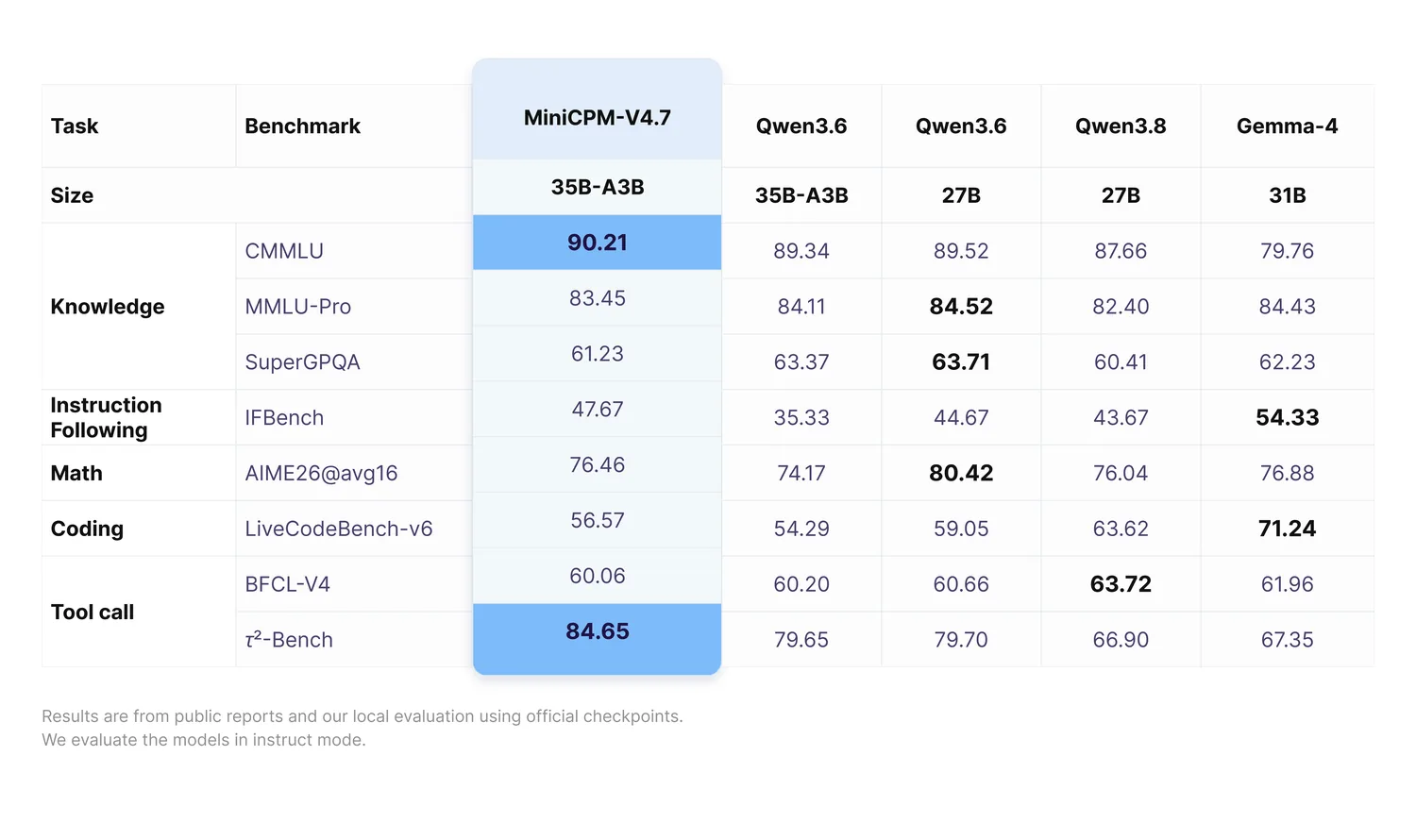
The company says that combining the three makes 35B-A3B the first open-source MoE model to run smoothly on-device without capability loss.
Measured Speed and “Capability Density”
Official on-device decoding data:
| Device | Decoding speed | Memory usage |
|---|---|---|
| iPhone 17 Pro Max | 13+ tokens/s | About 3GB |
| iPad Pro | 15+ tokens/s | Not provided in release materials |
One slightly counterintuitive point: the iPad Pro’s 15+ tokens/s is faster than the iPhone 17 Pro Max’s 13+, showing that on-device performance remains sensitive to device bandwidth and thermal conditions. There is still a gap between “it can run” and “it runs reliably.”
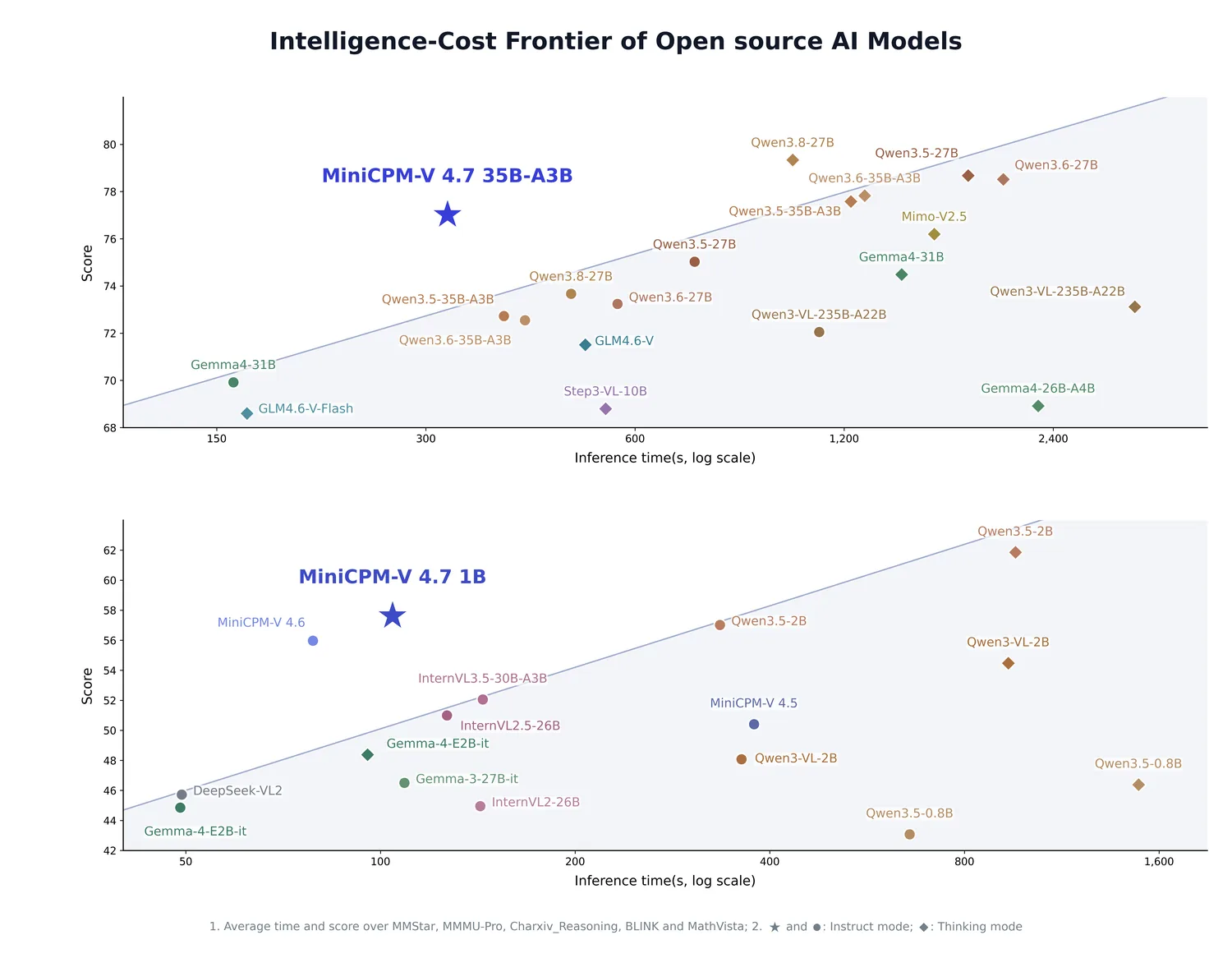
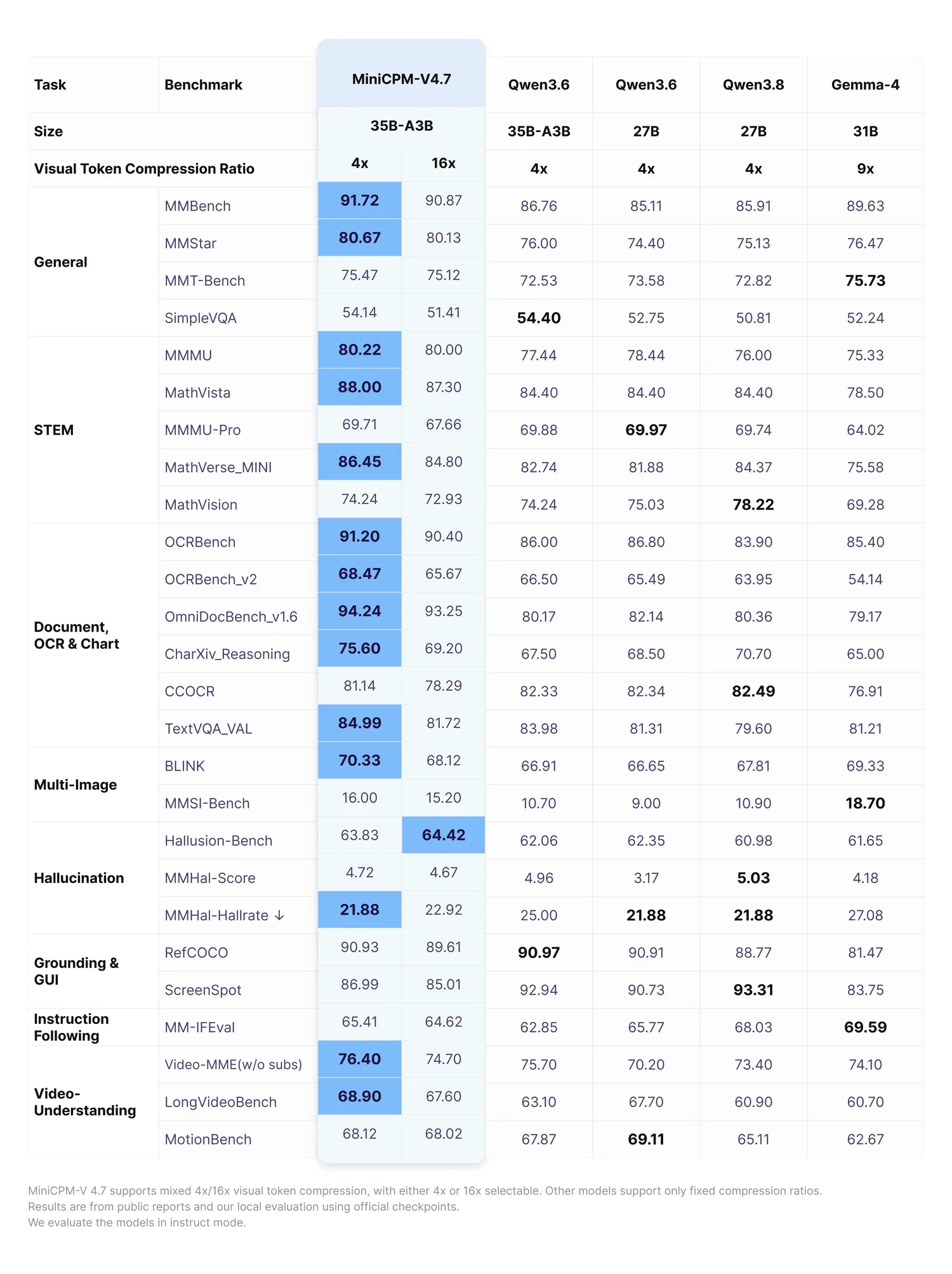
Another highlighted metric is capability density. The company says that in Instruct mode, 35B-A3B achieves a higher overall score than Qwen3.6 35B-A3B with less inference time, pushing the Pareto frontier of performance and efficiency forward. On the vision side, the model follows LLaVA-UHD v4’s idea of early compression inside the ViT, compressing visual tokens within the vision encoder itself to reduce computation in later encoding layers, and it supports 4x/16x hybrid visual token compression, letting developers trade off detail against inference cost depending on the task.
What Developers Get
The toolchain is a major focus of this release. Inference frameworks support SGLang, vLLM, llama.cpp, and Ollama; fine-tuning frameworks support SWIFT and LLaMA-Factory; quantization formats cover GGUF, BNB, AWQ, GPTQ, and FP8. It also releases SRFT (Self-Replay Fine-Tuning), for low-cost expansion of model capabilities while reducing forgetting of existing capabilities.
The official Transformers inference example requires transformers[torch]>=