
MiniMax released M3.1 Flash on October 19, a lightweight model tuned for coding and agent workloads that lands roughly 48 hours after DeepSeek’s V4.1 Flash-1017.
- Release: October 19, 2026; DeepSeek V4.1 Flash-1017 went live October 17
- Positioning: coding/agent optimized, 1M-token context
- Pricing: 1 yuan per million input tokens, 4 yuan per million output tokens, 0.1 yuan per million cached reads
- Speed: 200+ TPS output in everyday use, with a P50 median of 170+ TPS
- Cost: MiniMax says agentic task costs fell 70% versus the previous generation
- Weights: not mentioned in the source material
Space Bunny goes official

M3.1 Flash first circulated anonymously as “Space Bunny.” During that period it held second place on OpenCode’s usage leaderboard and briefly ranked first on OpenRouter. One developer compared it against Claude Opus 5, GPT-6 Sol and Gemini 3.8 Flash on a rocket-launch scene built at the highest thinking level, claiming Space Bunny finished in three minutes with results comparable to Opus 5. Zhidx’s own hands-on test found it close to GPT-6 Astra.
MiniMax said the production build keeps that responsiveness and pushes inference efficiency further with a more aggressive sparse attention architecture, yielding 200+ TPS.
Benchmarks: agent wins, code repair doubles
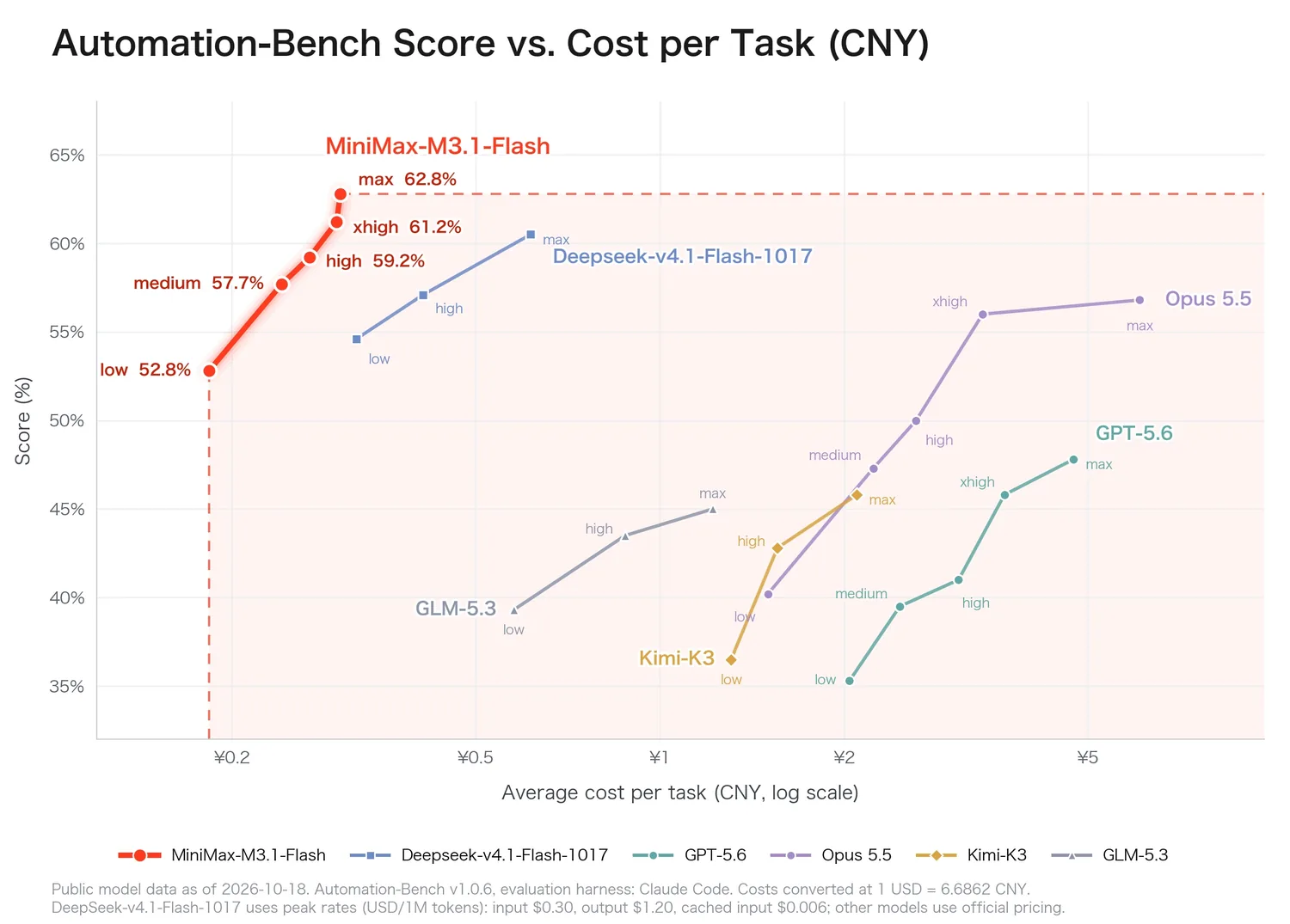
- Automation-Bench v1.0.6: 62.2 points, beating DeepSeek V4.1 Flash-1017’s 60.5 and passing Opus 5
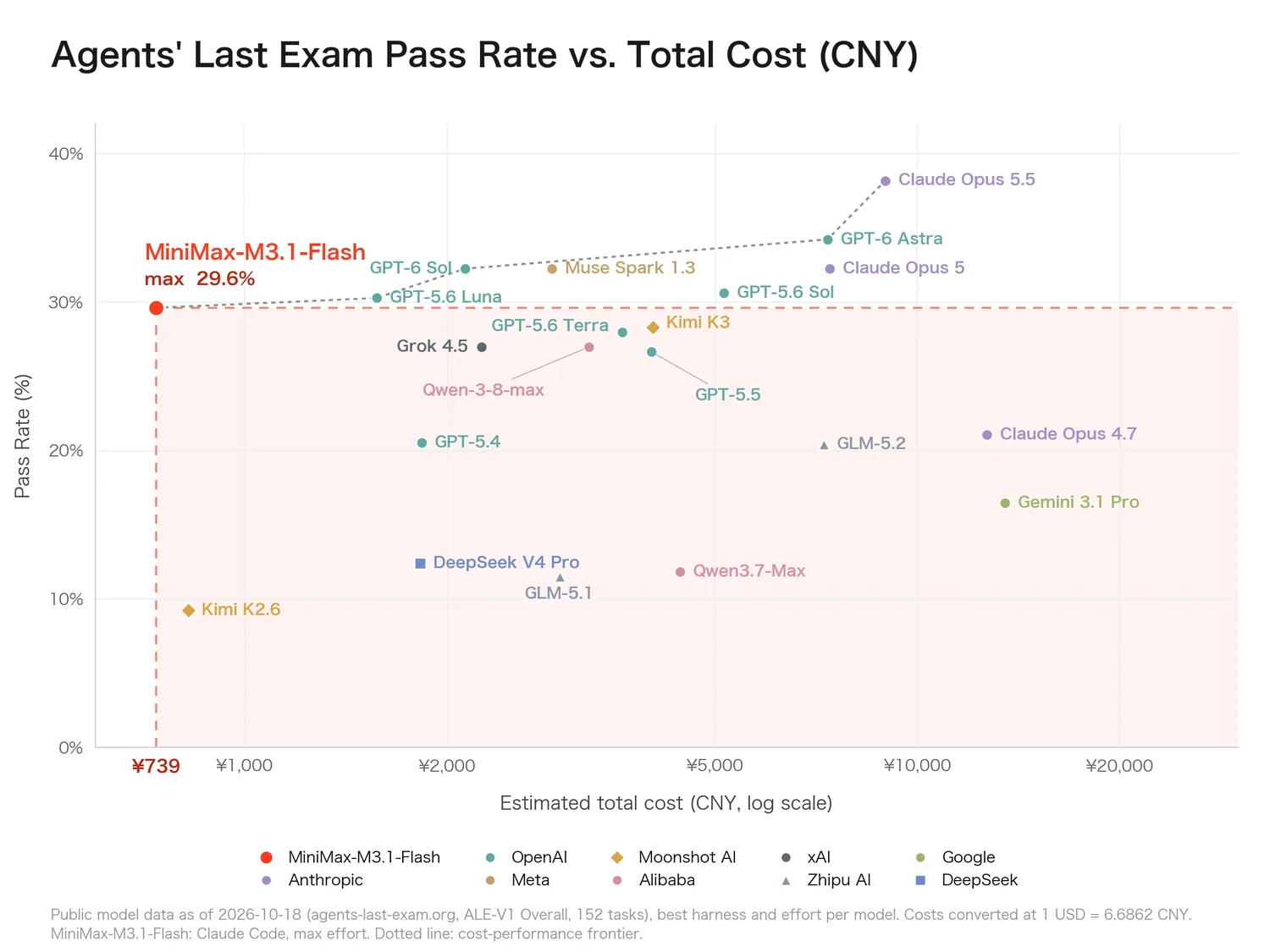
- Agents’ Last Exam: 29.6% pass rate at a cost of 739 yuan
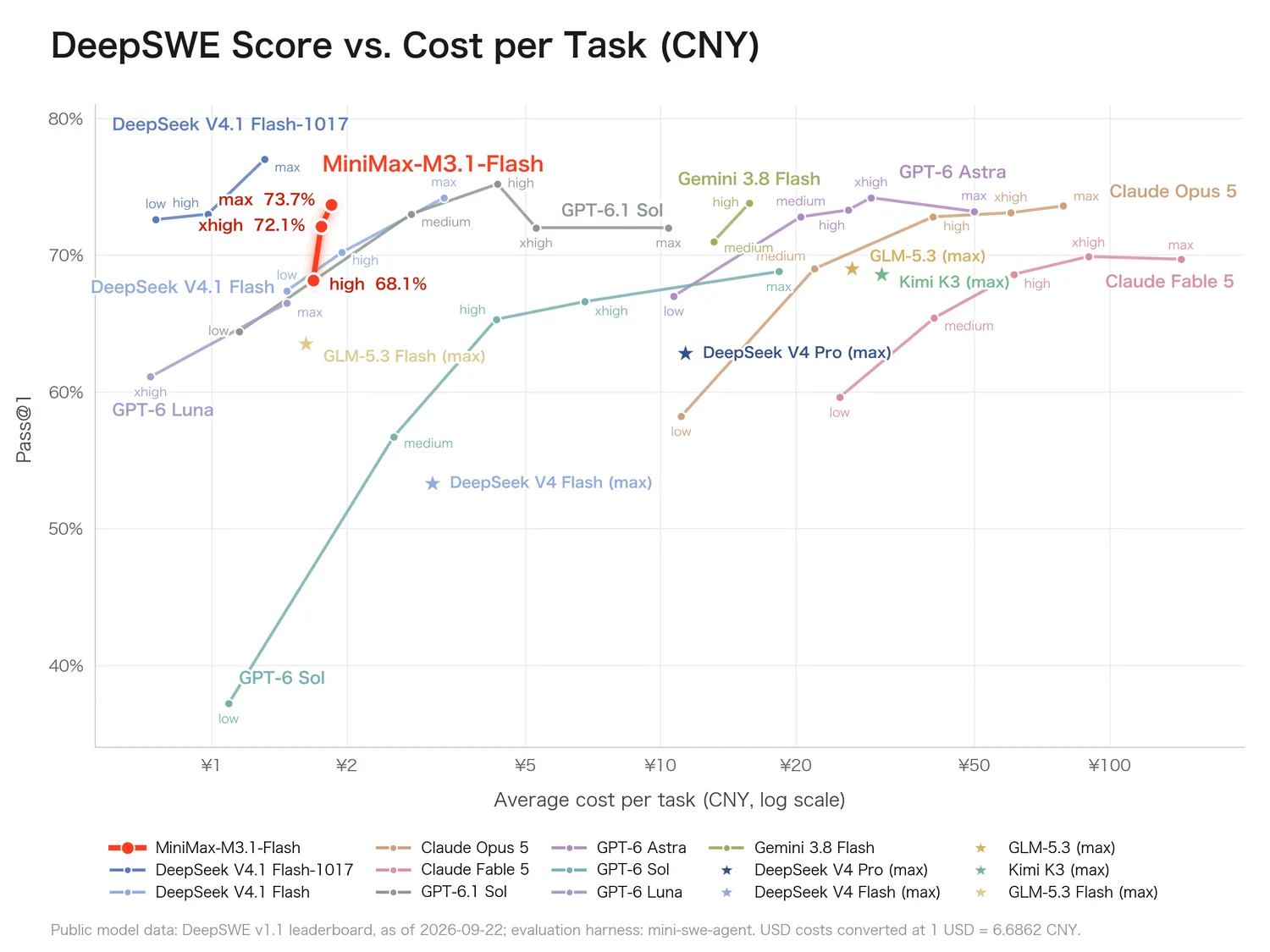
- DeepSWE v1.1: DeepSeek leads at 77.0; M3.1 Flash scores 73.7, just 0.3 behind Opus 5
- SWE Refore Bench: M3.1 Flash at 23.0, more than double DeepSeek’s score
- BankerToolBench: 76.2, tied with Opus 5 for first
- CyberGym: 82.2, top tier alongside GLM-5.3
- HLE w/o tools: 43.4, slightly above DeepSeek V4.1 Flash-1017
DeepSeek’s V4.1 Flash uses a sparse MoE design with 552B total parameters, but activates only 8B for input and 16B for output.
Pricing: about half of DeepSeek’s peak rates
| Billing item (per million tokens) | MiniMax M3.1 Flash | DeepSeek V4.1 Flash-1017 |
|---|---|---|
| Input (cache miss) | 1 yuan | 1.0 yuan off-peak / 2.0 yuan peak |
| Input (cache hit) | — | 0.02 yuan off-peak / 0.04 yuan peak |
| Output | 4 yuan | 4.0 yuan off-peak / 8.0 yuan peak |
| Cached reads | 0.1 yuan | — |
MiniMax charges a flat rate, while DeepSeek varies by time of day. M3.1 Flash therefore costs roughly half of DeepSeek’s peak price and matches its off-peak price.
Who should switch, who should wait
If your workload is long-horizon agent tasks, cross-app automation or frequent code repair, M3.1 Flash belongs on the shortlist, and the 0.1 yuan cached-read price suits repeated calls over the same context.
If code generation efficiency and cache economics matter more, or your pipeline is tied to the DeepSeek ecosystem, V4.1 Flash-1017 still leads DeepSWE v1.1 — no rush to migrate.
Final thoughts
Flash-tier models are shedding the “fallback” label and now trade blows with flagships on key metrics. With two launches 48 hours apart, DeepSeek and MiniMax have created the first genuine two-horse race in this tier for Chinese models.