Just Now, Xiaomi Unveiled MiMo-V2.6: Frontier, Fully Multimodal, Built in Public — 945 Points on Hacker News
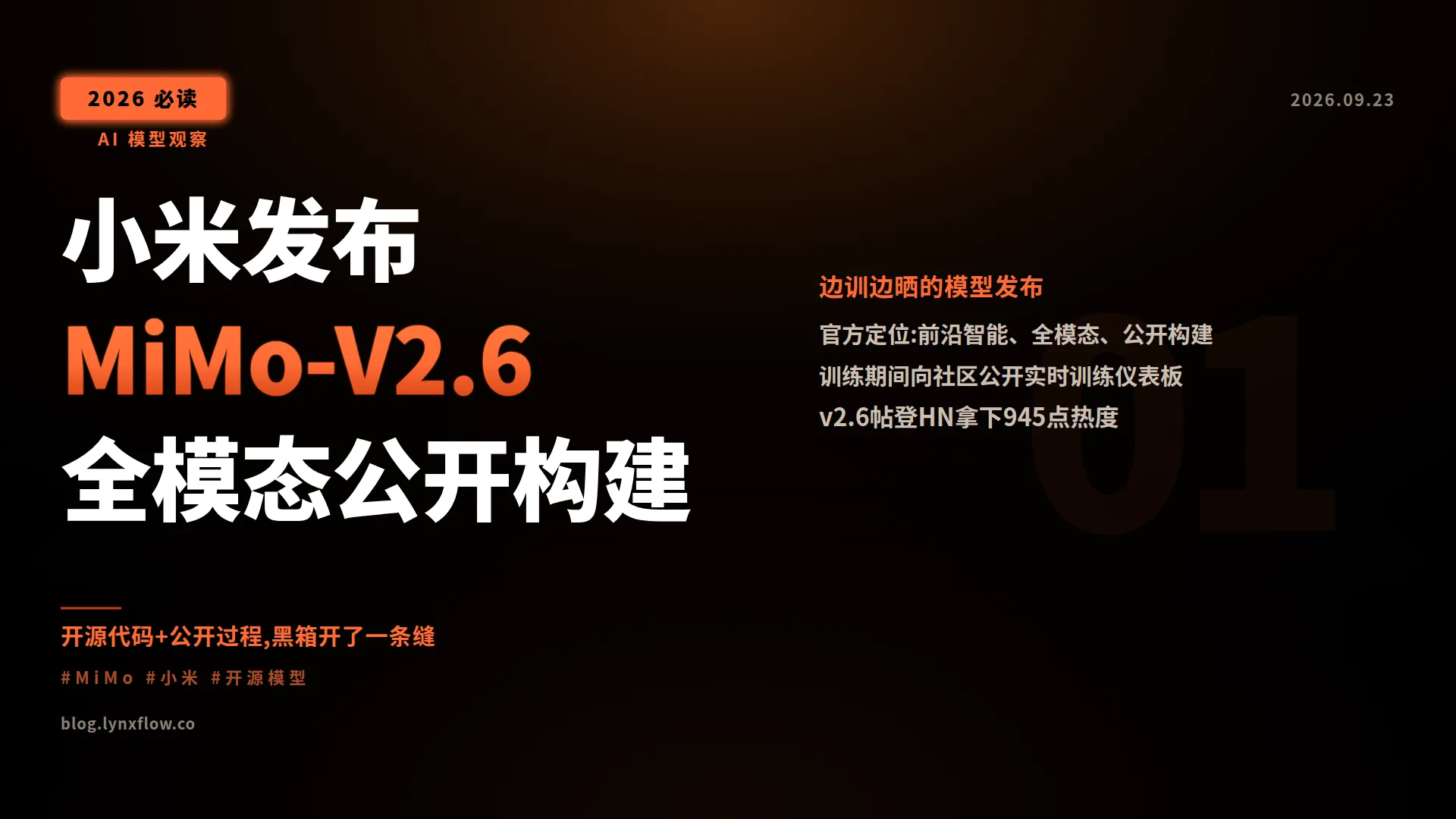
Xiaomi has officially launched the MiMo-V2.6 series of models, positioned as “frontier intelligence, fully multimodal, built in public” [EV-9880184a33]. The real highlight of this release isn’t benchmark scores—it’s the “built in public” approach. During MiMo 2.6’s training, Xiaomi opened a real-time training dashboard to the community [EV-5bfa47cd54]. The launch news hit Hacker News, landing at 945 points [EV-dbcd5263bc].
I. What Happened: A Model Launch with “Training in Plain Sight”
Xiaomi rolled out the MiMo-V2.6 series on its official page, with a launch message consisting of just one sentence: “frontier intelligence, fully multimodal, built in public” [EV-9880184a33]. Three phrases, each pointing to capability positioning, modality coverage, and working methodology. No lengthy technical report, no evaluation charts—at least not in any release materials currently available [EV-9880184a33].
One noteworthy phrasing: the official material refers to the “MiMo-V2.6 series”—a family of models, not a single one [EV-9880184a33]. Which specific variants are included and how they divide responsibilities hasn’t been elaborated in available materials [EV-9880184a33].
Taken alone, this release is notably restrained. But widen the lens, and the MiMo name already carries a string of verifiable footprint across overseas tech communities. The 945-point heat on the v2.6 post [EV-dbcd5263bc] didn’t come out of nowhere.
The previous generation, MiMo-v2.5-Pro-UltraSpeed, is a 1T (trillion-parameter) model with inference throughput of 1,000 tokens per second. Its related post earned 628 points on Hacker News [EV-2ecbcaf727][EV-fb6397d76b]. A trillion parameters paired with a thousand tokens-per-second—those two numbers together naturally sparked discussion.
On the transparency front, Xiaomi has published a real-time dashboard for the post-training phase of MiMo 2.6 at mimo.xiaomi.com/rl/, and the related HN post garnered 560 points [EV-2ed818758d]. The post-training stage has also been made publicly accessible as a live page.
On the open-source front, MiMo Code has been released and open-sourced, with a related post hitting 557 points [EV-d36c70bdb1]; Xiaomi’s MiMo inference model open-source code is hosted on the GitHub repo XiaomiMiMo/MiMo, with a related post at 482 points [EV-a2ac89aba8].
Laying those records out: 945, 628, 560, 557, 482 [EV-dbcd5263bc][EV-fb6397d76b][EV-2ed818758d][EV-d36c70bdb1][EV-a2ac89aba8]. Across verifiable records, MiMo-related posts now number five with heat above 450 points. That density isn’t common among recent model release sequences.
Running through this entire thread is a consistent clue: MiMo isn’t just a name that appears on launch day. It was live during training [EV-5bfa47cd54], it went online during the post-training phase [EV-2ed818758d], and the code repo sits on GitHub [EV-a2ac89aba8]. For a model team, this “always-on” presence is, in itself, a form of existence.
II. What the Official Line Says: Three Phrases, One Verifiable Claim
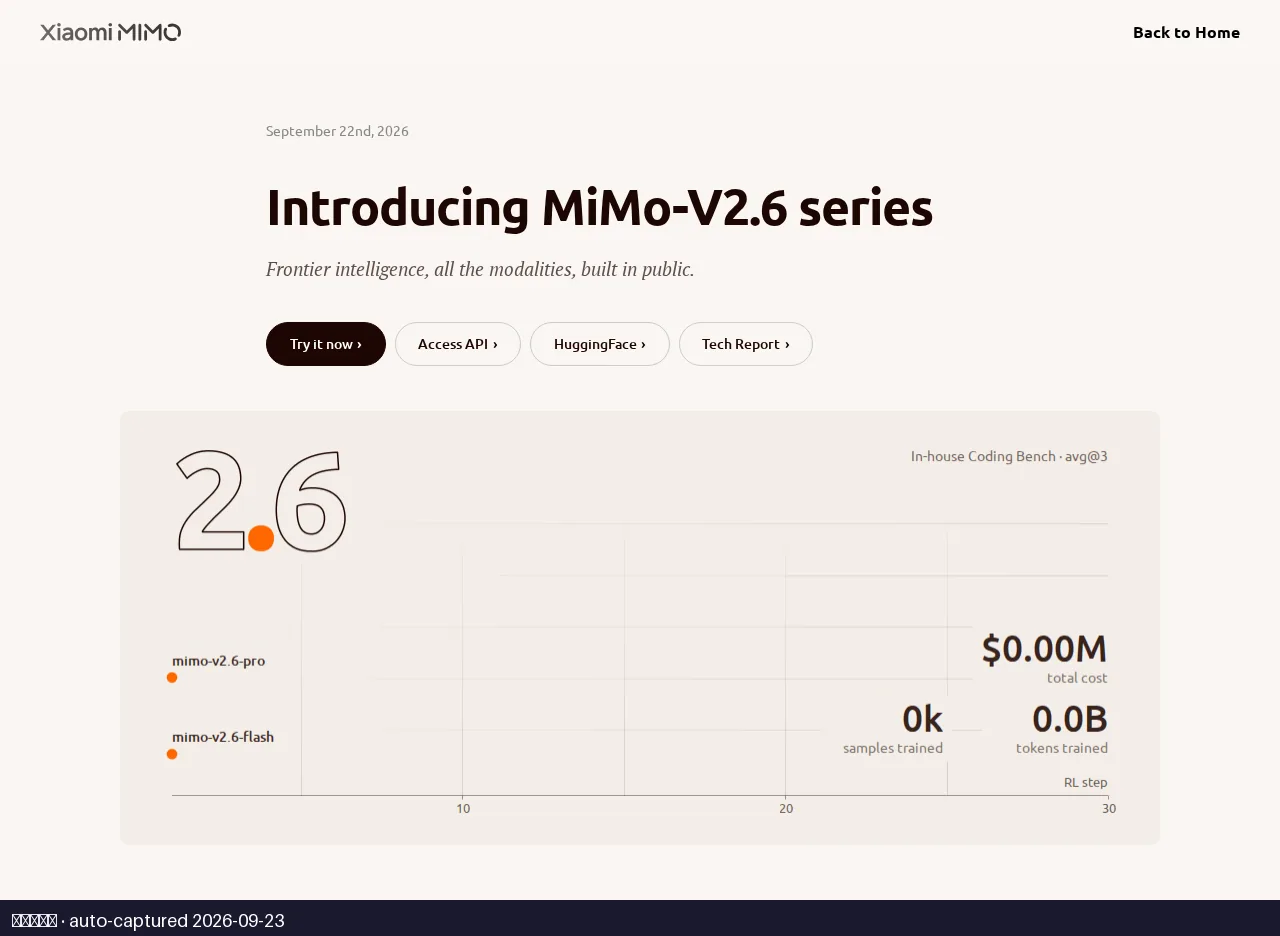
Xiaomi’s full positioning for MiMo-V2.6 is: “frontier intelligence, fully multimodal, built in public” [EV-9880184a33]. The three phrases can be unpacked one by one.
The first phrase, “frontier intelligence”—a self-description commonly used by leading model teams, placed at the front of Xiaomi’s launch message [EV-9880184a33]. Positioning is one thing; actual substance requires evaluation numbers. And notably absent from that launch sentence are any such numbers [EV-9880184a33].
The second phrase, “fully multimodal” (official wording: “all the modalities”) [EV-9880184a33]. In currently available public information, there’s still no specific modality list—what inputs are supported, what outputs, will need to wait for follow-up materials [EV-9880184a33].
The third phrase, “built in public,” is the most concrete and the easiest to verify of the three [EV-9880184a33]. It corresponds not to a slogan but to two already-executed actions.
The first action took place during training: Xiaomi publicly shared a real-time training dashboard with the community [EV-5bfa47cd54]. External observers no longer need to wait until launch day to see process data—it’s visible as training proceeds.
The second action came during the post-training phase: Xiaomi continued to publish a real-time dashboard at mimo.xiaomi.com/rl/ [EV-2ed818758d]. The official term is “live post-training dashboard.” The meaning of the “rl” in the URL isn’t explained in the materials cited here.
Putting both the training and post-training phases online is uncommon in the industry. The standard practice among most model teams is to run training as a black box and deliver a technical report at launch. MiMo’s choice is to surface the in-between process as well, making “the process” itself part of the launch narrative.
Of the three phrases, the first two are capability claims; the third is a commitment to working methodology. Capability claims need evaluation to verify; the methodology commitment can be checked right now—open the URL and see whether the dashboard is live [EV-2ed818758d].
One more detail: Xiaomi placed “built in public” directly alongside “frontier intelligence” and “fully multimodal” in the launch sentence [EV-9880184a33]. Positioning working methodology as a selling point, in the same sentence as capability selling points—this arrangement in itself is a statement.
III. Community Reaction: 945 Points and One Noted Detail
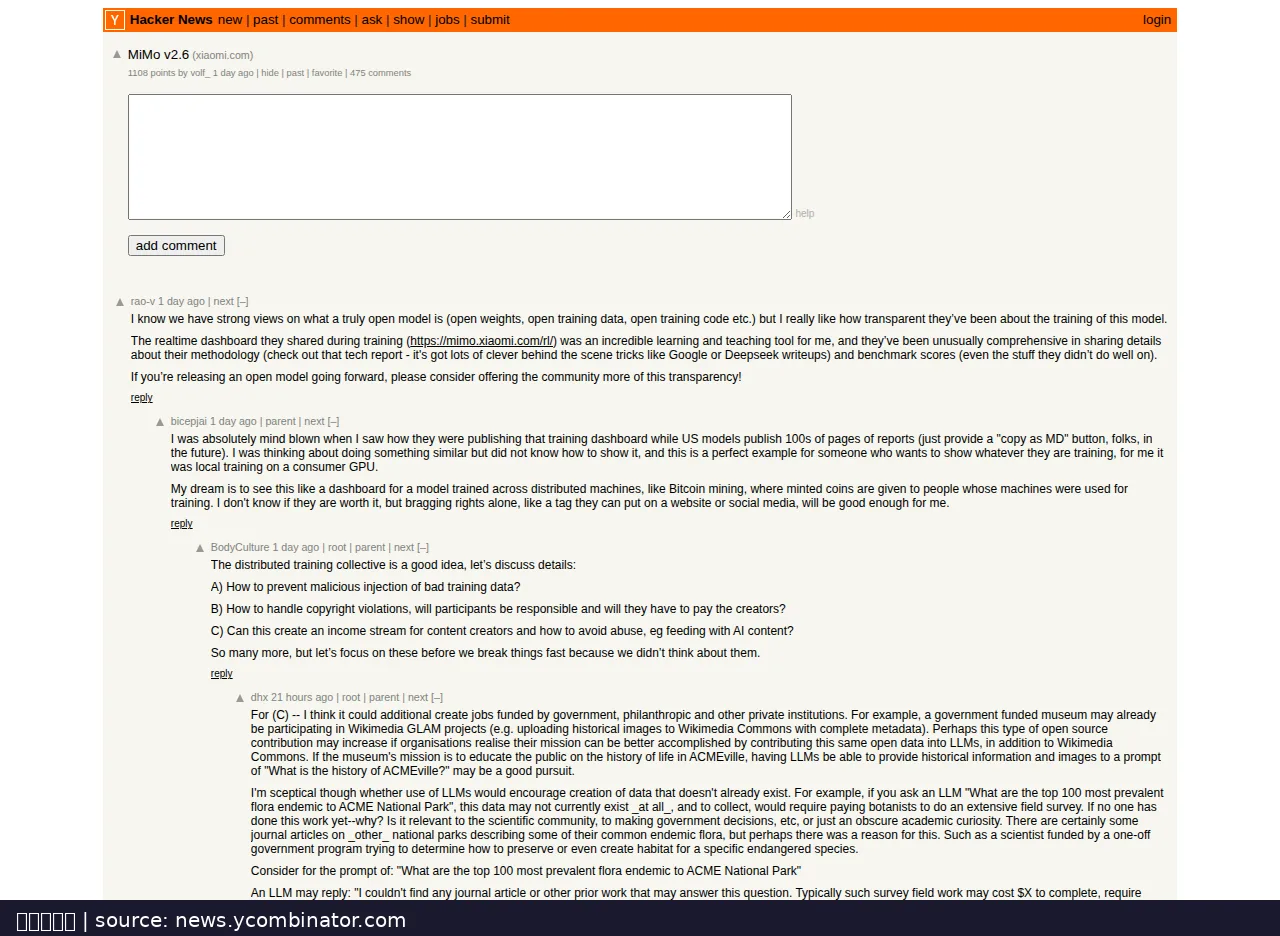
On Hacker News, the “MiMo v2.6” post scored 945 points [EV-dbcd5263bc]. For reference, other MiMo-related post scores are: UltraSpeed at 628 [EV-fb6397d76b], the post-training dashboard at 560 [EV-2ed818758d], MiMo Code at 557 [EV-d36c70bdb1], and the GitHub open-source repo at 482 [EV-a2ac89aba8]. At 945, this is the highest value in the series.
In community discussion, one detail kept coming up: the training dashboard. A user specifically noted that Xiaomi shared a real-time dashboard during MiMo 2.6’s training period [EV-5bfa47cd54]. For a community accustomed to “launch day = all the information,” seeing real-time data mid-training is a novelty.
But the community also quickly identified the boundary of that transparency. As one user put it: the dashboard “is missing only the dataset descriptions”—it shows random IDs like “dataset-zrso” [EV-dac5881356]. In other words, you can see training is running, but not on what data.
This observation came from community discussion, not official documentation. But it points to a very concrete issue: the process is open, but the data isn’t.
On the team, community lore holds that the Xiaomi MiMo team is led by Luo Fuli, who previously worked at Alibaba and DeepSeek [EV-9e5df700d8]. This also comes from community discussion and hasn’t been directly confirmed in any official materials cited here—take it with a grain of salt.
One more thing worth noting: community attention to MiMo has been cumulative, not one-off. The open-sourcing of the inference model [EV-a2ac89aba8], the UltraSpeed speed figures [EV-2ecbcaf727], the two real-time dashboards [EV-5bfa47cd54][EV-2ed818758d], the v2.6 launch [EV-9880184a33]—each move left a verifiable heat record on HN. That accumulation itself is part of the community’s attitude.
Of course, HN heat is influenced by topic, timing, and many other factors, and can’t be directly换算ed into model capability. But with scores ranging from 482 to 945 across several posts, at least this much is clear: a notable number of people are keeping an eye on MiMo.
IV. How to Read This: The Value of “Built in Public” and Its Boundaries
First observation: “built in public” is currently MiMo’s clearest differentiator. In the industry, training processes are almost universally black boxes; model credibility is built primarily through launch-day evaluation reports. MiMo has opened real-time dashboards for both the training period [EV-5bfa47cd54] and the post-training phase [EV-2ed818758d], effectively shifting the anchor of credibility from “outcome” to “process.”
The direct cost of this move may not be high—a dashboard alone doesn’t constitute a technical barrier—but the signaling value is significant. It at least shows the team is willing to let outsiders watch as training proceeds. That’s a posture, and it’s also a form of self-constraint.
Second observation: transparency has boundaries. The dataset shows only random IDs with no descriptions [EV-dac5881356], meaning “built in public” stops at the process layer and hasn’t reached the data layer. The community has already flagged this gap [EV-dac5881356]. Dataset composition is core information for any model team, and nondisclosure is understandable; but this also frames the actual substance of “built in public”—it’s process transparency, not full transparency.
Third observation: engineering capability has precedent. The previous-generation MiMo-v2.5-Pro-UltraSpeed is a 1T-parameter model with inference speed of 1,000 tokens per second [EV-2ecbcaf727]. Those two numbers show that Xiaomi has publicly documented results in both enormous parameter scale and inference efficiency. As for the parameter scale and evaluation scores of v2.6 itself, no numbers are available in currently visible information. The materials to judge this generation’s capability aren’t yet in place.
Fourth observation: the team’s background is worth noting. Per community information, the team is led by Luo Fuli, who previously worked at Alibaba and DeepSeek [EV-9e5df700d8]. If that information is accurate, the team lead comes from two companies with model R&D track records. Track records don’t substitute for results, but in a route choice that leans toward engineering culture—“built in public”—the team’s background is a coordinate worth referencing.
One detail easily overlooked: open-source is part of the MiMo narrative. MiMo Code has been released and open-sourced [EV-d36c70bdb1], and the inference model code is hosted on the GitHub repo XiaomiMiMo/MiMo [EV-a2ac89aba8]. Open-source code paired with the public training dashboard [EV-5bfa47cd54]—the two together complete the “built in public” puzzle, or at least complete the posture, as it stands.
Three things to watch next: first, v2.6’s parameter scale and evaluation scores—currently no numbers are visible; second, the modality list, since the official side has only said the three characters “fully multimodal” [EV-9880184a33]; third, whether the dataset column on the dashboard will transition from random IDs to real descriptions [EV-dac5881356]. These three items correspond, respectively, to capability, coverage, and the substance of transparency.
Closing Thoughts
The MiMo-V2.6 release carries a surprisingly thin direct information payload: one positioning statement, three phrases [EV-9880184a33]. What carries real weight is the working methodology behind it—the real-time training dashboard [EV-5bfa47cd54], the real-time post-training dashboard [EV-2ed818758d], the open-source code repo [EV-a2ac89aba8], and a post that earned 945 points on Hacker News [EV-dbcd5263bc].
The actual caliber of the model itself will need to wait for hard numbers like parameter scale and evaluation scores—those haven’t appeared yet in currently visible information. But the “built in public” approach has already made MiMo a sample worth tracking closely: it has pried open a crack in the industry’s customary black box. Whether that crack widens is something a simple litmus test can reveal—on the next-generation dashboard, will the dataset column still read “dataset-zrso” [EV-dac5881356]?
References
- Xiaomi MiMo-V2.6 Official Release Page: https://mimo.xiaomi.com/mimo-v2-6 [EV-9880184a33]
- Hacker News Community Discussion: https://news.ycombinator.com/item?id=49792730 [EV-dbcd5263bc][EV-dac5881356][EV-5bfa47cd54][EV-9e5df700d8]
- Hacker News Algolia Search Record: https://hn.algolia.com/api/v1/search?query=MiMo&tags=story [EV-fb6397d76b][EV-2ed818758d]
- MiMo-v2.5-Pro-UltraSpeed Official Blog: https://mimo.xiaomi.com/blog/mimo-tilert-1000tps [EV-2ecbcaf727]
- MiMo 2.6 Real-Time Post-Training Dashboard: https://mimo.xiaomi.com/rl/ [EV-2ed818758d]
- MiMo Code Official Page: https://mimo.xiaomi.com/mimocode [EV-d36c70bdb1]
- XiaomiMiMo/MiMo GitHub Repository: https://github.com/XiaomiMiMo/MiMo [EV-a2ac89aba8]
Note: Square brackets contain in-text evidence identifiers; some evidence spans multiple sources (e.g., the dashboard heat of 560 points is also verifiable via Algolia records).