MXC SDK Officially Released: A Secure Execution Sandbox for AI Agents
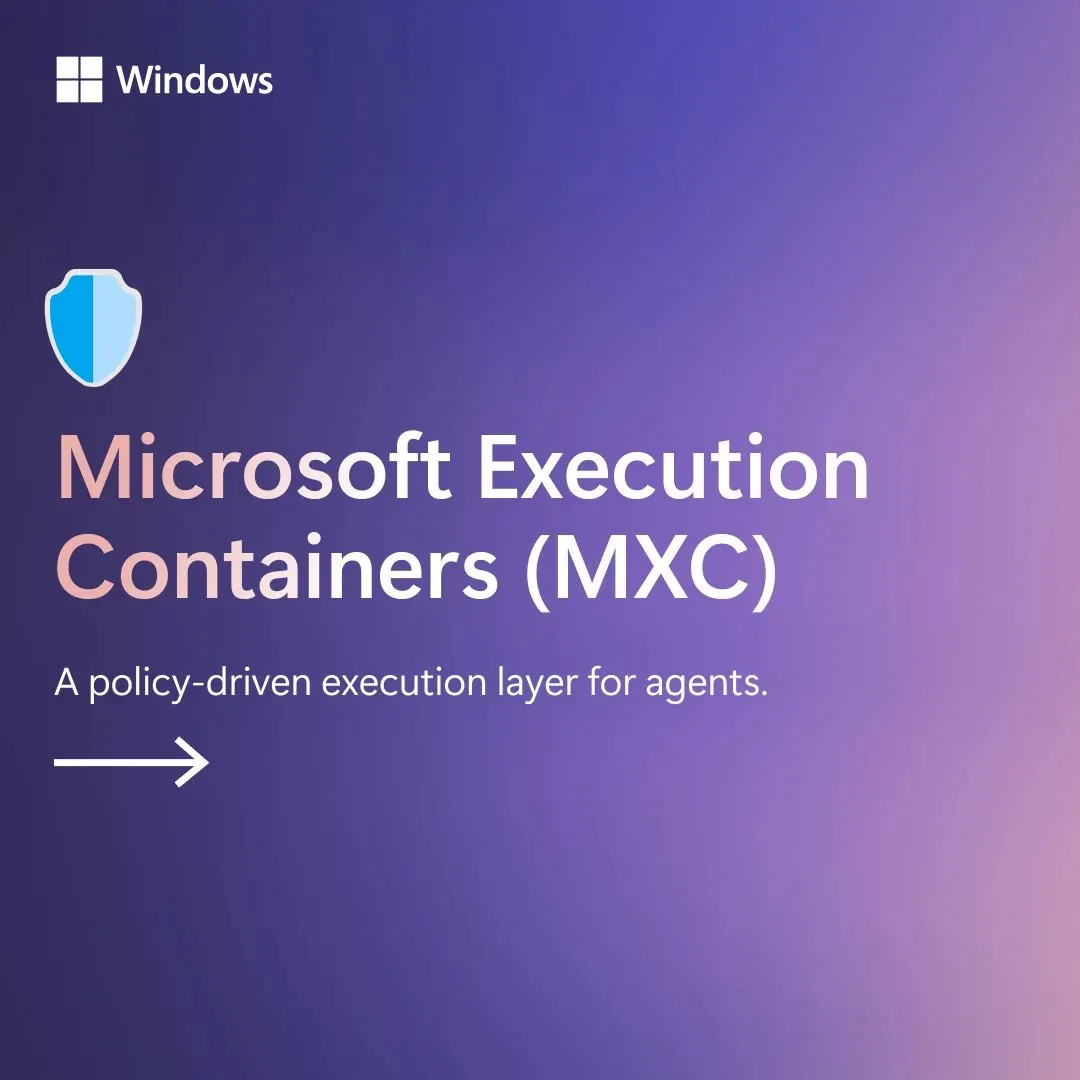
Microsoft officially introduced the MXC (Microsoft Execution Containers) SDK at its Windows and Surface launch event, positioning it as a core component of its Windows AI strategy. This is a key foundational technology Microsoft is introducing for AI agents. At present, complete technical details, availability scope, and launch timing have not yet been announced.
- Product name: MXC (Microsoft Execution Containers) SDK
- Release status: Specific release date not disclosed
- Availability status: Complete technical details and availability scope not yet announced
- Core positioning: A key component of the Windows AI strategy
MXC’s core goal is to create a relatively isolated, controlled execution environment—commonly called a “sandbox”—for AI agents, enabling them to complete complex operations such as code execution, tool invocation, and task processing without frequently accessing sensitive user data. This marks an extension of the capability boundary of AI agents on the Windows platform from “Q&A” to “execution.”
Controlled Execution: Technical Implementation Within a Trust Framework
Within Microsoft’s AI ecosystem, MXC plays a critical role in addressing the “trust” problem. Microsoft CEO Satya Nadella lists trust, intelligence, and “AI infused with human ambition” as the three pillars of the frontier ecosystem. MXC’s design logic is centered precisely on “trust,” one of those three pillars: using technical means to confine an agent’s operating scope within predefined boundaries and prevent it from freely accessing sensitive data such as the file system, email, and browser history.
This design creates an important contrast: although many AI agents today rely on cloud computing for complex reasoning, MXC chooses to build a controlled environment locally. This means agents do not need to send sensitive instructions or intermediate data to remote servers, which reduces both network latency and the risk of data leakage. For enterprise users and high-privacy scenarios, this localized execution approach is more attractive.
Synergy with the Existing Product Ecosystem
MXC is not an isolated technology; it will directly serve Microsoft’s key AI product lines, such as Agent 365 and Microsoft IQ. Nadella has said that these products will become core assets for Microsoft’s future. MXC provides foundational security for these upper-layer applications—AI agents can be authorized to perform tasks such as scheduling meetings, editing documents, and calling external APIs, but their operations always remain constrained by the sandbox.
It is worth noting that the release of the MXC SDK shows Microsoft is moving AI security from the “policy layer” to the “engineering layer.” Previously, enterprises often relied on permission configuration and policy restrictions to constrain AI behavior, whereas MXC uses containerization technology to achieve finer-grained, instruction-level isolation. This architecture is similar to browser Site Isolation or mobile app permission sandboxes, but it is specifically optimized for the high-frequency, dynamic task invocation scenarios of AI agents.
Practical Adoption Recommendations
Who should use it: Enterprise developers should keep an eye on MXC. If they plan to build AI agents that handle sensitive data (such as applications in finance or healthcare), MXC offers a compliance-ready technical path. Windows app developers are another audience; in the future, they may use the MXC SDK to build safer local intelligent assistants.
Better to wait: At present, Microsoft has not announced how to obtain the SDK or its developer program, and there is no definite timeline for power users and creators. For scenarios with extremely high requirements for execution environment security, it may be worth waiting for Microsoft to publish further technical white papers.
Final Thoughts
At its core, MXC is Microsoft’s concrete expression of an AI security path—when large model capabilities converge, differentiated competition will shift to “how to make AI more trustworthy.” Containerized execution environments may become standard infrastructure for the next generation of agents, and Microsoft’s decision to release the MXC SDK now is intended to claim for the Windows ecosystem the right to define localized AI execution.