
Meta’s Muse Wonder, released on October 12, returned nothing but a red cylinder in a developer-run 3D coding test — a reminder that leaderboard scores and hands-on capability are two different things.
- Release: October 12, Meta launched Muse Wonder and Muse Wonder Full, pitched at coding agents, tool calling and long-horizon task execution.
- Published scores: Wonder Full scored 57.5 on SWE-Marathon and 79.0 on DeepSWE 1.1.
- Pricing, open weights and availability: not stated in the source report.
One lava lamp, one red cylinder
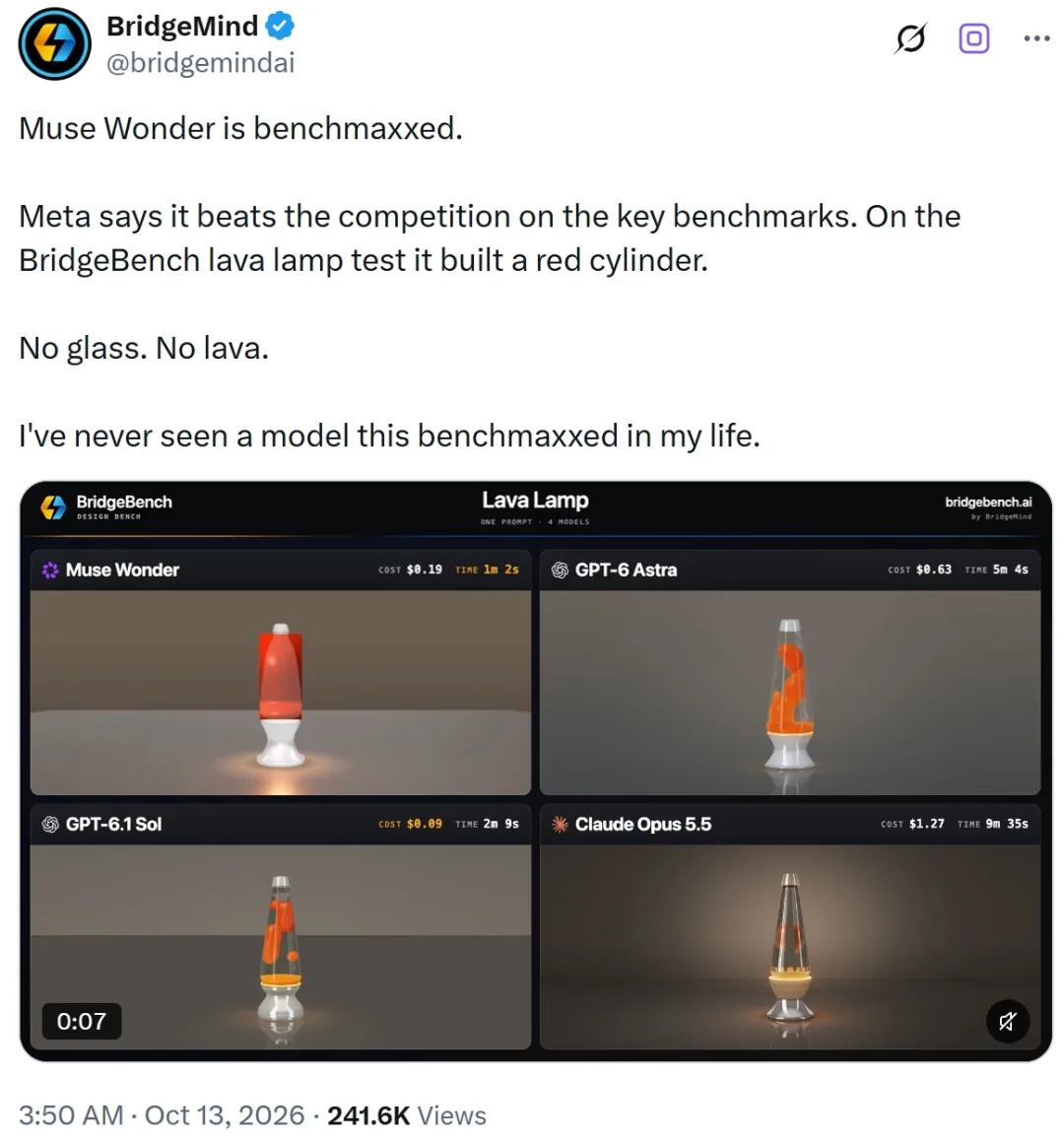
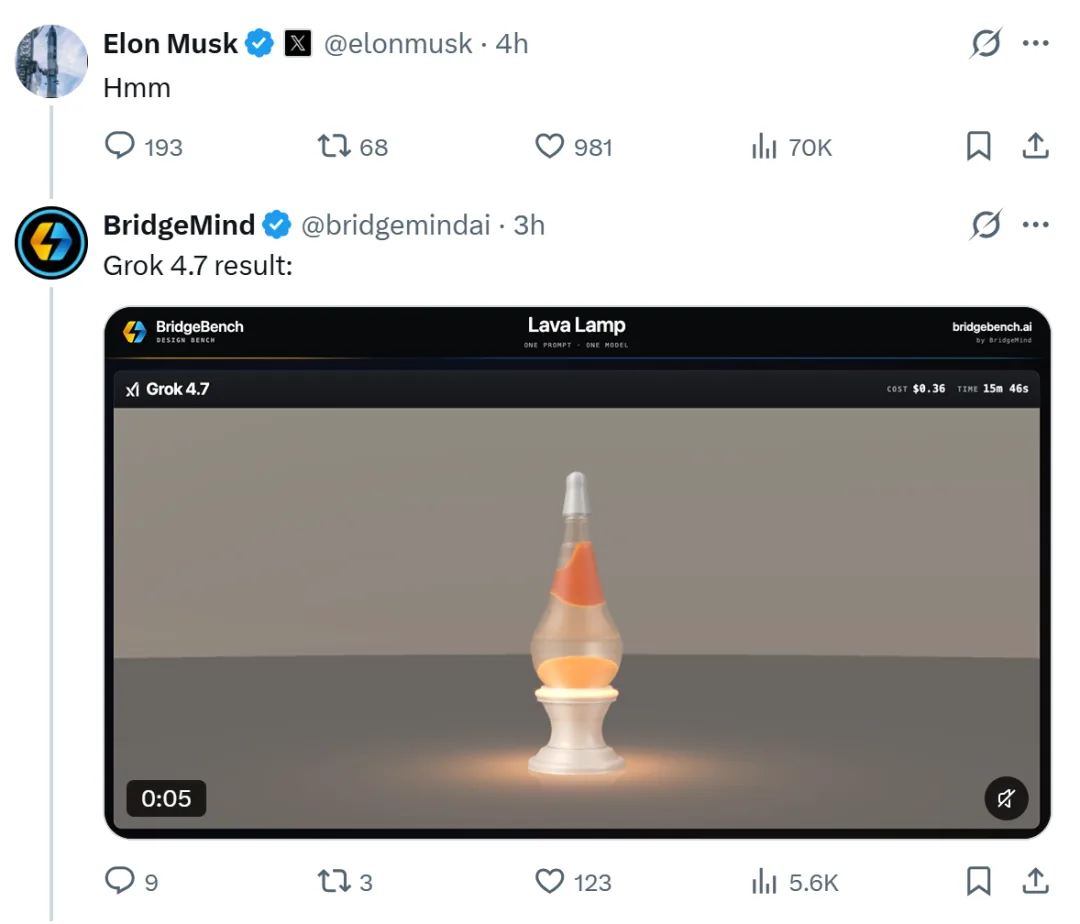
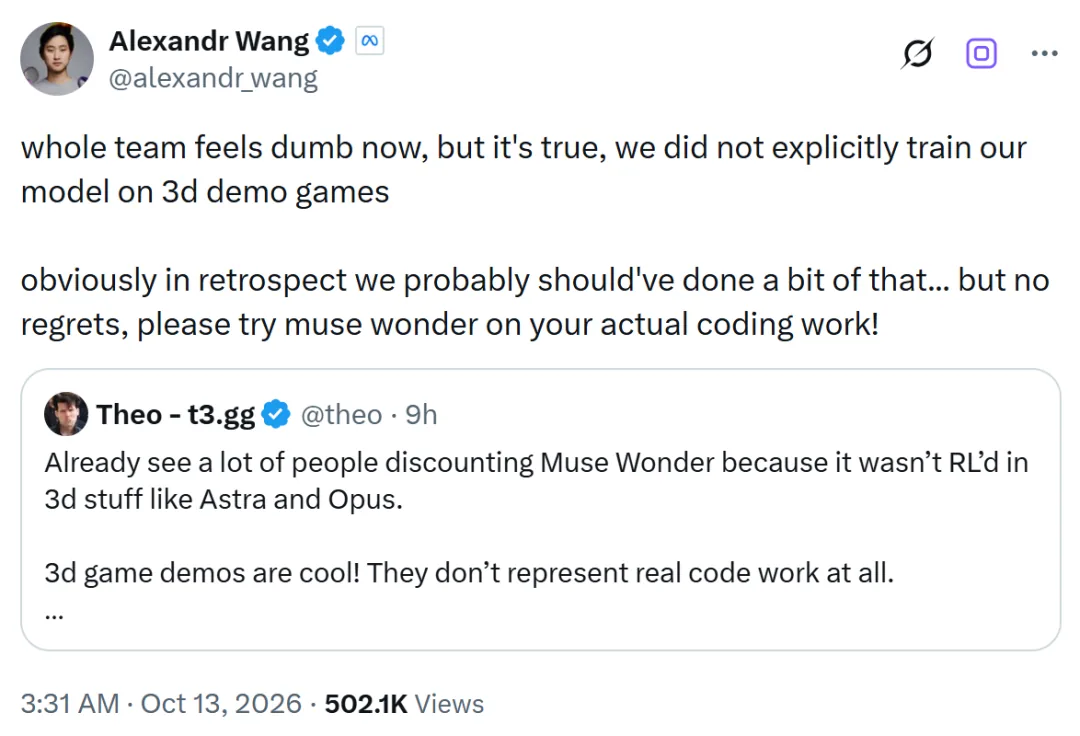
The task from the developer community BridgeMind was modest: build a lava lamp with a transparent glass shell, animated lava and lighting. Muse Wonder produced a red cylinder. BridgeMind accused the model of benchmaxxing — heavy optimization for public benchmarks that falls apart on unfamiliar work. Musk replied “Hmm”, adding drama without taking an explicit position. Meta chief AI officer Alexandr Wang said the team had done no explicit training for 3D demo games and that, in hindsight, it might add some — but he urged developers to try Muse Wonder’s coding ability for themselves.
The contrast is that Meta’s own model card already lists vision and spatial reasoning, especially 3D tasks, as a known weakness — and the controversy landed precisely there. The lava lamp test also ran on the standard Muse Wonder, while several headline scores come from Wonder Full.
The explanation lies in training. Models increasingly rely on post-training — the stage after pre-training where reinforcement signals shape behavior — and coding agents fit that mold well: hand the model a buggy repository, have it locate the problem, edit files and run tests, and compile results plus unit tests supply relatively clear feedback. Meta says Muse Wonder was trained on diverse long-horizon tasks and uses Active Focus, which lets it try alternative approaches and resume after hitting a wall.
But that depends on the environment returning useful feedback. A lava lamp breaks the pattern. It involves 3D geometry, transparent materials, lighting and animated deformation; built in Three.js, the model must construct a glass shell, generate irregular lava geometry and drive shape changes with time variables or noise functions. The code can run while the image is entirely wrong — mis-set transparency turns glass into an opaque solid, and without continuous variation the interior collapses into a static block. Compilers and unit tests cannot judge visual quality, so the agent needs a visual feedback loop: render a screenshot, spot the deviation, translate it back into code.
The score isn’t the model’s alone
A second layer is easy to miss: agent benchmarks are no longer just “questions for a language model”. SWE-Marathon measures sustained software engineering, where the model reads files, drives a terminal, edits code and runs tests. Completion rates depend on the Harness — the execution scaffolding around the model that organizes tool interfaces, manages context, stores task state and handles failures. When terminal logs run to thousands of lines, a poor Harness drowns the key error; one that extracts errors, compresses noise and tracks progress keeps long tasks alive. Error recovery matters too: checkpoints, locating the step that introduced a bug, and local rollback can save rerunning an entire task chain. Inference budget also counts — more tokens, more tool calls or multiple candidate solutions widen the search space at higher cost.
Meta’s model card says as much: on SWE-Marathon, GPT-6 Astra and Claude Fable 5.1 ran on Codex and Claude Code respectively, so the comparison is not controlled under a single Harness; Wonder Full’s 57.5 also used the xhigh reasoning setting.
| Item | What the source records |
|---|---|
| Lava lamp 3D test | Standard Muse Wonder produced only a red cylinder |
| SWE-Marathon | Wonder Full 57.5, at xhigh reasoning setting |
| DeepSWE 1.1 | Wonder Full 79.0 |
| Comparison conditions | GPT-6 Astra on Codex, Claude Fable 5.1 on Claude Code; not one Harness |
| Official limitation | Model card lists vision and spatial reasoning, especially 3D, as weak |
Notably, Meta devotes a “Capabilities That Generalize” section to exactly this problem: two models can score similarly on common benchmarks yet differ sharply on unfamiliar tasks. The team splits tasks into in-distribution ones targeted by post-training and out-of-distribution ones that were not, comparing Muse Spark 1.3 with Muse Wonder Full across reasoning budgets. It argues Wonder Full improved on unfamiliar tasks relative to the previous generation’s trend, crediting a stronger base model that transfers post-training gains more effectively.
But how unfamiliar is unfamiliar is itself a design question. A never-seen repository is still close to the same software engineering task for an agent trained on code repair; switching frameworks or introducing an unfamiliar API demands re-reading the tool environment; a lava lamp adds spatial modeling, material rendering and visual judgment on top. So one failed lava lamp shows the model did not finish this task — not that it was tuned excessively against public test sets.
Who should try it, who should wait
- Worth trying: teams already using coding agents for sustained software engineering, multi-step edits and long-running tasks. Don’t judge by the leaderboard alone — build an evaluation around your own repositories’ unfamiliarity and log token use, tool calls, runtime and failure recovery.
- Wait: teams that include 3D modeling, graphics rendering or visual output in their criteria, or that need to move across frameworks and unfamiliar APIs. Meta’s model card already flags 3D.
Final word
A benchmark score describes task completion under one specific configuration; the more complex the scenario, the less a single number can tell you. The open question is whether a model can spot problems in unfamiliar territory, build its own verification methods and correct course through feedback. One lava lamp didn’t answer that — it just marked how wide the gap still is.