
Meta Releases Muse Spark Open, Claims It Is America’s Strongest Open-Weight Model
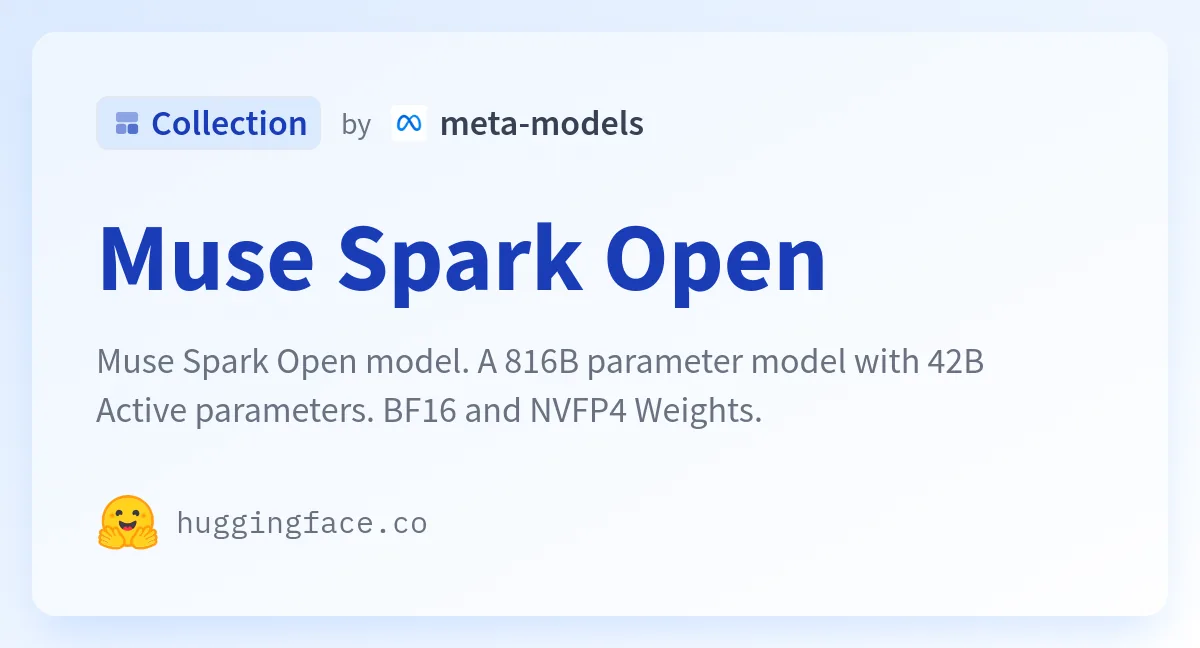
On October 15 local time, Meta launched the open-weight model Muse Spark Open in the meta-models collection on Hugging Face, officially calling it “the most capable U.S. open-weight model to date.” Chinese media followed up with reports on October 16.
- Release date: October 15 local time
- Version: Muse Spark Open, native multimodal architecture (text and images are processed in the same pathway from the start of training, rather than having a vision module bolted on and stitched in afterward)
- Parameter scale: 816B total parameters, 42B active parameters (B means billion; active parameters are the parameters actually involved in computation during a single inference)
- Context window: 1M tokens (a token is the smallest unit the model reads and writes text in; the larger the window, the more material it can “remember” at once)
- Positioning: designed for code building and agent collaboration (agents are model programs that can call tools on their own and complete tasks step by step); the official emphasis is on long-horizon tasks, complex software engineering, and multi-step reasoning
- Are the weights open?: Yes; the collection page provides both BF16 and NVFP4 weights
- Price and licensing: this source does not mention API pricing or license terms
816B Total, 42B Active: The Two Numbers Mean Different Things
816B and 42B are not two ways of describing the same thing; they are “everything the model owns” and “what gets used on each call.” 816B is the full set of weights the model holds, while 42B is the portion actually activated in a single forward pass, about 5%. This “large total, small active” design has become common over the past two years. The point is that inference cost is determined by the 42B, not the 816B, so even models with hundreds of billions of parameters can keep serving overhead relatively manageable.
Another number worth noting comes from quantization. The collection page releases both BF16 and NVFP4 weights: NVFP4 is a 4-bit floating-point format. Simply put, it compresses each weight from 16 bits to 4, yielding a large reduction in size and VRAM footprint at the cost of a slight loss in precision. On the collection page, the BF16 repository is listed at 822B and the NVFP4 repository at 484B, which does not fully align with the official “816B”; the source did not explain this discrepancy.
The source summary also mentions that, thanks to the latest MLX framework (Apple’s machine learning framework), the model “becomes the first in its class to rely on just two Apple M5 Ultra chips (512 GB memory version) …” — the sentence is truncated here, and the exact qualifiers cannot be confirmed. In addition, both repositories on the collection page list their task type as Image-Text-to-Text (image-plus-text input, text output). Within about 7 to 9 hours of launch, the collection received 85 likes.
How to Choose Between the Two Weight Versions
| Weight version | Format | Size listed on collection page |
|---|---|---|
| Muse-Spark-Open-816B-A42B | BF16 | 822B |
| Muse-Spark-Open-816B-A42B-NVFP4 | NVFP4 | 484B |
The same collection also includes Muse Glimmer; this source does not provide details about it.
Who Should Get Started, Who Should Wait
- Can start now: teams that need to build their own code agents and have large-VRAM inference clusters can start with the NVFP4 version; developers who want to verify whether ultra-long context and multi-step reasoning are reliable can also run small-scale evals first.
- Better to wait: individual users with only a single consumer-grade GPU who want to run everyday Q&A locally; and teams that need clear commercial licensing, API pricing, and Chinese-language capability data. Whether 1M context can land reliably in real engineering will have to wait for third-party reproductions.
Final Thoughts
Meta has pushed open-weight parameter scale to 816B and released quantized versions alongside it. This move is more about positioning: U.S. vendors want to offer an answer on the open-weight track that corresponds to Chinese open-source models. But “America’s strongest” is currently only the official claim; the real comparison will have to wait for third-party leaderboards and reproduction results.