
Background and the 405B Infrastructure Bottleneck
Over the past several months, the open-source AI community has navigated a pronounced dilemma: while Meta’s Llama 3.1 405B proved that open weights could trade blows with elite proprietary models like GPT-4o and Claude 3.5 Sonnet, its colossal hardware requirements placed it out of reach for all but the best-funded engineering labs.
In production settings, even with FP8 quantization, serving the 405B flagship model requires at least eight 80GB H100 GPUs connected over high-bandwidth NVLink backplanes to sustain reasonable latency. For enterprise developers building private retrieval-augmented generation (RAG) pipelines, coding assistants, and multi-agent workflows, hosting a 405B cluster carries tens of thousands of dollars in recurring monthly cloud expenditure. What industry practitioners truly needed was not an ivory tower benchmark champion, but frontier-class reasoning packaged into single-node hardware footprints.
Today, Meta delivered that breakthrough with the official release of Llama 3.3 70B. This is not an incremental parameter bump—it represents an engineering coup powered by multi-stage synthetic data filtering and teacher-student knowledge distillation. Official benchmarks confirm that Llama 3.3 70B matches or closely trails the 405B flagship across mathematics, software engineering, and multilingual reasoning, while slashing production inference costs by 70% to 85%.
Industry Takeaway: “When a 70B parameter open-weight model matches 405B intelligence and runs smoothly on two consumer-grade RTX 4090 GPUs, the high-margin subscription moat maintained by closed API vendors faces immediate pricing pressure.”
Architectural Breakdown: How Distillation Subverts Scaling Limits
From an architectural perspective, Llama 3.3 70B preserves a dense autoregressive Transformer architecture rather than adopting a sparse Mixture-of-Experts (MoE) design. How did Meta achieve 405B-level reasoning in an architecture with 80% fewer active parameters? The answer lies in three architectural advancements:
1. Two-Stage Interleaved Knowledge Distillation
Throughout pre-training curation and post-training alignment, Meta used the original 405B model as an omniscient teacher. Beyond simple logit matching, Llama 3.3 implements a step-by-step thought trajectory filter:
- The teacher model generated hundreds of thousands of structured chain-of-thought solutions across high-difficulty mathematics, competitive programming, and multi-hop reasoning.
- The 70B student model was supervised on the intermediate reasoning tokens, assimilating the high-dimensional latent heuristics of the 405B model without inflating network depth.
2. Native 128k Context Window with Calibrated RoPE
Llama 3.3 70B provides native out-of-the-box support for 128k token context lengths:
- A retuned Rotary Position Embedding (RoPE) base frequency prevents attention entropy degradation across prolonged sequences.
- On standard “Needle in a Haystack” evaluations, the model maintains near-flawless factual retrieval fidelity across its full 128k window.
3. High-Efficiency 128k Tokenizer
The expanded 128k vocabulary preserves subword compression gains introduced in Llama 3, yielding an estimated 25% reduction in token consumption across Python, C++, and multilingual text compared to Llama 2.
Benchmark Comparison: Erasing the Flagship Gap
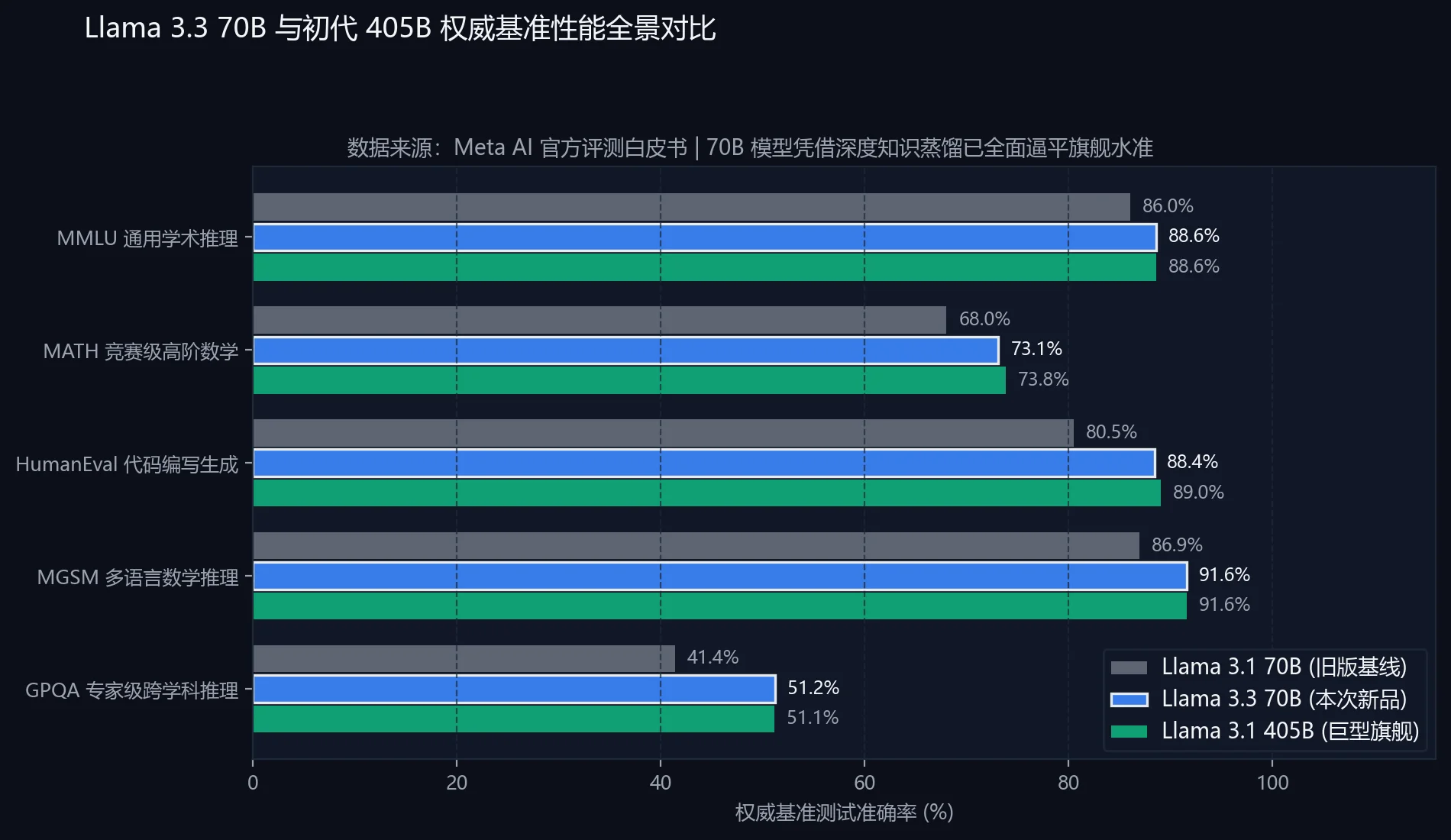
As shown in Figure 1, official evaluations demonstrate that Llama 3.3 70B largely erases the capability delta separating mid-tier models from the 405B titan:
| Benchmark | Capability Area | Llama 3.1 70B (Baseline) | Llama 3.3 70B (New Release) | Llama 3.1 405B (Flagship) | Relative to Flagship |
|---|---|---|---|---|---|
| MMLU (5-shot) | General Knowledge & Academic Reasoning | 86.0% | 88.6% | 88.6% | 100% Parity |
| MATH (0-shot CoT) | Advanced Mathematics Competitions | 68.0% | 73.1% (+5.1%) | 73.8% | 99.1% Parity |
| HumanEval (0-shot) | Code Synthesis & Unit Test Generation | 80.5% | 88.4% (+7.9%) | 89.0% | 99.3% Parity |
| MGSM (0-shot CoT) | Multilingual Mathematical Logic | 86.9% | 91.6% (+4.7%) | 91.6% | 100% Parity |
| GPQA (Diamond) | Expert-level Interdisciplinary Reasoning | 41.4% | 51.2% (+9.8%) | 51.1% | Parity / Outperformed |
The data reveals that the most pronounced improvements occur in HumanEval and GPQA, highlighting how post-training distillation eliminates the structural reasoning drift that previously hampered 70B models on extended logical proofs.
Inference Economics and Production Deployment Guide
For CTOs and platform infrastructure teams, Llama 3.3 70B radically transforms total cost of ownership (TCO):
1. VRAM Footprint and Hardware Sizing Matrix
| Precision Mode | Model Weights VRAM | Recommended Hardware Setup | 32k Context Single-Stream VRAM | Expected Throughput | Ideal Deployment Use Case |
|---|---|---|---|---|---|
| FP16 / BF16 | ~140 GB | 2x A100 / H100 80GB | ~158 GB | 40~55 tokens/s | Lossless research evaluation, fine-tuning |
| FP8 (vLLM Recommended) | ~70 GB | 1x H100 80GB or 2x RTX 4090 (48G) | ~78 GB | 65~85 tokens/s | Production enterprise RAG clusters |
| INT4 (AWQ / GPTQ) | ~38 GB | Dual Consumer RTX 4090 (24Gx2) | ~45 GB | 70~100 tokens/s | On-premise developer coding assistants |
2. Quickstart: Serving with vLLM in 30 Seconds
Using vLLM with tensor parallelism and PagedAttention, deploy Llama 3.3 70B with one terminal command:
| |
Individual developers can also run the 4-bit quantized version locally via Ollama:
| |
Community Impact and Strategic Outlook
Meta Chief AI Scientist Yann LeCun remarked upon release:
“Open-source AI is not a degraded commodity. With high-fidelity distillation and rigorous data curation, mid-sized models are closing the frontier capability gap at an unprecedented rate. Advanced intelligence will inevitably become a universal public utility, just like Linux.”
Llama 3.3 70B signals a fundamental turning point: brute-force parameter scaling is giving way to architectural and data refinement. As frontier capabilities condense into single-node servers, enterprise AI adoption in 2026 enters a far more sustainable era balancing raw performance, private governance, and operational economics.