
Key Event Snapshot
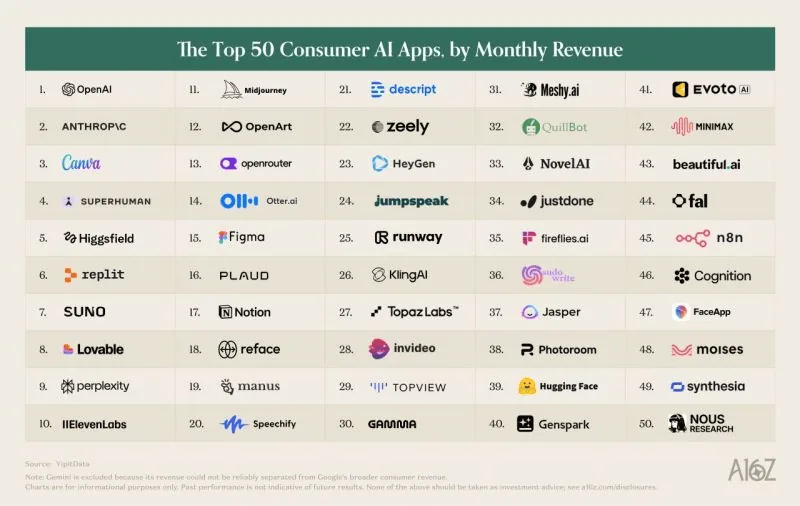
On October 5, 2026, Silicon Valley venture capital firm Andreessen Horowitz (a16z) released the seventh edition of its “Top 100 AI Consumer Apps” report, launching for the first time a Top 50 list of consumer AI apps by monthly revenue. AI 3D company Meshy was ranked No. 31, making it the only vendor on the list focused exclusively on 3D generation.
- List publisher: a16z (Andreessen Horowitz)
- Data source: U.S. consumer card spending data tracked by YipitData
- Meshy ranking: No. 31
- Distinction: The only company on the list demonstrating the commercial value of AI 3D
- Industry significance: 3D generation has been proven for the first time to be able to stand alone as a paid category
Key Facts and Figures
This time, a16z’s list shifted away from its previous evaluation logic based solely on website traffic and mobile engagement, relying instead on real spending data provided by YipitData. This metric, which is closer to commercial reality, highlights which AI tools consumers are actually willing to pay for.
A key observation is that although Meshy is relatively young, its competitors include established giants such as OpenAI, Anthropic, and Canva. Interestingly, the report notes that most of the leading creative products on the revenue list are built on in-house models; even as general-purpose models continue to improve in image and video generation, consumers keep paying for specialized creative tools—a validation of the strategic wisdom of Meshy’s in-house 3D multimodal model.
Meshy’s growth is equally striking: the company recently announced that its annual recurring revenue (ARR) has surpassed $100 million; in July 2026, it completed a nearly $400 million Series B financing, with a post-money valuation of more than RMB 10 billion (about USD 1.5 billion), setting a record for the largest single round in AI 3D. The company was founded by MIT PhD Hu Yuanming (Ethan Hu), and its global registered users now exceed 15 million.
Notably, Meshy’s core product turns text and images into production-grade 3D assets for games, film, and 3D printing, with a clear positioning: serving the commercial needs of artists, studios, and creators rather than stopping at concept demonstrations.
The Logic Behind AI 3D Payments
In the report, a16z explicitly states that several top creative products on the revenue list are built on in-house models. This observation reveals the deeper business logic of professional creative tools: while general-purpose models can generate basic content, professional creators need controllability, fidelity, and compatibility with downstream workflows—requirements that only in-house models can meet.
Pan Fei, Meshy’s Vice President of Growth, said: Every day, a large number of artists, studios, and creators use Meshy to turn ideas into 3D works in minutes. We believe 3D will be the next great creative medium. This vision echoes the data—when 3D tools are easy enough to use and cheap enough, creators are willing to pay for them, just as professional cameras still have a market after photography became widespread.
In terms of use cases, AI 3D has clear applications:
- Game development: Rapidly generate character and scene assets
- Film and television production: Build concept designs and VFX assets
- 3D printing: Directly output printable model files
What these use cases have in common is that they are time-cost-sensitive + commercially valuable. If a developer uses a traditional generation engine, it may take hours, whereas Meshy can compress that to minutes; this efficiency gap translates directly into enterprise-level willingness to pay.
Practical Takeaways for Readers
Who should use it:
- Indie game developers: Need to rapidly prototype and validate 3D assets
- Small studios: Lack budget for outsourced art but need production-grade output
- Educators: Need instant 3D visualization support for teaching demonstrations
Who may want to wait:
- Enterprise customers: If they need complex physics simulation or industry-specific asset libraries (such as architectural BIM), current solutions are not yet mature
- Minimalist creators: If the output is only for social media animations, lighter free tools are already available as alternatives
Final Thoughts
Meshy’s inclusion marks AI 3D’s formal transition from technology demo to commercial monetization. When professional creators vote with real money, proving that 3D generation has crossed the “usable” threshold and entered a rational consumption cycle of “buy it if it’s good enough”—this may be a signal more worthy of industry reflection than the ranking itself.