
DeskcommCRM: An Open-Source CRM That Closes the Sales Loop with WhatsApp.AI
Today on GitHub Trending, DeskcommCRM — built by Brazilian developer Rafael Melga — racked up 505 stars in a single day. It’s not just another customer management tool; it deploys an AI sales agent directly inside WhatsApp — no subscription fees, no black box, and all data stays on your own servers.
This reflects a clear trend: enterprise AI is shifting from “showing off large models” toward “deployable sales engines.” While the domestic market is still debating whether Agents are just PPT-level concepts, DeskcommCRM has already proven the full pipeline — from lead acquisition → qualifying → closing — in the Latin American market.
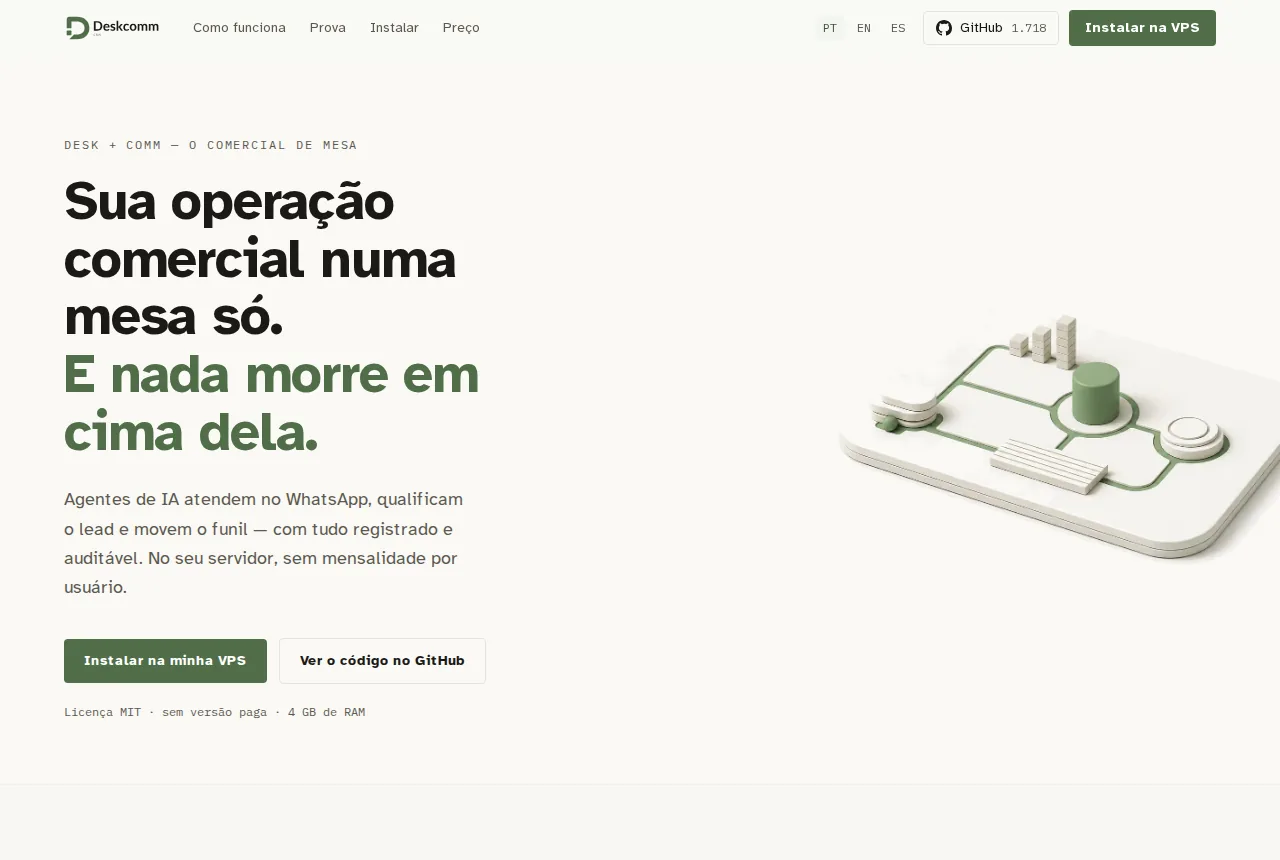
1. Core Features: The Triple Combo of CRM + WhatsApp + AI Agent
DeskcommCRM’s design payload is remarkably lightweight: it’s essentially a Next.js application that treats WhatsApp as the sole user touchpoint. You can think of it as this combination:
- Supabase backend: All data for users, conversations, leads, and automation rules lives in an open PostgreSQL schema
- WAHA WhatsApp integration: Two modes — Meta official API or QR Code — naturally suited to markets like Brazil and Mexico where WhatsApp market share exceeds 95%
- AI Agent stack: Supports three model providers — OpenRouter / Anthropic / OpenAI — with local RAG for product knowledge base retrieval and multi-tenant prompt isolation
Its biggest strength lies in “zero friction on user habits”: all sales conversations happen inside WhatsApp. Customers don’t need to download a new app or register a new account — and that’s exactly why it outperforms traditional CRMs in WhatsApp-heavy markets.
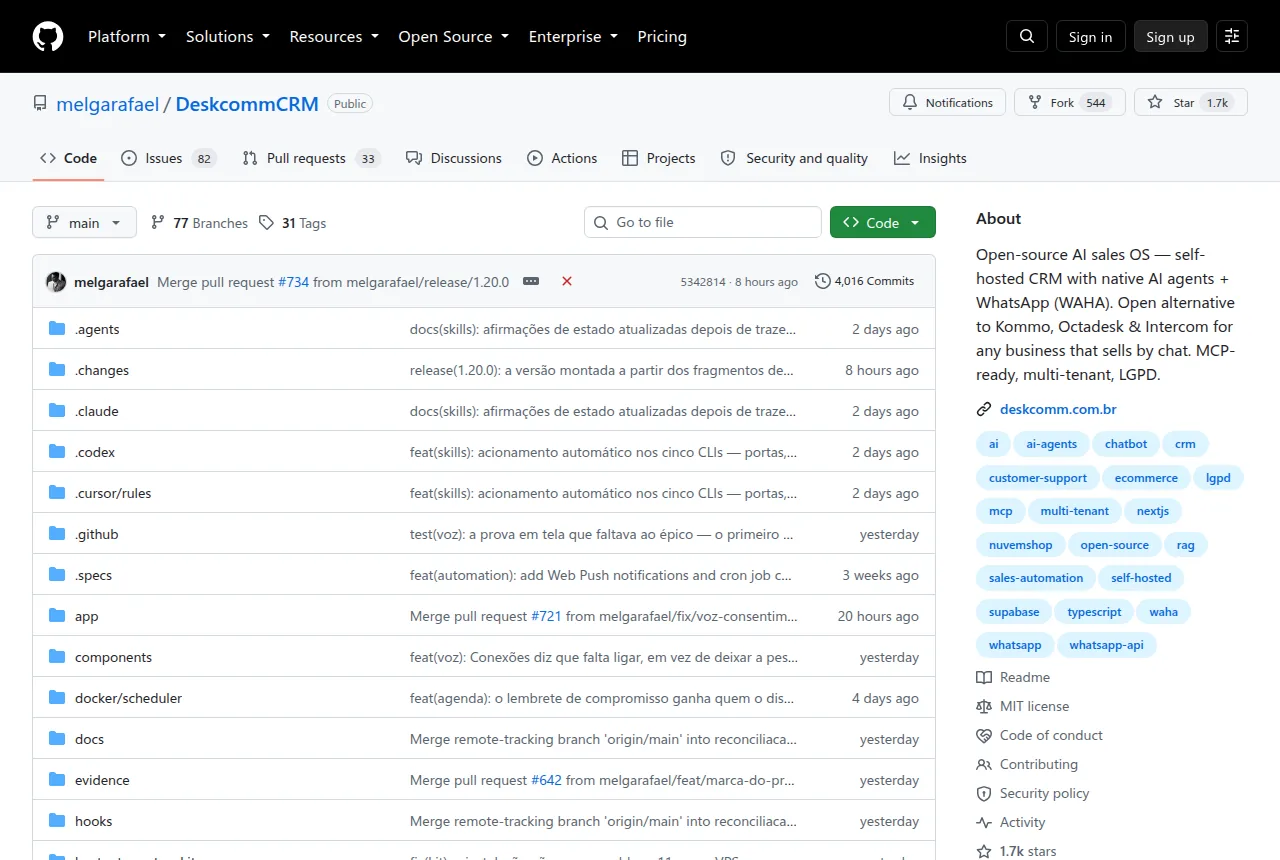
2. Three Steps to Get Started: Even Simpler Than Docker Compose
The project’s hostgator-setup-kit distills the installation process to the absolute minimum:
| |
The installation process requires zero knowledge of image versions, network modes, or pg_dump backup procedures. It even thoughtfully distinguishes between two deployment paths:
- Production environment: HostGator partnership plan (starting at 4GB RAM), with pre-configured cron auto-updates and daily backups
- Local trial: Run
bash hostgator-setup-kit/comecar.shdirectly on MacOS / Linux / WSL — the script analyzes your current setup and recommends an appropriate plan
Updates don’t even require SSH access — just log into the admin panel and click “Update.” The system automatically: backs up the database → pulls the new image → migrates the schema → runs health checks. If anything fails, it rolls back to the previous version automatically.
3. Technical Trade-offs: The “Dumb Approach” Built for Localization
DeskcommCRM’s design philosophy is hidden in a seemingly counterintuitive decision: it refuses to provide a web-based customer chat portal.
Why? Because in the Latin American market, 80% of business owners and their customers already live on WhatsApp. Adding another web channel only creates fragmented touchpoints and slower response times. This “dumb” choice yields three real benefits:
- Lowest compliance cost: Brazil’s LGPD regulations require that user data be deletable. With all data in a self-managed Supabase instance, one click clears everything for compliance
- Zero-friction multi-tenancy: Different brands share the same codebase but isolate model prompts and knowledge bases, with plug-in style configuration (MCP-ready)
- Budget-friendly: Supabase free tier + self-hosted WAHA brings monthly costs close to zero — unlike commercial solutions that charge per seat
Technically, it makes a few smart compromises:
- No Kubernetes: Single VPS deployment is sufficient for small-to-medium teams; complex orchestration only increases the failure surface
- Unified chat entry point: Routes through a single WAHA channel rather than aggregating Telegram / Email, reducing model context confusion
- Idempotent schema tracking:
baseline.sqlsupports repeated re-runs to auto-repair historical data structures, making upgrade scripts extremely simple
4. Who Should Pay Attention?
- Outbound companies with WhatsApp sales teams: Especially in Mexico, Brazil, Indonesia, and similar markets — no need to educate users on a new app
- Business owners tired of monthly SaaS fees: After a one-time deployment, costs are limited to API calls and server expenses
- Technical teams wanting custom Agent prompts: Automatically builds RAG vector stores from product materials, with fully closed-source data that never leaves your infrastructure
- Teams who want more than open-source toys or hobby Agent bots: It provides a complete business loop — leads → deals → reminders
Its competitive positioning is clear:
- vs. Kommo / Octadesk: No feature gating, no per-seat fees — but you need to run your own server
- vs. Intercom: Focused on WhatsApp as a single channel rather than omnichannel, but with lower conversation latency and easier customer reach
- vs. self-built LangChain bots: Out-of-the-box with complete CRM functionality — backlog / ticket workflows are already polished
Final Thoughts
The emergence of DeskcommCRM reminds us: when an open-source project seriously studies a specific market’s local entry point (like WhatsApp in Brazil), it may well be redefining the footprint and barrier to entry of “enterprise software.”
It may not fit every scenario, but if your customers already live on WhatsApp — this project deserves a spot on your tech radar.
The author has open-sourced the complete ARCHITECTURE.md and VISION.md. Recommended reading.