
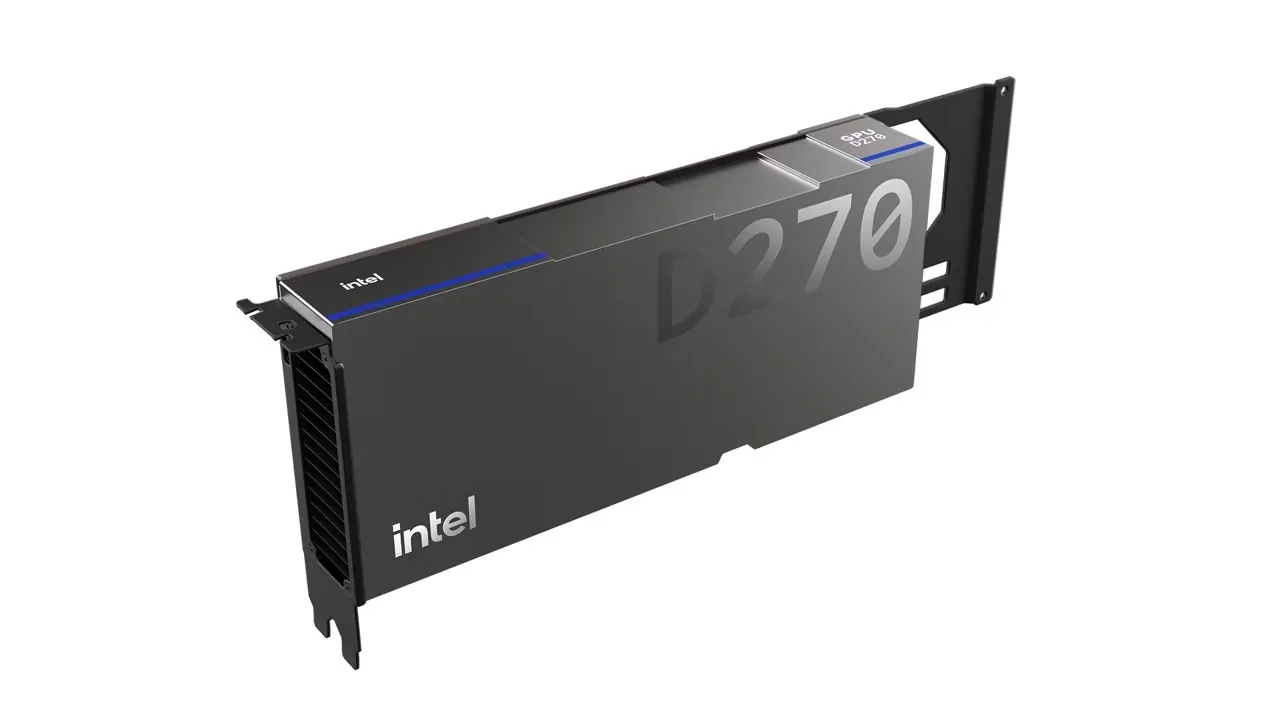
Intel has formally named its Crescent Island data-center inference GPU as the GPU D series, and Maxsun has disclosed in materials for the 2026 Intel LOEM summit that it will deeply participate in the project’s R&D and manufacturing. Maxsun plans three product forms: Turbo, Fanless and mini-PC. The move points to a deployment-first GPU strategy: large LPDDR5X capacity, standard PCIe add-in-card mechanics and air-cooled 350W operation are aimed at the cost, memory and form-factor constraints that now shape LLM inference.
Background and industry bottleneck
The AI workload center of gravity is moving from training to inference delivery. Production inference is not a single benchmark run; it is long-running, multi-tenant and concurrent service. Long context increases KV cache pressure. KV cache is the reusable short-term memory a model reads while generating tokens; longer contexts and more simultaneous requests require more memory.
Most high-end data-center GPUs rely on HBM. HBM provides high bandwidth and low latency, which helps training and high-throughput inference, but it is expensive and supply-constrained. For deployments calibrated around FP8 or INT8 inference, where cost per token and rack density matter more than peak training throughput, HBM may not be the most economical choice. The GPU D series puts LPDDR5X capacity and cost efficiency first.
Architecture and memory logic

According to IT Home, the first product, Intel GPU D270, uses the Xe3P architecture and has 32 Xe cores and 256 XMX engines. Its FP8 performance is 1.3 PFLOPS. XMX engines are dedicated matrix and tensor units that accelerate AI multiply-accumulate operations. FP8 is an 8-bit floating-point format that trades precision for throughput and smaller memory footprint, suitable for calibrated inference workloads.
D270 pairs the compute block with up to 480GB of LPDDR5X and 1.5TB/s memory bandwidth. The card draws 350W, uses a standard PCIe AIC form factor and supports PCIe Gen5. PCIe AIC means a conventional PCIe add-in card, allowing deployment in existing servers and workstations without custom baseboards or mandatory liquid cooling. The 1.5TB/s bandwidth is below top HBM systems, but 480GB capacity is the defining feature. At roughly one byte per parameter for FP8, a 300B-parameter model needs about 300GB for weights, leaving room for KV cache, activations and runtime buffers. This matches Intel’s stated target of one card supporting a 300B model and an eight-card system supporting a 1T model.
| Comparison | Intel GPU D270 | Conventional high-bandwidth data-center GPU route |
|---|---|---|
| Memory solution | Up to 480GB LPDDR5X | Often uses HBM, with capacity constrained by stacks and cost |
| Memory bandwidth | 1.5TB/s | Usually higher, suited to training and high-throughput inference |
| Power and cooling | 350W, air-cooling allowed | Often higher power and stronger cooling requirements |
| Board form | Standard PCIe Gen5 AIC | Often PCIe, OAM or custom baseboards |
| Main target | Long-context, multi-tenant, latency-sensitive inference | Training, research computing and extreme throughput workloads |
Maxsun’s three form factors and compute budget

Maxsun’s role extends Intel’s reference design into three deployment classes. Turbo uses a blower fan for PC workstations; Fanless uses passive cooling for servers; the mini-PC keeps chassis size tight for edge AI sites. Each form factor maps to a different airflow and physical constraint: workstations need self-contained cooling, servers depend on rack airflow, and edge boxes must preserve compute density in small volumes.
The compute budget is straightforward. A single D270 provides 1.3 PFLOPS FP8 and 480GB memory at 350W. An eight-card node would provide about 10.4 PFLOPS FP8, 3.84TB total GPU memory and roughly 2.8kW of GPU power. PCIe Gen5 x16 provides about 64GB/s of one-way theoretical bandwidth per link, so an eight-card node requires sufficient CPU PCIe lanes and NUMA scheduling. Intel also showed rack designs based on Xeon processors, with some Xeon 6+ configurations scaling beyond 46,000 CPU cores and 133.45kW, indicating that GPU D is meant to be integrated with CPU platforms, rack density and inference orchestration rather than sold as an isolated accelerator.
For operators, the practical value will depend on software maturity: quantization pipelines, operator coverage, scheduler support and memory management will determine token latency and throughput. The hardware boundary is clear: this is not a training flagship, but a high-capacity, low-precision, air-cooled and standard-form-factor inference base. Maxsun’s three designs attempt to place that base into workstations, server racks and edge nodes.