
Key Event: MVP Release and Full macOS Apple Silicon Compatibility
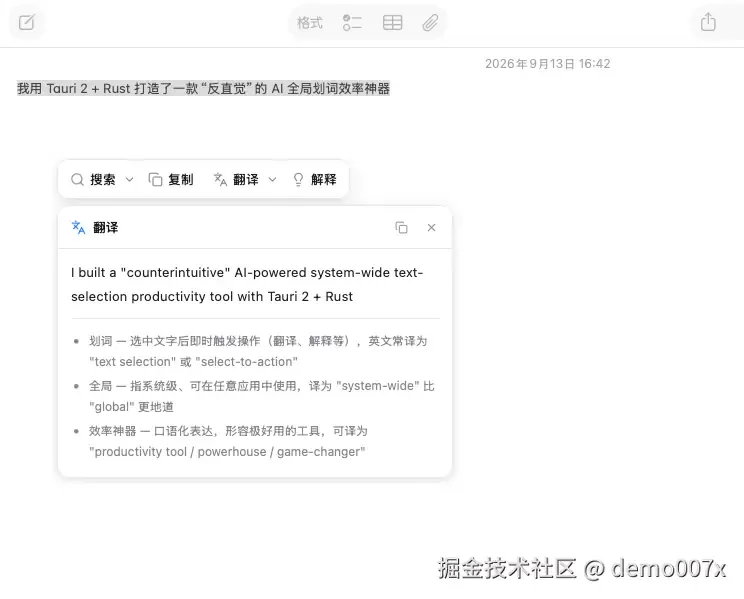
The open-source project Magpie (拾趣) has recently released its M1 (MVP) version, now officially available for download and use by macOS 13+ Apple Silicon users. The project uses a Tauri 2 + Rust + TypeScript stack. Under the hood, it reads selected text through native system accessibility features, without ever polluting the system clipboard, solving the data-loss problem caused by users frequently switching tools. The project is currently fully open source and supports streaming responses from the DeepSeek large model. After users click AI Summarize or AI Translate, the reply streams word by word in a pop-up beside the mouse cursor.
- Open-source license: Not explicitly mentioned, but the code is open source
- Current version: M1 (MVP)
- Supported systems: macOS 13+ (Apple Silicon)
- Clipboard behavior: Read via native system accessibility features, zero pollution
- Response mode: SSE streaming (Stream)
- Underlying framework: Tauri 2 + Rust
Core Value: Reimagining Workflows for Developers’ High-Frequency Use Cases
Magpie positions itself as an “unobtrusive productivity tool,” redesigning the interaction flow around three typical developer pain points. The first scenario is consulting English technical documentation. Traditional translation tools often fail to convey the intended meaning because they are out of context, whereas Magpie leverages large-model comprehension to provide “faithful, expressive, and elegant” interpretations grounded in the technical context. The second scenario focuses on reading source code. When users double-click to select a term and click AI Explain, the model immediately outputs the underlying logic, use cases, and even a short pseudocode example, enabling in-place understanding without leaving the editor.
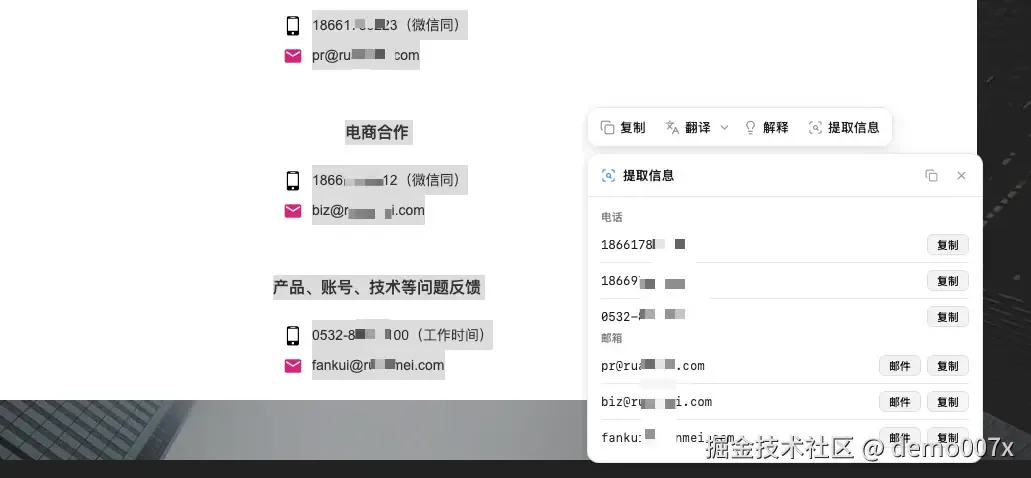
The third scenario addresses log processing. The project is described as a “contextual entity sniffer”—it can automatically recognize links, email addresses, or verification codes and provide one-click navigation or extraction. The key to this capability is a lightweight Rust-based pipeline (SSE Pipe) that forwards AI requests, perfectly bypassing the front-end WebView’s CORS cross-origin issue. Meanwhile, all prompt action registrations are handled in the TypeScript layer. Future new actions (such as code refactoring or weekly report polishing) require only a front-end registration object, with zero changes to Rust code.
Technical Architecture: A Decoupled Design with Rust for Stability and TypeScript for Speed
The project follows a clear principle of layered decoupling: Rust handles global text-selection capture and window management for stability, while TypeScript takes on the fast-moving UI and prompt management. This combination delivers a dual advantage: the reliability of low-level system event listening and the agility of front-end feature expansion.
Particularly noteworthy is its stealth mechanism: the project includes a strict built-in app blacklist and automatically goes invisible in sensitive applications such as Terminal or password managers, reflecting deep consideration for user privacy and usage scenarios.
Practical Advice: Clarifying the Target Audience and Usage Boundaries
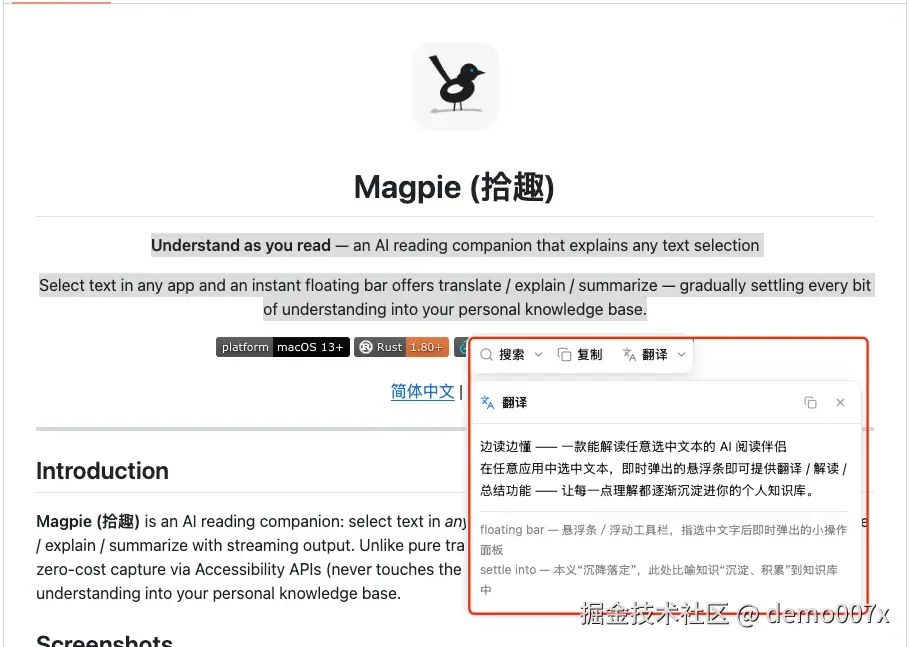
Magpie is especially well suited to developers who frequently consult English technical documentation and open-source code every day, particularly those who are sensitive to clipboard pollution and need sustained focus in their workflow. If you’re used to constantly switching between your IDE and tools like ChatGPT, it can significantly reduce the risk of losing context.
If you’re looking for the following features, it’s best to wait: Windows support (coming in M2), multi-turn follow-up conversation capability (coming in M2), and local knowledge base accumulation (coming in M3). The current MVP version only supports macOS Apple Silicon and primarily relies on the DeepSeek large model, so flexibility in switching among multiple model providers may be limited.
Final Thoughts
Magpie’s core innovation lies in combining the age-old interaction of “global text selection” with large-model capabilities, while using system-level permissions instead of clipboard relay to ensure privacy and smoothness. It proves that lightweight system-integration tools can deeply couple with low-level capabilities to deliver a truly seamless AI-assisted experience for developers.