
Let AI Build the Next-Gen Robots: Simate Tops RoboDojo in 3 Months, Bets on Physical RSI
Physical AI company Simate (Guji Partner) has topped the RoboDojo physical AI leaderboard just three months after its founding, using its AI-assisted research system AutoResearch to develop a general physical fast system model.
Core Milestones
- Announcement Date: September 24, 2024
- New System: AutoResearch automated research platform + General physical fast system model
- Benchmark Result: #1 on RoboDojo leaderboard
- Availability: AutoResearch open for early access; researchers from Tsinghua, MIT, and HKUST have joined
- Technical Approach: Physical RSI (Recursive Self-Improvement for Physical AI), human-in-the-loop weak RSI paradigm
Core Team: Autonomy + World Model + Humanoid Control Experts
Simate was founded by Zhang Ying, previously a technical leader at a top-tier autonomous driving company. The team combines expertise across three domains critical to physical AI:
- Zhang Ying: Founder, background in autonomous vehicle end-to-end production
- Zhan Fangneng: Assistant Professor at HKUST, World Mind Lab Director, 50+ papers at SIGGRAPH/CVPR/ICCV/TPAMI
- Ji Mayu: 00s-era young scientist, UC San Diego graduate, ex-founder of Assured Robot Intelligence (ARI) acquired by Meta
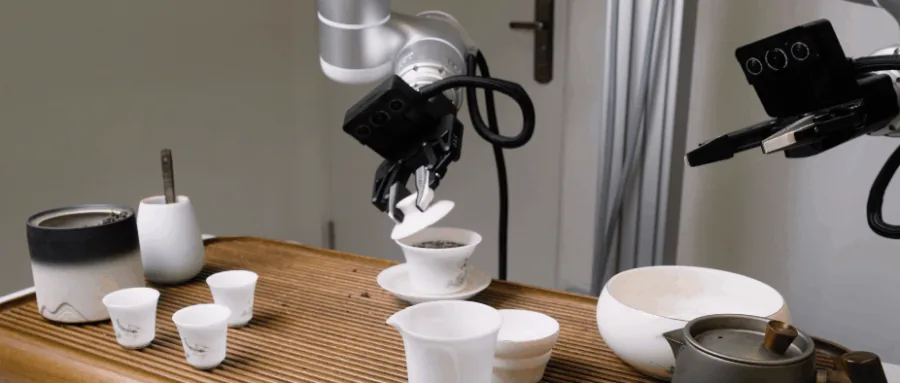
RoboDojo Breakthrough: Real-Robot Tea-Making Task Demonstration
RoboDojo evaluates general robotic manipulation across five dimensions: generalization, memory, fine control, long-horizon tasks, and open-ended tasks.
Simate demonstrated true-machine capabilities:
- Long-horizon task execution: Multi-step “tea brewing” workflow
- Historical memory: Retaining completed steps and current progress status
- Environment adaptation: Adjusting actions based on real-time changes
- Fine manipulation: Successfully grasping objects of varying shapes/materials
Technical Novelty: 4D Perception, Memory Architecture, Efficient Coding
To balance computation costs and information completeness for long tasks, Simate introduced three key innovations:
- 4D Physical Perception & Memory: Processes depth, geometry, motion, and contact relationships; structures historical data to balance consistency with real-time response
- Efficient Visual Encoding: Enables larger models for onboard real-time inference
- SiPAI Plug-and-Play Framework: Modular design supporting world models, VLA, and VLM architectures
Notable contrast: Simate did not disclose model size, training data volume, or computational costs, yet claims rapid engineering translation—a direct departure from academia’s common focus on “scale via parameter growth,” emphasizing instead an engineering-first approach.
AutoResearch: AI Agent in the Research Loop
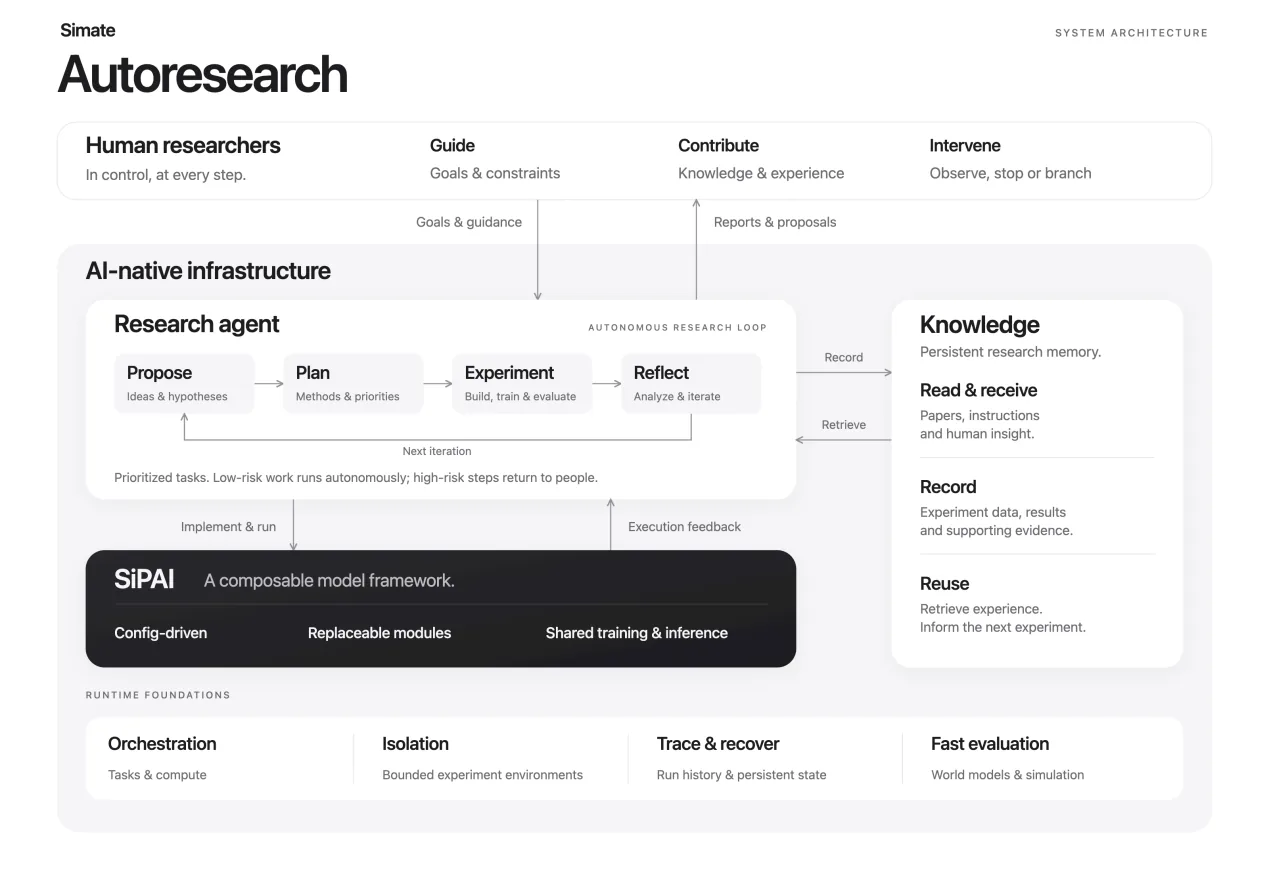
AutoResearch automates the full machine learning R&D pipeline—not just script execution:
- Functionality: Reads code/configs, modifies components, calls training/evaluation, decides next steps
- Interface: Features “From Experiments to One Policy” workflow board; cross-scenario evaluation tracking
- Adoption: Early access available; researchers from Tsinghua, MIT, and HKUST have joined
Physical RSI Roadmap: Three Tiers of Self-Improvement
Simate categorizes RSI maturity into three levels:
| RSI Tier | Characteristics | Human Involvement | Example |
|---|---|---|---|
| Weak RSI | Well-defined boundaries, short feedback loops | Human sets goal | Code fixes, data pipeline optimization |
| Medium RSI | Multi-stage planning, human-AI collaboration | Human filters hypotheses | Memory system improvements, data ratio tuning |
| Strong RSI | Open-ended objectives, autonomous problem-finding | Human directs direction | Improving zero-shot generalization, research direction discovery |
Current development sits at weak-to-medium RSI transition; strong RSI remains researcher-led.
##落地建议 (落地建议 translated for English readers)
- Who should adopt now: Engineering teams with robotics deployment infrastructure who seek rapid iteration cycles and are experienced enough to integrate AI-assisted R&D workflows
- Who should wait: Teams without real-robot access or data feedback loops—Physical RSI critically depends on physical interaction data that simulations cannot fully replicate
Final Thoughts
Physical RSI is less about automating experiments and more about redefining how AI research itself evolves. When models can not only solve tasks but also “think” about better ways to solve them, physical AI iteration cycles may shift from months/years to weeks/days. However, the technology remains in early internal testing, and scaling will depend on overcoming real-robot reliability and cost barriers.