A five-year-old internal research checklist was accidentally made public because of a copyright lawsuit—and it maps almost item by item onto Anthropic’s entire product line today.
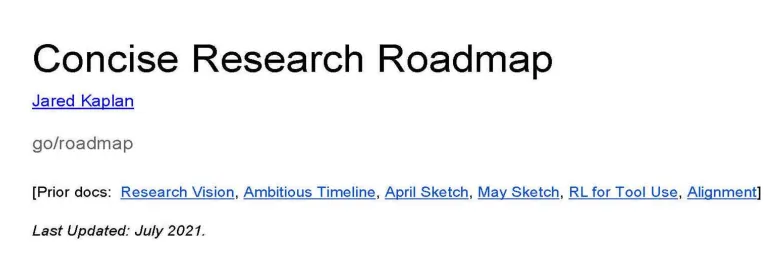
Written in 2021, the Concise Research Roadmap was authored by Anthropic co-founder Jared Kaplan and runs only three or four pages. The key hard facts are as follows:
- Document type and author: An internal Anthropic research roadmap, only three or four pages long, authored by co-founder Jared Kaplan
- How it surfaced: It was made public in a copyright lawsuit, not through an official release
- Time frame: 2021, when Anthropic was only six months old and had raised $124 million in total; it was still 16 months before ChatGPT took the world by storm and 20 months before Claude 1 launched
- Areas covered: Coding Agent, Tool Use (letting models call external tools to complete tasks), long context, reinforcement learning (RL, training models with reward signals), automated feedback, and Agent safety
The Annotations Cut Deeper Than the Text: Three Pages That Set a Five-Year Roadmap

The densest part of the document is not the body text but the annotations. Co-founder Tom Brown saw “repository browsing as a simple, high-value entry point,” while systems and interpretability research scientist Nelson Elhage anticipated that “automatically finding type definitions in a project” would be extremely valuable to users. Faced with a route dispute between “the strongest coding assistant” and “a tool-capability demo,” CEO Dario Amodei set the direction on the spot: demonstrate tool use in the short term, and build the strongest coding assistant in the long term.
Alignment scientist Amanda Askell raised a deeper concern: if alignment work were done only in natural language while capability research were done in code, the two would inevitably drift apart; capability research and alignment research must advance in lockstep and in proportion. Sam McCandlish asked at the time “how to safely deploy non-sandboxed tools,” and Dario also warned that tools capable of executing code directly carried extremely high risk—this is precisely the origin of today’s discussions about Agent sandbox isolation and permission interception.
As first author of the Scaling Laws theory, Jared Kaplan put “scaling” first among all research directions, preparing from the outset for trillion-parameter (1T) scale, and planning to raise GPU utilization, adapt to next-generation hardware such as TPUs, and build security protections for model weights. Interpretability researcher Christopher Olah was responsible for another track: dissecting neurons and attention heads to figure out how arithmetic reasoning, multi-turn dialogue, and code generation are implemented inside neural networks.
From 9K to 1M: Every Box on the Roadmap Got Filled
At the end of 2022, ChatGPT exploded in popularity thanks to RLHF; half a month later, Anthropic published a paper proposing “Constitutional AI”: first set a set of behavioral principles for the model, then have one model judge and revise another model’s answers. In March 2023, the first-generation Claude arrived, focused on long text and safety; in September of the same year, Anthropic released the first version of its Responsible Scaling Policy (RSP), dynamically tightening safety controls according to capability levels; and in October, a Google-led round pushed its valuation to $18.4 billion.
Long context is the most tangible promise delivered:
| Model/date | Context window |
|---|---|
| Anthropic’s previous-generation model (before May 2023) | Under 10K tokens |
| Claude (May 2023) | 100K tokens, about 75,000 English words |
| Claude 2 public beta (about two months later) | 100K tokens |
| GPT-4 at the time | Up to 32K |
| Claude 3 Opus (March 2024) | 100K supported by default |
| Claude (2025) | Processes 1M tokens at a time |
A token is the smallest unit of text a model processes, roughly equivalent to a word or half a word. The most striking contrast came in May 2024: the team used sparse autoencoders (SAEs) to extract 34 million features from inside Claude Sonnet, located the internal circuits corresponding to concepts such as “Golden Gate Bridge” and “program vulnerability,” and manually activated the “Golden Gate Bridge” feature so that whatever the model answered could not avoid it—the first time humans achieved precise interpretation and manipulation in a commercial-grade large model. OpenAI was doing related research at the same time but never publicly disclosed specific progress.
In October 2024, “computer use” launched; in November, the MCP protocol was open-sourced, unifying how models connect to tools and data into a general-purpose interface. In the first quarter of 2025, OpenAI and Google successively announced support for MCP, and Chinese vendors followed suit intensively within four months. On valuation: it was $18.4 billion at the start of 2024 and about $41 billion by year-end, with Claude’s annual revenue exceeding $1 billion; in February 2025, Claude 3.7 and Claude Code were released simultaneously, and after a new funding round in September, the valuation reached about $183 billion; from May to October, the full 5.5-generation model lineup was updated intensively.
Who Should Use It, and Who Should Wait
- Developers building Agents or tool integrations: MCP has spread from model vendors to application developers; evaluating integration now has the lowest cost, and adopting early saves adaptation work.
- Users who need long-document or whole-repository code analysis: 100K to 1M tokens is already a mature capability; reading an entire book or the whole codebase in one go no longer requires manual chunking.
- High-compliance teams in finance, healthcare, legal, and similar fields: Constitutional AI and the RSP are Anthropic’s differentiation points, but safety mechanisms do not equal compliance immunity; you still need to run your own evaluation process before deployment.
- Ordinary users who are still on the fence: generational updates are too frequent—the full 5.5-generation lineup was updated within five months—so the version you get now may no longer be the main act a few months later; if it is not an urgent need, you can wait a bit longer.
Final Thoughts

The value of this document lies not in prophecy but in turning “scaling, tool use, coding capability, alignment, and interpretability” into a sequenced execution checklist—and in not changing course with every hype cycle over five years. The industry moved from an early “one dominant player plus several strong contenders” landscape to a race led by OpenAI, Google, and Anthropic; beyond luck, continuity of roadmap is the harder explanation. For anyone doing technology planning, it is more worth reading than any single model release.