
On October 23, at its 2026 Kingdee Creator Conference, Kingdee released three core capability upgrades to Lingee, its enterprise agent operating system, and teamed up with model vendors and universities to launch Lingee Bench, which it describes as China’s first agent benchmark built for enterprise-management scenarios.
- Announced: October 23, 2026, at the Kingdee Creator Conference
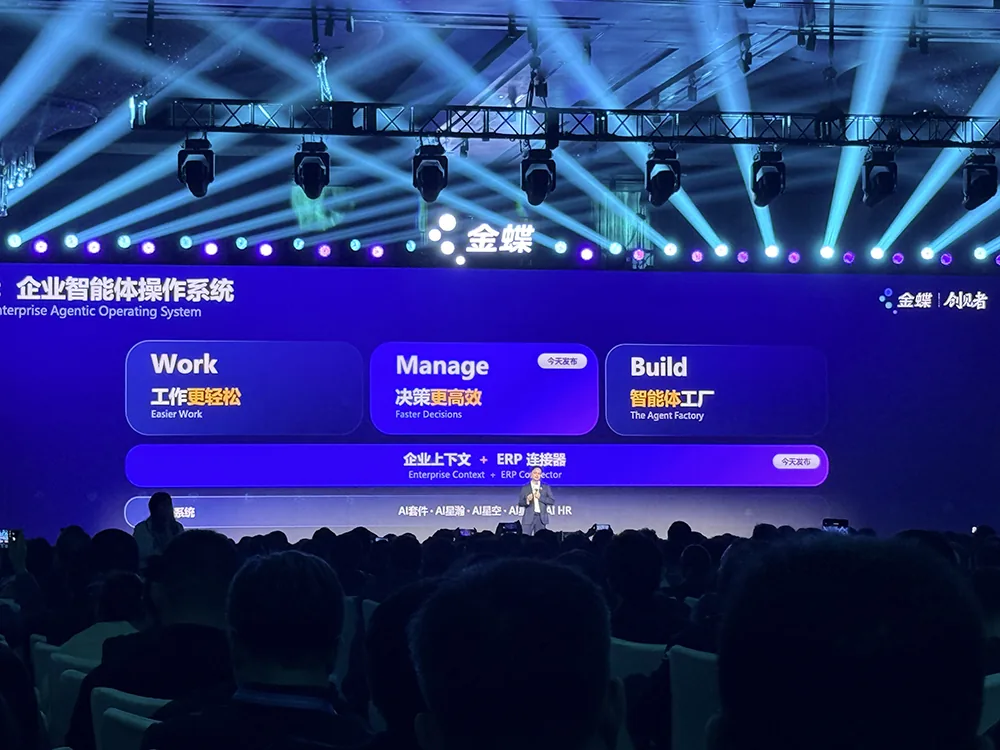
- What shipped: Lingee Manage, enterprise context, and ERP connectors
- Benchmark: Lingee Bench — 4 evaluation suites, 1,400+ tasks, plus a whitepaper
- Scale: 3,706 paying Lingee customers as of the announcement
- Availability: ERP connectors launch with 70 connectors and 1,127 tools; Lingee Bench is offered to agent vendors and model makers to evaluate their own models and harnesses
- Not disclosed: model weights, standalone pricing, or specific GA dates for individual products
Three upgrades aimed at “understanding the enterprise on day one”

Liu Zhongwen, Kingdee China’s vice president and head of product R&D, framed the goal as turning companies into “AI-native organizations”: agents execute within authorization while humans make key judgments and own the results.
Lingee Manage is positioned as a decision entry point for managers. It combines “Xiaoling,” a personal AI assistant that acts within granted permissions, reports proactively and runs tasks in parallel; a “Lingee Space” that closes the loop from agenda to resolution to task follow-up with full traceability and memory; and an “AI organization” in which people and agents work side by side.
Enterprise context addresses business understanding. ERP data, knowledge bases, memory, ecosystem MCP and external data are funneled into one traceable asset layer. Kingdee says it now covers 30-plus data source types, over 30,000 business objects, more than 800,000 semantic fields and 170,000 business rules.
ERP connectors address execution: the first batch ships 70 connectors and 1,127 tools, reaching across Kingdee’s AI suite, Cosmic, HR, Galaxy and Stellar product lines so agents can both query data and carry out business actions.
On the ecosystem side, StepFun founder Jiang Daxin said its model-native agent phone STEPX Neo will fully connect to Lingee, letting its personal agent Amoo call Lingee skills directly. In one demo, telling Amoo to hand a receivables-overdue issue to a finance manager with a Friday deadline triggers task creation, push notification and a reminder after user approval. StepFun models already power Lingee’s enterprise data analysis and AI meeting-notes scenarios.
Customer numbers: reimbursement from 5 days to 1, bids from 6 days to 1.5

Kingdee cited two customer cases. Malaysia’s Zhenxing Group spans six listed companies, four industries and 3,000 employees, and previously ran more than 40 heterogeneous systems. After consolidating onto Kingdee, its expense reimbursement cycle fell from 5 days to 1, and manual work for three-way matching dropped 89%.
Sungrow’s Sunny Zhiwei covers 31 Chinese provinces and three overseas regions. Its bidding-document agent cut preparation from 6 days to 1.5 days, while a nine-agent audit system handles over 50,000 invoices and 3,000-plus contracts a year, with development efficiency up more than 70%.
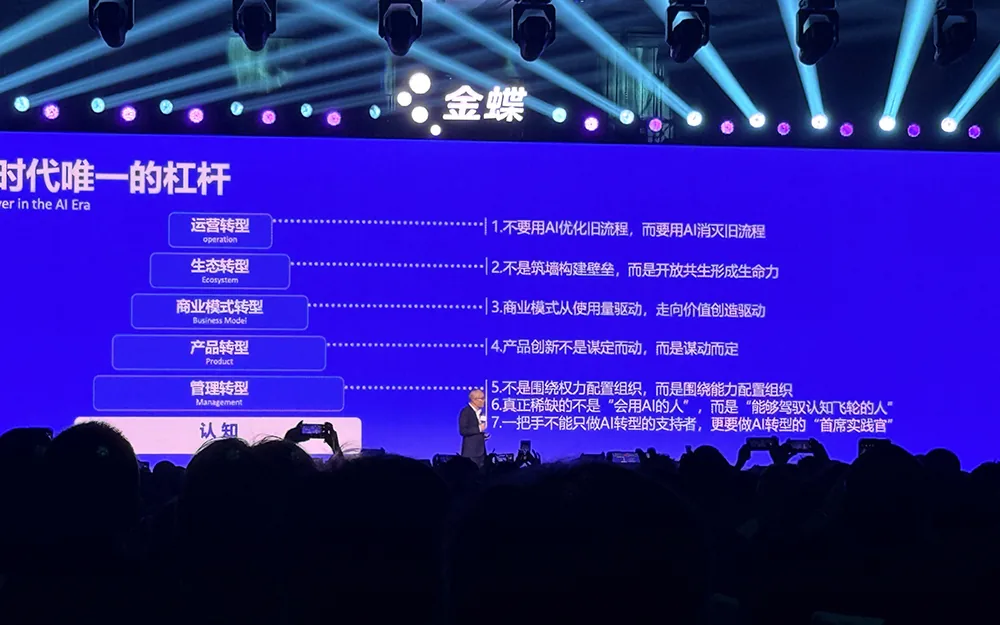
The most telling number is 3,706 paying customers. For a domestic enterprise-SaaS leader, that shows enterprise agents are still early in penetration — a visible gap against the conference’s rhetoric of organizational reinvention. Chairman and CEO Xu Shaochun spent his keynote on cognition rather than parameters, arguing companies should “use AI to eliminate old processes, not optimize them.”
Who should move now, and who should wait
Start now if you already run Kingdee ERP and have high-frequency, rule-heavy, audit-sensitive workflows such as finance shared services, bidding or contract review — connectors and context are readily available, and the Zhenxing and Sunny Zhiwei cases give you cycle-time and labor-hour metrics to copy.
Wait if your ERP stack sits outside Kingdee or your data is scattered across dozens of systems. Context quality depends on data governance, and the engineering cost of cross-stack integration was not addressed; per-user pricing terms were also undisclosed, so a small paid pilot should come first.
Final take
The battleground for enterprise agents is shifting from “can the model answer” to “can the data connect and can the results be audited,” and Kingdee is right to make context and connectors the main front. But 3,706 paying customers signals a long race, and whether outside vendors actually adopt Lingee Bench will matter more than the launch itself.