
Same Backbone, a 35% Cut on the Bill

On Oct 24, Moonshot AI released Kimi K3.1 Pro. The headline change is not in the parameter sheet but in the invoice.
- Release date: Oct 24, with official docs and third-party aggregators updated the same day
- Editions: standard K3.1 Pro plus a Highspeed tier; the Kimi Work desktop app must be on 3.1.0 or above (Windows, Apple-silicon Mac)
- Price: $2 / 13 RMB per million input tokens, $10 per million output tokens
- Weights: full open-source release promised before Nov 4
- Context: 1M tokens, unchanged from the previous generation
- Access: web, app, Kimi Code, API and third-party platforms
The underlying model did not change. It is still a mixture-of-experts architecture (MoE, which splits one large model into many specialist sub-models and routes each request to only a few), with 2.8 trillion total parameters and 16 experts — roughly 104 billion parameters — activated per pass. According to the source, the gains come from joint reinforcement learning and sandbox training: the same hospital, with a new shift of senior physicians.
Benchmarks, and the Odd Number in Enterprise Ops
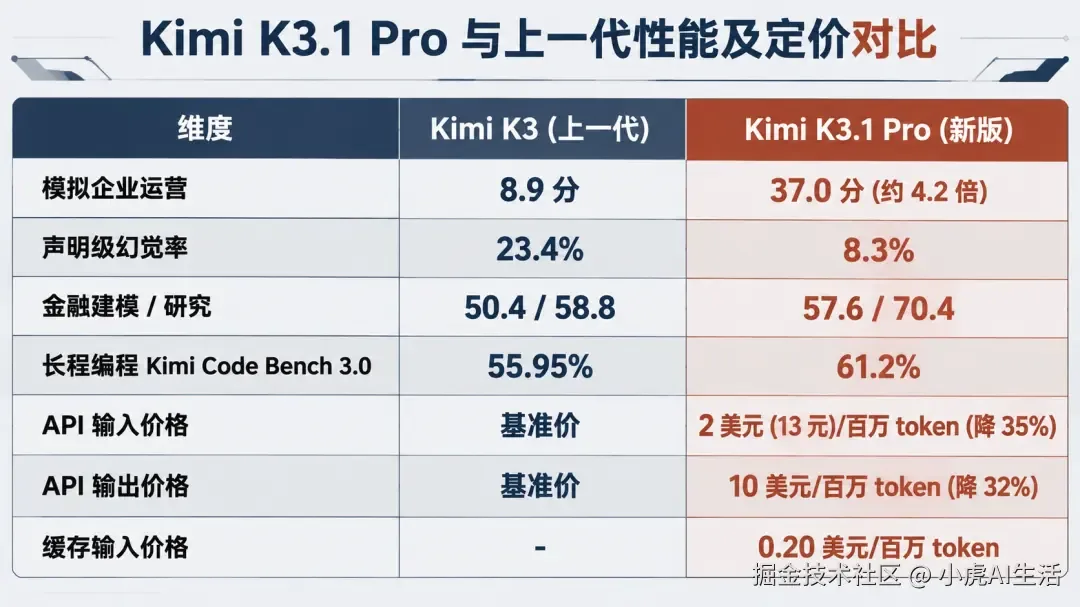
On public tests the picture looks like this:
- SWE Marathon, a long-horizon software engineering benchmark: 51.7% versus Claude Opus 5.5 at 46.3%
- Terminal-Bench 4.0, terminal operation: 65.7% versus GPT-6 Astra at 58.2%
- BenchCAD: 92.7%; OfficeQA Pro v2: 64.4, reported as state of the art
- Internal finance modeling: 57.6; financial research: 70.4
The real outlier is an internal simulated enterprise-operations test, which rose from 8.9 on the prior generation to 37.0 — a 4.2x jump as described in the source. That is less a benchmark crawl than a shift from “too risky to delegate” to “delegable with supervision.” The second反差 (contrast) is hallucination: the declared hallucination rate fell 65% to 8.3%, while wrong answers dropped to 42.4% of the previous generation. The two percentages measure different things and should not be quoted as one.
In practice, the author — who trains enterprise teams and has coached more than 200 students — names three kinds of work worth handing over: hardware prototyping and industrial parts, where the web or app “3D Make” feature turns parameter tweaks into printable 3D files; e-commerce finance running quarterly books and production simulations across 1M-token spreadsheets; and engineering teams pointing it at Unreal, Unity or internal scripts for long bug-fixing runs without losing the thread. The common thread: clear acceptance criteria, brutal process — exactly the part teams were unwilling to delegate before.
The Price Sheet: Cache Is the Real Story
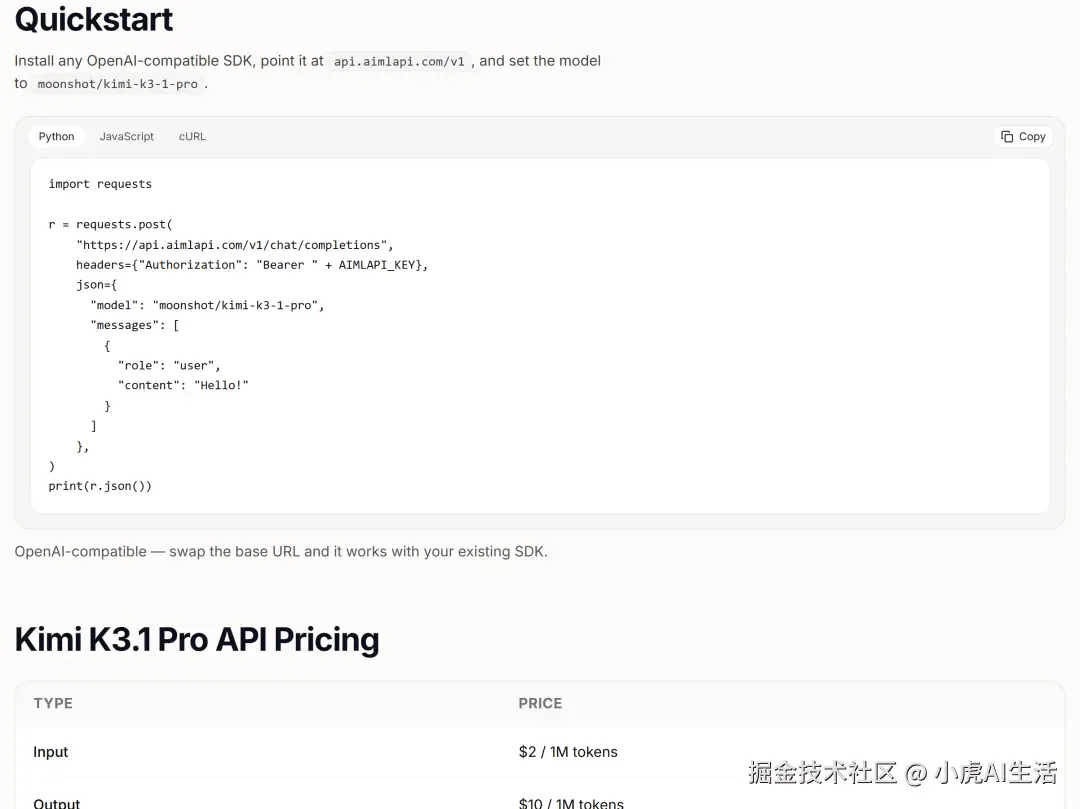
| Item | K3.1 Pro standard | Highspeed |
|---|---|---|
| Input (per 1M tokens) | $2 / 13 RMB | $4 |
| Output (per 1M tokens) | $10 | $20 |
| Cached input (per 1M tokens) | $0.20 | $0.20 |
| Versus prior generation | input −35%, output −32% | roughly 2–3x faster |
| Context window | 1M tokens | 1M tokens |
The number worth staring at is cached input: $0.20, under a tenth of the standard input rate, and identical across both tiers. For a long-document knowledge base that re-feeds the same material every turn, that is closer to a flat-rate broadband plan for reference material. The 35% in the headline will be remembered; the cache line is what decides whether an agent fleet can run month after month.
Three Steps to Hook It Up, and Three Failures That Stay Silent
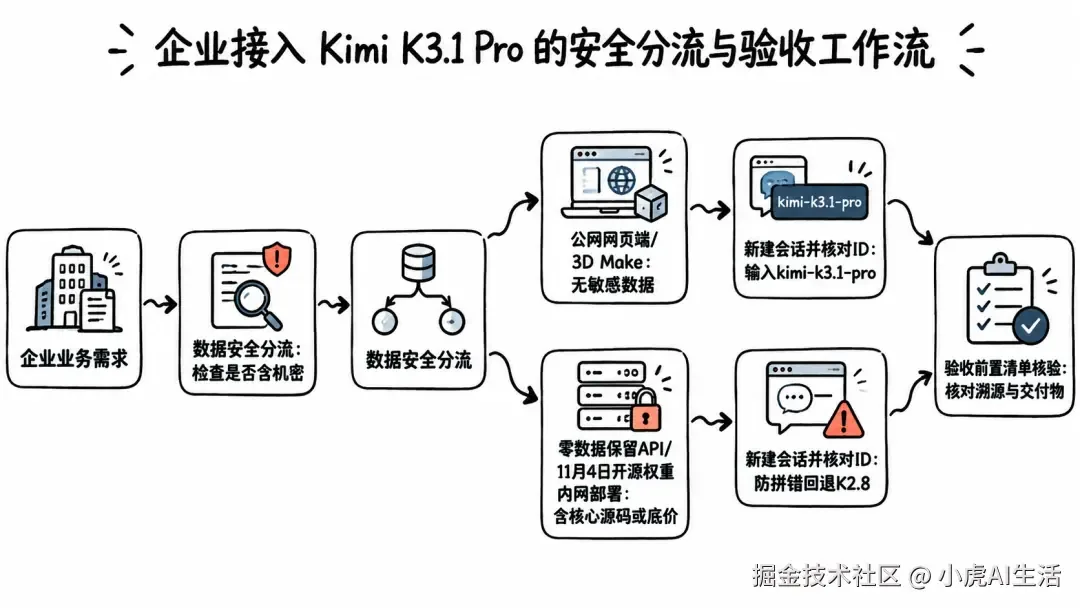
Step one: upgrade the client. Use kimi.ai in the browser; move Kimi Work desktop to 3.1.0 or above; in Kimi Code run /model kimi-k3.1-pro. Then open a brand-new session — continuing an old conversation will not activate the new model’s full reasoning.
Step two: check the model ID character by character. kimi-k3.1-pro and kimi-k3.1-pro-highspeed. The Oct 24 documentation is explicit: a mistyped ID inside a third-party tool does not throw an error or stop; it silently falls back to K2.8 Preview, which has no thinking mode. On enterprise plans, ask an admin to enable the option in the backend.
Step three: draw the red lines before connecting business flows. Core algorithm source code, customer ID numbers and phone numbers, and unredacted pricing floors should not go into the web client. If they must be processed, use the API with ZDR (zero data retention) enabled, or wait for the open weights promised before Nov 4 and run them inside your own network. The source also notes that to limit cyber-risk the company removed related training data, holding exploit pass@3 to 81.0%.
Who should move now: small and mid-sized teams producing content at volume, mining cross-sheet research, or hunting a cheaper stand-in for Claude — plus anyone who needs 1M-token context for financial modeling. Push fixed reference material into the $0.20 cache pool before scaling up.
Who should wait: light users writing a couple of hundred words a day have no reason to migrate. Teams planning agent automation in production should wait until the open weights actually land and are validated locally — whether they ship by Nov 4 is the biggest open question right now.
Final Word
The signal in K3.1 Pro is not the 35% cut but the $0.20 cache price, which turns repeatedly feeding the same documents from a cost line into a rounding error. Price cuts get remembered; cache pricing decides whether agents can run long term. One question remains: whether the open weights arrive by Nov 4.