A teaser, a codename, and a month of leaks
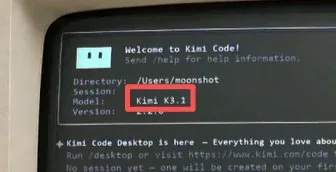
Kimi released a teaser this week: rapid cuts of scientific imagery and particle effects. Sharp-eyed viewers spotted the string “Kimi K3.1” inside the footage, and some argue the video itself was rendered by the model. As of publication, Moonshot AI has not announced a release date, pricing, or whether weights will be opened. What follows comes from developer-community leaks and small-scale testing.
- Release and availability: not official. On October 21, Kimi Code’s model switcher quietly added a K3.1 entry, effectively opening limited testing to developers.
- Model identifier: in late September, developers found “kimi-k3-1” in Moonshot’s API platform config files.
- Price and weights: both undisclosed. The only cost figures so far come from testers, not the company.
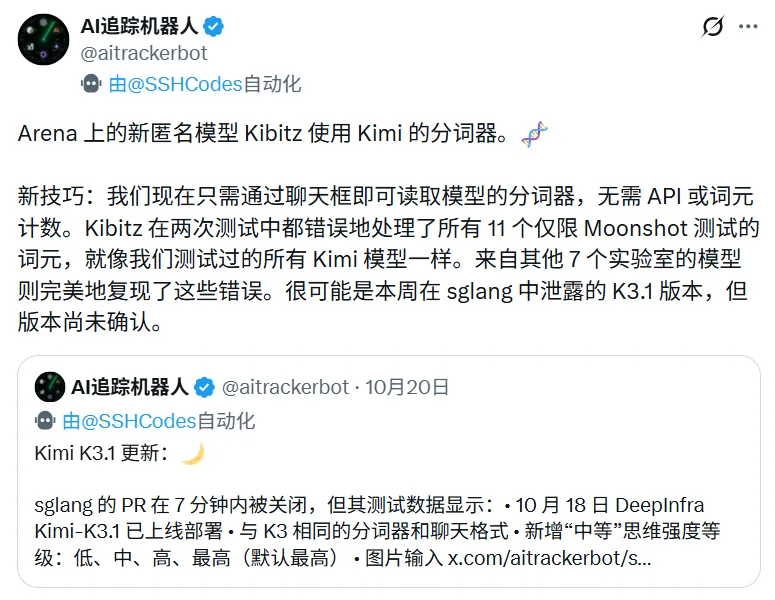
- Blind testing: in late October, two strong anonymous models, Kibitz and Kalmia, appeared on Arena, a blind model-comparison leaderboard. Kibitz stood out on front-end and 3D code tasks.
Developers matched tokenizer fingerprints and concluded Kibitz is K3.1 — consistent with Kimi’s naming habit: K2.5 was Kiwido, K2.6 Kiwire, K3 Kivine. A merge request in SGLang, an open-source inference framework, then leaked another detail: K3.1 adds a “Medium” thinking tier, expanding reasoning levels from three to four, letting the model budget compute by task difficulty.
One week of testing: 15 minutes, 70%, 1/14
AI blogger Chris says he has tested K3.1 for a week. He reports strong performance on Three.js, the open-source 3D library that runs in browsers and computes vertices, lighting and textures in real time — a notoriously resource-hungry workload. He puts its cost at 70% of K3, with a broad gain in token efficiency. Tokens are the billing unit for model input and output; fewer tokens per task means a smaller bill. His demo: a full 24-hour day-night environment simulation, with light shifting from morning diffusion to dusk, frame-by-frame continuous throughout.
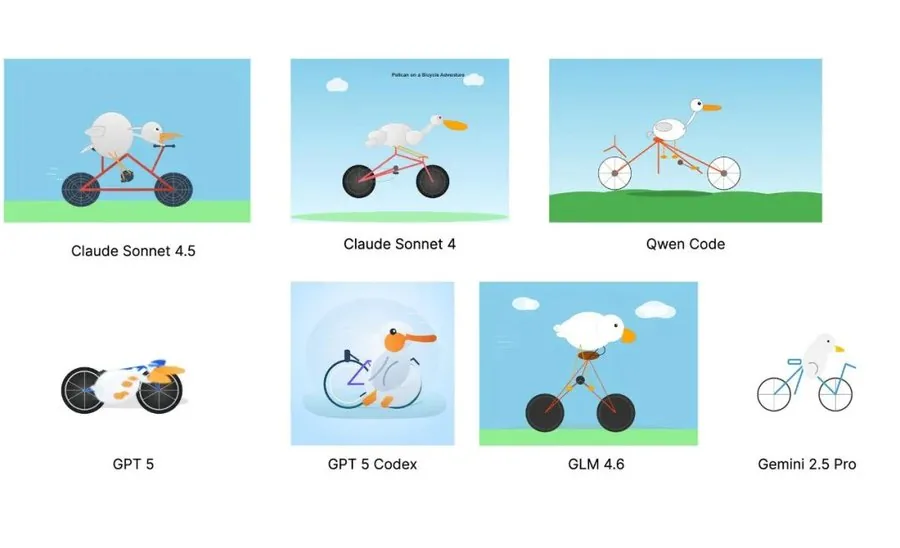
“Pelican riding a bicycle” is a standard spatial-reasoning test: no reference asset exists, so the model must understand pelican anatomy and bicycle mechanics, then compute geometry in code. Early Claude 3.5 produced two circles plus a ball with a banana-shaped beak. K3.1’s version stacks the joke the other way — a bicycle riding a pelican — yet keeps the center of gravity plausible and the frame upright, with a crescent moon, lighthouse beam, waves, a crab and a distant sailboat all in correct spatial relation. It is not a pixel image; it is vector rendering computed line by line.
Other circulating demos include a medieval castle whose towers, drawbridge, moat and floating rock mass share one spatial logic; a disassemblable steam train whose locomotive, carriages, cylindrical tanks and red wheels float as separate, precise parts like a moving engineering drawing; and a high-precision interactive 3D helicopter built in 15 minutes. Testers also mention new controls for time and render quality.
The sharpest contrast is cost. In a Minecraft building comparison, GPT-6 Astra produced a robot-shaped structure and K3.1 a spherical one — comparable results, but K3.1 cost roughly 1/14 as much. In blind tests, generating 3D code of equal complexity consumed a fraction of the tokens of top overseas models. Against Haiku 5.5, both built a village with dragon attacks, thunderstorms and a day-night cycle in 15 minutes, with similar detail. The weak spot: in a test of who can approach Claude Opus 5.5, K3.1’s running giraffe moved in a way that violates normal biomechanics.
The known numbers, side by side
| Item | Kimi K3.1 | GPT-6 Astra | Haiku 5.5 | Kimi K3 |
|---|---|---|---|---|
| 3D cost | ~70% of K3 (tester estimate) | ~14x K3.1 by conversion | undisclosed | baseline |
| Task time | ~15 min for village, helicopter | undisclosed | ~15 min for village | undisclosed |
| Parameters | undisclosed | undisclosed | undisclosed | 2.8T, released July 2026 |
| Known position | 3D and front-end code | general vision | lightweight vision | No.1 on Arena front-end code |
The table only carries figures that appear in the source; blanks are not guesses. Note that “14x” is converted from “K3.1 costs about 1/14 of GPT-6 Astra,” and like the 70% figure it is a tester estimate, not official pricing. The capability line has been built for nearly two years: K1 in December 2024 first brought reinforcement learning to vision; Kimi-VL, open-sourced in April 2025 with 2.8 billion activated parameters, matched models ten times larger on math-vision and OCR; and K3, with 2.8 trillion parameters, took first place on Arena’s front-end code board in July 2026. Separately, a Nomura report says Moonshot is developing a larger 5–6 trillion parameter model, with compute shortage the biggest obstacle and no clear training timeline.
Who should try it, who should wait
- Try it now: front-end and creative developers working on Web 3D, interactive display walls, H5 dynamic simulation and data visualization; teams that need prototype-grade 3D assets fast. The 15-minute turnaround matters mainly at the prototype stage.
- Wait: enterprises that need formal API pricing, service-level commitments and a weights-open roadmap — none of which exist yet; and anyone needing accurate character or creature animation, where the giraffe case shows the model still slips.
Final thoughts
Kimi’s approach — write graphics code first, render, self-check, rewrite — is an engineer’s path rather than an impressionist one, and it pays off on structurally strict 3D and front-end work. But K3.1 is still a leaked, limited-test model, and whether the 1/14 cost advantage holds depends on official pricing and access. Treat it as a prototyping tool for now, not a production bet.