
The Two “Highest-Expected-Benefit” Optimizations, Both Rejected in Real-World Testing
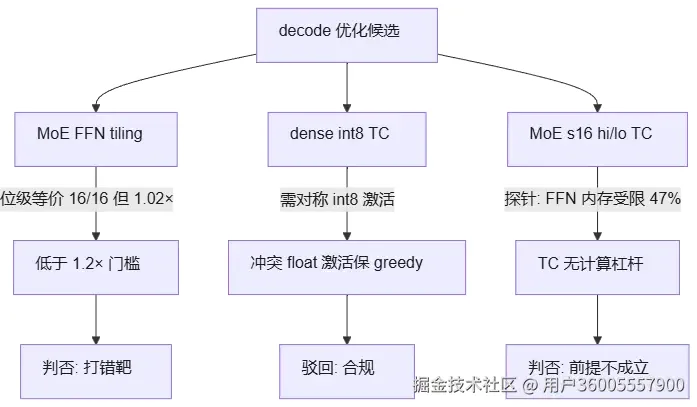
The 13th technical note published by the Kestrel_VLLM project on 2026-10-19 delivers a counterintuitive conclusion: the two CUDA optimizations with the highest projected gains in the plan—MoE FFN row-blocking tiling (expected 1.2×) and Tensor Core (expected 1.5×)—were both rejected after real-world testing. The basis was not that they “weren’t written,” but that they were written, ran correctly, and still produced no gain.
- Published: 2026-10-19, Juejin Developer Community
- Environment: x86-64 + NVIDIA RTX 5090 (sm_120), Stage 3 30B-A3B MoE (Qwen3-30B-A3B q4: 128 experts / top-8 / dim=2048 / 48 layers)
- Openness: source paths and function names are provided (vllm_cuda_kernels.cu, vc_decode_body); supporting resources are in the project’s Gitee repository
- Reproduction status: the author notes that it has not been independently reproduced and requires a 30B model, the VLLM_CUDA_STUB_MOE probe, and 64-token timing
Terminology in one line each: MoE (Mixture of Experts) means only part of the expert network is activated per layer; tiling slices the computation into blocks so more threads can work in parallel; a Tensor Core is a GPU hardware unit dedicated to matrix multiply-add; greedy decoding takes the highest-probability token at each step and is often used to verify whether values drift numerically.
Occupancy Raised from 25% to 100%, Throughput Up Only 1.02×
The original k_moe_gate_up split d=2048 into nbG=64 K blocks, one thread per block, so only 64 of 256 threads were busy, for 25% occupancy. The author changed it to a row-blocking fast path that maps the 256 threads 1:1 onto “4 rows × 64 K blocks,” maxing out occupancy; the reduction-tree order is unchanged, and the floating-point results are bit-for-bit identical to before the change.
The project’s discipline requires using same-methodology A/B tests to measure gains. The pass threshold is decode ≥62 tok/s (1.2×), and greedy must be bit-identical. Correctness passed first: the new CPU reference was compared token by token under --stream-n 16, and greedy was 16/16 identical. The gain, however, was:
| Test arm | decode throughput | Conclusion |
|---|---|---|
| Baseline (before tiling) | 52.0 tok/s | — |
| After tiling | 53. |