
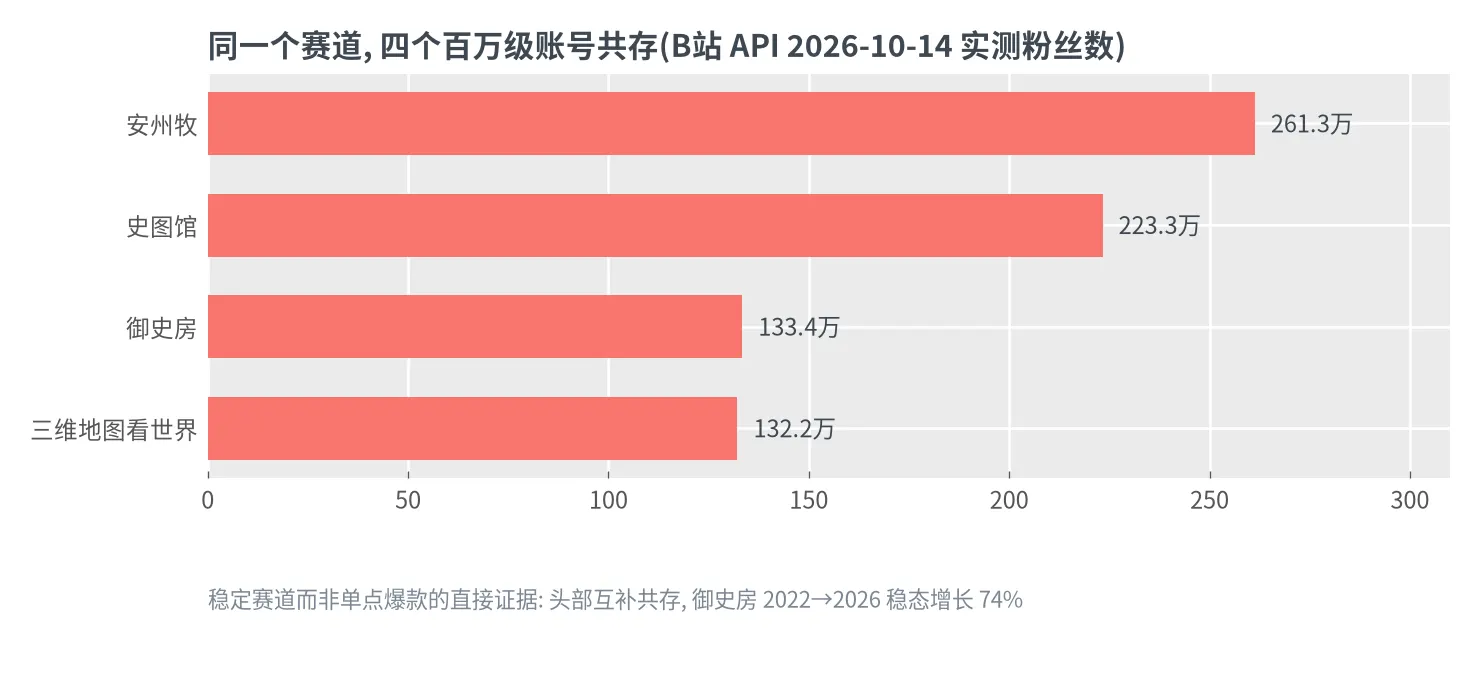
Bilibili’s knowledge zone, same API, same day: Anzhoumu 2.613M followers, Shituguan 2.233M, Yushifang 1.334M, 3D-Map-View 1.322M — four million-plus channels doing the same thing: animating the Chinese historical trivia everyone has heard of but nobody can explain, on maps. This lane has produced a new breakout channel every year for six years, and I found it by reading a viewer comment.
The comment deserves quoting in full:
“Beacon towers, tiger tallies, 800-li express, Yellow River course changes, Ming-dynasty paper money, the impact of Shi Jingtang ceding the Sixteen Prefectures, the three canals Qin relied on to unify China, the vanished Ji River, why Mount Tai heads the Five Sacred Mountains, why ancient capitals kept moving east, why the Qing army could pass Shanhaiguan, the distribution of the Great Wall, the spread of paper. I binged them all. So many things I’d never have learned in my life without this kind of explainer.”
Most comment sections are noise. This one isn’t — it delivers three things in a single comment: 14 concrete topic samples (free market research), behavioral evidence in “I binged them all” (completion rate + session chaining, exactly what recommendation algorithms reward), and emotional motive in “never would have learned this” (the sense of gain that drives saves and shares).
I have a half-built video pipeline: Claude Code does research and scripting, Remotion renders from code, SVG animation + maps + data charts carry all visuals, TTS does the voiceover — no human on camera, zero filmed footage. What it lacked was a niche. So I treated this comment as a lead and ran two workflows, 40 AI agents in total, across 24 candidate niches.
Method: how 40 agents split the work
Phase one: 24-domain scan. Chinese history, world history, war/military, geopolitics, space, paleontology, hard science, medicine, economics, engineering, archaeology, ocean/polar — plus 12 more: psychology, law, AI tech, food science, linguistics, art history, energy/climate, transport/urban planning, demographics, sports science, cryptography, mythology/religion. One agent per domain, each hunting for: demand heat (viral-play evidence from the last 12 months), competition intensity (how many 1M+ incumbents), supply gaps, fit with a no-camera code-rendered pipeline, and compliance risk on Chinese platforms.
Phase two: adversarial verification. Each top-4 finalist got three skeptic agents whose job was not to confirm but to refute: the competition lens hunted for overlooked incumbents, the demand lens tried to separate one-off hits from durable demand, the pipeline lens checked whether leading videos’ visuals could actually be replicated without filmed footage.
Cost: 38 agents, 1.25M tokens, 628 tool calls, 42 minutes. In return: every key number carries a source, and channel follower counts were measured same-day via the same Bilibili API, not screenshots of screenshots.
One engineering incident worth recording: 9 agents died by opening image attachments while searching, accumulating past the 32MB per-request hard limit of the Anthropic API — a server-side cap no client config can change. The patch was a hard line in the prompt: never open images, PDFs, or videos; text search results only. A few recurrences happened anyway — prompt discipline can’t fully restrain model behavior; the real fix belongs in the tool layer.
Results: history didn’t top the scan — until the deep dive
Final ranking after adversarial verification (demand 40% + blue-ocean-ness 35% + pipeline fit 25%, compliance penalty applied):
| Score | Niche | Compliance | One-liner |
|---|---|---|---|
| 7.75 | Language / characters / dialects | Low | Huge latent traffic around Chinese characters (6M+ plays for derivative content) but the best serious explainer tops out at 420k — refined supply gap; pipeline fit 9/10, best in field |
| 7.55 | Sports science / world records | Low | “World-record data-viz + exercise physiology diagrams” is unclaimed; red line is zero event footage (IOC copyright) |
| 6.90 | AI / computer science | Low | No Chinese equivalent of 3Blue1Brown exists; demand heavily concentrated at the head |
| 6.55 | World history | Low | Data-dense world history is blank; the main battlefield is Bilibili, not YouTube |
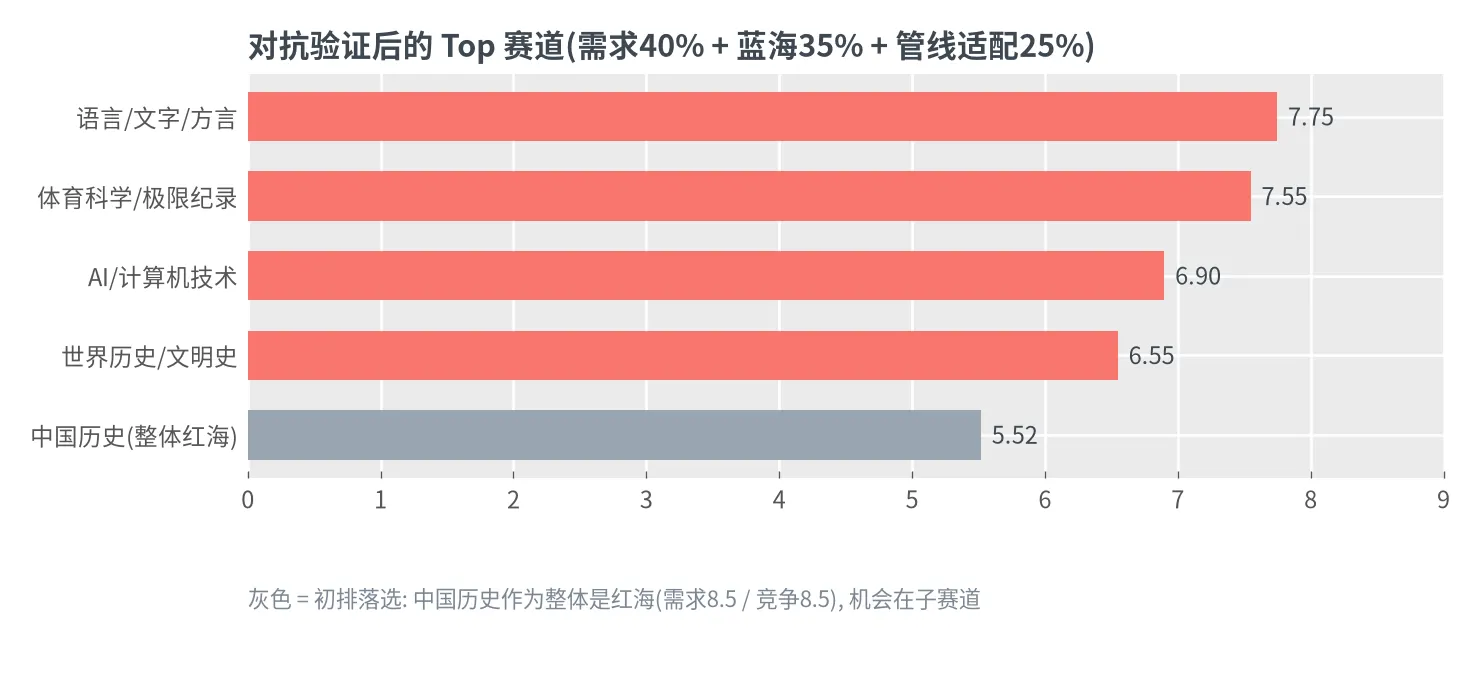
Chinese history scored 5.52 in the scan — demand 8.5 but competition 8.5, with story-driven incumbents like Xiaoyuehan (10.34M followers) saturating the narrative lane. It fell out of the top four.
But the viewer comment pointed straight at Chinese history. Contradiction? The deep-dive workflow (two agents tracing the comment’s likely source and validating the topic formula) resolved it: the 8.5 competition score belongs to “character stories / dynastic narrative,” not to “mechanism trivia + map animation.” Same macro-niche, different sub-lane. The incumbent of the latter is Yushifang — 1.334M followers, 397 videos, 766k→1.334M from 2022 to 2026: 74% steady growth over four years, no boom-bust curve. That’s the signature of a mature lane, not a capped one.
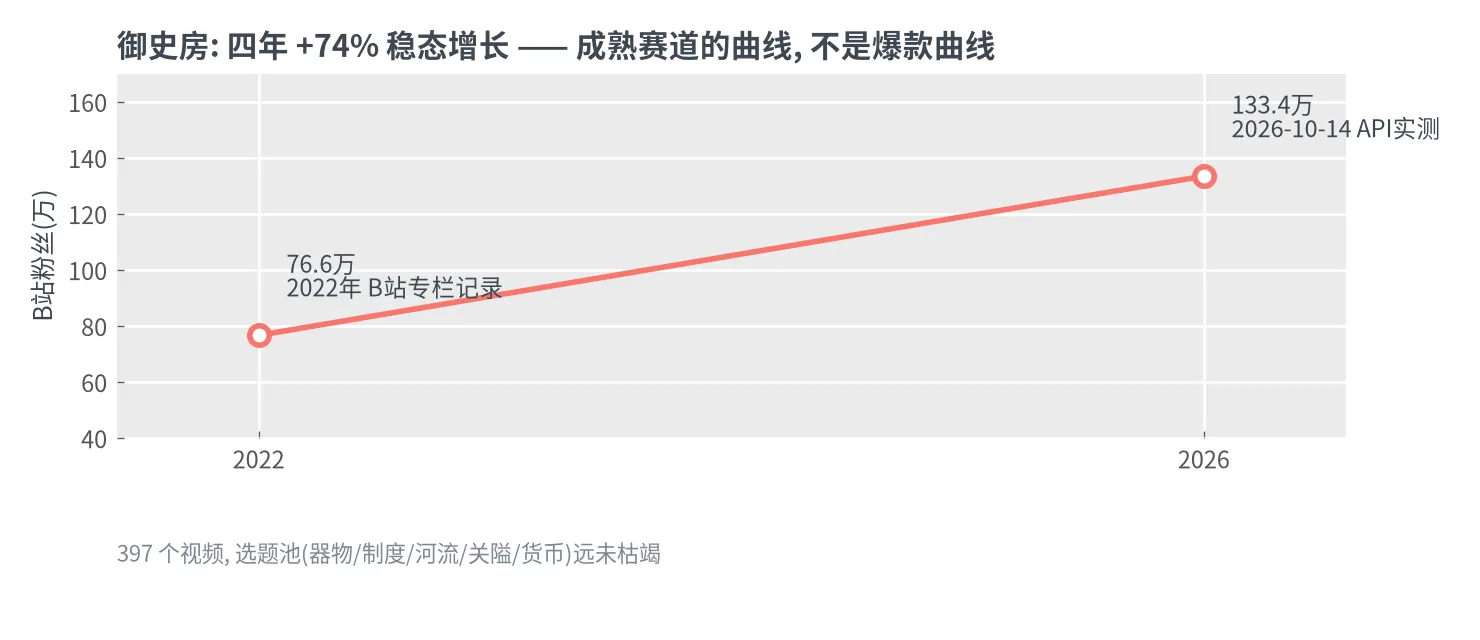
So the corrected conclusion: Chinese historical-mechanism explainers, via the “familiar name, unknown mechanism” formula, rank first. The scoring system wasn’t wrong — the niche granularity was. “Chinese history” as one cell is too big; the opportunity hides in the sub-lane.
The formula: familiar × unexplained
Break down the 14 topics in the comment and the pattern is almost brazen: beacon towers, tiger tallies, 800-li express, the Great Wall — military communication and defense infrastructure; Yellow River course changes, the vanished Ji River, eastward-moving capitals, Shanhaiguan, the Sixteen Prefectures, Mount Tai — how geography decides history; Ming paper money, Qin’s three canals, the spread of paper — institutions and technology economics.
Every one fits the same structure: the noun is universally familiar (textbooks, idioms, TV dramas pre-install the familiarity), while the mechanism is answerable by nobody (the knowledge gap tears open). Psychologically this is Loewenstein’s information-gap effect — familiarity is cheap to establish, and once the gap opens, the brain must close it; completion rates are structurally high. “I’d never have learned this in my life” is the sense of gain made visible, and gain drives saves, shares, and “might as well binge the whole channel.”
Variants of this formula have been validated repeatedly across Chinese platforms: Xiaoyuehan’s debut “Why was the USSR strong?” hit ten million plays on his way to 10.344M Bilibili followers; Hunzhi gained 780k Douyin followers in a single week; native Douyin account “History Is a Bit Cold” holds 2.82M followers and 20.42M likes; one “all of Chinese history in 8 minutes” video earned 14.436M likes. Douyin’s official pan-knowledge report: pan-knowledge video plays grew 74% year over year, and quality creators gained followers at 4.2× the platform average.
The supply of topics is the least of the worries: the Twenty-Four Histories plus archaeology reports plus toponymy and institutions make for a theoretical pool in the tens of thousands. The deep-dive agent generated 20 fresh topics on the spot using the same formula — a sample: “Does a death-exemption medallion actually exempt you from death?”, “Why exactly ’three quarters past noon’ for executions?”, “With no banks in ancient times, how did you carry money across provinces?”, “How did Guan Yu turn from a general into the God of Wealth?”, “Why is Sichuan called ‘four rivers’ and not three or five?”
Why this lane fits my pipeline perfectly
Production lines determine topics. Mine: no human on camera, no filmed footage, SVG animation + map animation + data charts + TTS voiceover, batch-renderable.
Walk the comment’s topic list one by one: beacon-tower relay routes, Yellow River course changes, eastward capitals, Great Wall distribution — map animations; tiger tallies, paper money, paper itself — object schematics; 800-li express — route map plus data chart. Not one requires filming. Not one requires archival footage.
That matters more than it looks. Incumbent history channels lean heavily on documentary footage — a ticking bomb under YouTube’s Content ID and a takedown risk on Bilibili. A pure self-drawn animation route is not only compliant but becomes the differentiation moat. The verifying agent’s own words: “giving up footage means visual density must be carried by animation quality — but Content ID’s strictness toward documentary clips actually favors the fully self-made route.”
Cross-platform migration has measured precedents: Daxiang Screening Room runs the same content at 1.33M on Bilibili, 1.32M on Douyin, 1.97M on Xigua, and self-reports “Bilibili works best”; Xiaoyuehan pairs 10.34M Bilibili followers with a 216k-subscriber, 49.73M-view YouTube Chinese channel. The multi-platform shape: Douyin gets the 60s-3min single-point burst cut, Bilibili gets the 8-25min deep version for binge-following and search long-tail, Channels (视频号) reuses the Douyin cut, YouTube gets the horizontal long video with SEO titles.
Risks: all three are evidence-based, not boilerplate
Historical accuracy is risk #1. The history comment sections are dense with amateur archaeologists; one wrong regnal year or geographic slip gets amplified indefinitely, and channels at Yushifang’s scale have been burned. AI-drafted scripts are especially prone to fabricating classical citations, so a primary-source + archaeology-report fact-check pass is mandatory — this directly shapes the prompting structure of my scripting agent.
Ming-Qing transition and frontier history are flame-war zones. Topics like the Sixteen Prefectures or the Qing entry through Shanhaiguan are natively sensitive; a fighting comment section invites platform throttling. The topic pool needs a red-line zone: modern revolutionary history and contested ethnic-relations topics are off-limits.
The first 3 seconds decide everything on Douyin. The “familiar” hook must land in the very first sentence — “You say ‘800-li express’ all the time, but how fast was it, really?” — or the formula doesn’t engage. That’s not a content problem but a script-engineering problem: the script template needs “first-3-seconds hook” as a required field.
Now it’s execution’s turn
A research report ends wherever it sits; only published videos produce a second comment like the first.
Everything is on disk: the 24-niche scan (demand / competition / pipeline fit / compliance / same-day-measured channel follower counts), 10 pilot topics each for the two runner-up niches, plus the 20-topic history list — 40 ready topics in total. Next step: pick 3, run the full pipeline end to end — research, script, storyboard, SVG, voiceover, Remotion render — measure per-video labor and output quality, then push toward daily or every-other-day cadence.
The backups stay in the drawer: if history doesn’t lift, linguistics (7.75 — “26 languages go silent every year”, “Were simplified characters really invented after 1949?”) and sports science (7.55 — “Why 9.58 seconds in the 100m may be a wall humanity never breaks”) are already specced.
That viewer probably never imagined their casually typed list would become the founding document of a production line.