
Lynx from LingXu|GitHub Deep Dive: colibrì|Running 100-Billion-Parameter LLMs on an Ordinary Computer
Here’s something small from today’s GitHub Trending champion: Your home laptop or old workstation can, in theory, already run a cutting-edge model with 744 billion parameters.
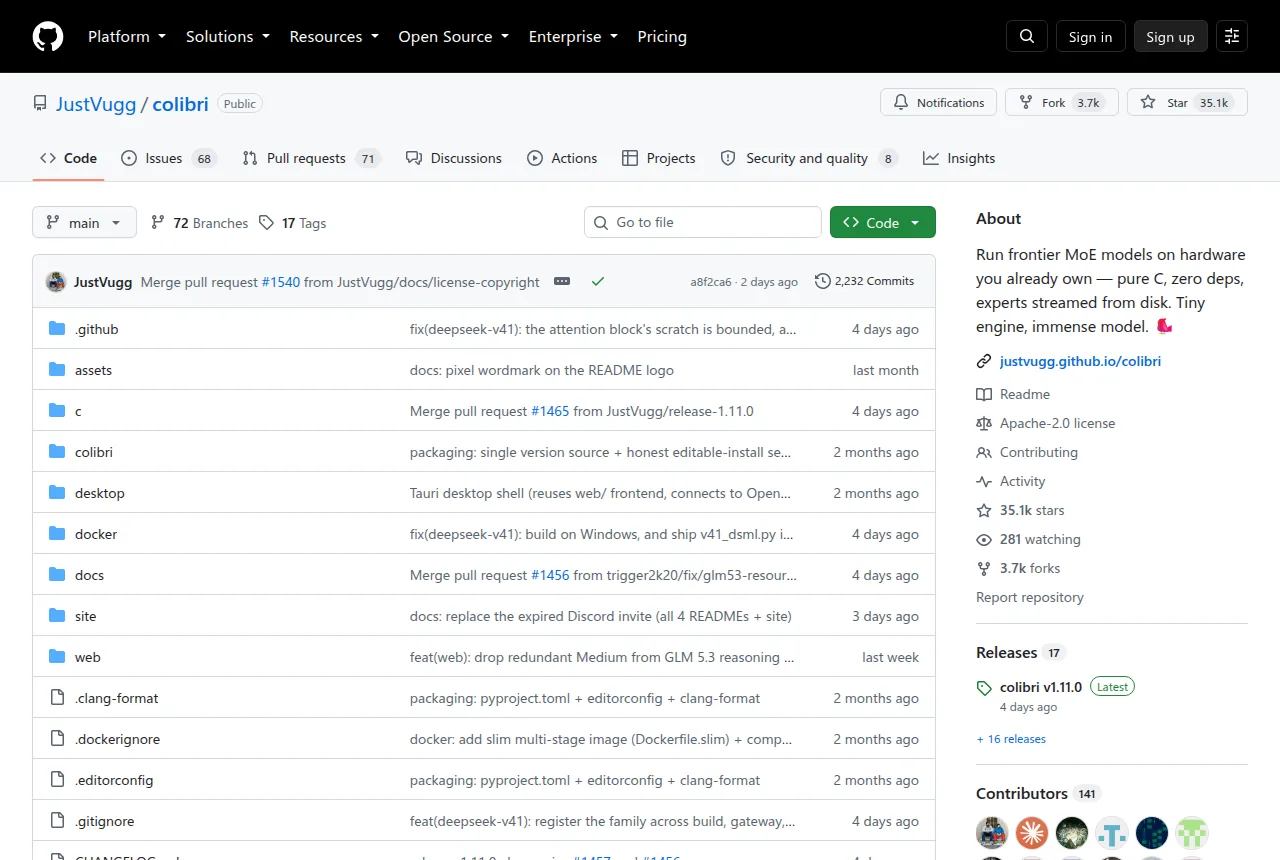
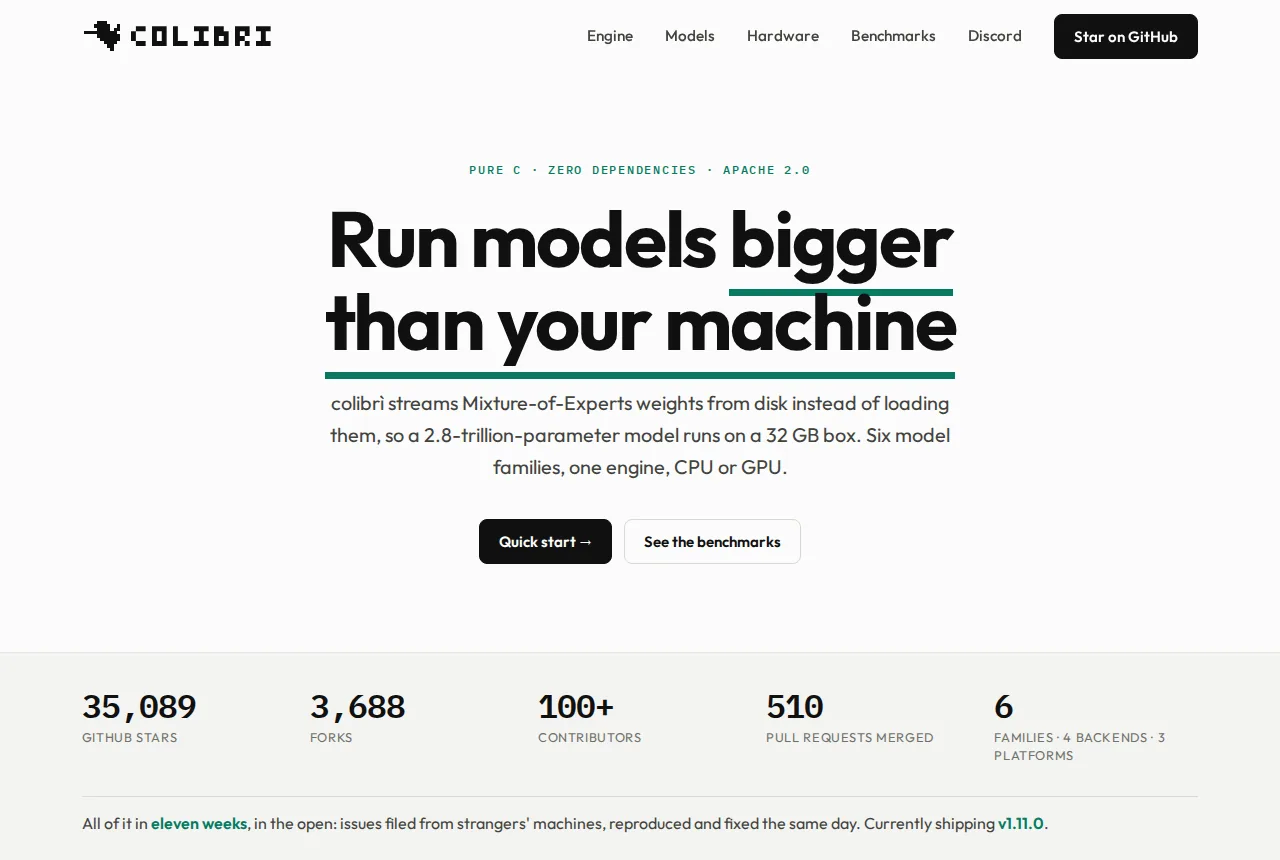
The project is called colibrì (pronounced roughly “ko-li-bree”), an inference engine written entirely in C with zero external dependencies. It earned 1,546 new stars on GitHub today — proving that so-called “frontier models” no longer belong solely to cloud GPU clusters.
Core Concept: Treating RAM, Storage, and VRAM as One Unified “Sheet of Paper”
Colibrì’s core philosophy treats VRAM, RAM, and NVMe storage as a single unified memory hierarchy rather than fragmented islands separated by hardware. When VRAM runs out, it doesn’t crash — instead, it offloads part of the computation to RAM or even disk and keeps running. The speed drops a bit, but the model’s behavior stays exactly the same.
What this means:
- A 744-billion-parameter GLM-5.2 model activates only about 40 billion parameters during actual inference
- It boots with as little as 9.9 GB of physical memory
- Supports nine model families: GLM-5.2/5.3, Inkling, Kimi K3, DeepSeek V4 series, Qwen3, OLMoE, and more
The web console (launch it with ./coli web) offers an intuitive visualization of model execution: routing heatmaps per layer, VRAM vs. RAM utilization ratios, expert activation distributions, and even a flowing network diagram reminiscent of a real brain — all 19,456 experts displayed in full.
Hands-On: Five Steps to Boot a 100-Billion-Parameter Model
The project provides an exceptionally lean CLI — the entire workflow fits in under ten lines:
| |
All interactions go through a single coli command: chat for conversations, serve for the API, web for the visualization dashboard — no extra binaries, no Python runtime, no pip dependency hell.
Technical Highlights & Design Philosophy
Colibrì’s design trade-offs are boldly clear. It feels more like an inference lab than a polished product:
Streaming Expert Scheduling: The “experts” (i.e., sub-networks) in the model are never all loaded into memory at once. They’re read from disk on demand, much like a JIT compiler loading code lazily.
- It includes an LRU hot-cache strategy — frequently reused experts are优先kept in fast memory
- Single-layer prefetch (“ahead” reads) is supported, but the dev team admits it can slow things down on certain machines — so it can be toggled on or off as needed
I/O–Computation Overlap: Memory transfers to VRAM and model inference run in parallel; CPU, GPU, and Metal devices can be scheduled together.
- O_DIRECT raw I/O is supported to cut kernel buffering overhead
- Dual SSD striped reads are already implemented, though the team explicitly notes the community still needs to validate behavior across different environments
Lossless Semantic Guarantee: This is Colibrì’s red line. When VRAM is insufficient, it never silently downgrades precision (e.g., swapping int8 for int4) or swaps in a weaker router to “make do.” Speed may drop — but answer quality is never sacrificed.
End-to-End Optimization Focus: The author insists every experiment must be measurable from prompt to output, not just single-operator microbenchmarks. Most features in the project come with real measurement data — though no SLA is promised.
Who Is This For? Differences from Similar Projects
- AI educators and researchers: Validate various MoE architecture strategies at low cost, without renting expensive GPU nodes
- Local deployment enthusiasts: Those who want to run large models on personal servers or laptops will find a more aggressive memory-tiering approach than llama.cpp offers
- Systems engineers: Anyone interested in storage I/O, heterogeneous scheduling, or expert placement algorithms — the entire codebase is remarkably compact at just one C file per model
Compared to mainstream alternatives:
llama.cpp and similar projects are more mature but more “conservative”: they refuse to run once they exceed memory limits
vLLM and other cloud solutions prioritize throughput and concurrency for multi-user serving scenarios
Colibrì chooses to sacrifice some stability and ease of use in exchange for maximum experimental freedom on the inference side
Low hardware threshold: A standard consumer laptop can boot a 100-billion-parameter model
Low experiment cost: One A/B test just means re-running a command
Full transparency: Every optimization must prove itself with end-to-end results — no black-box promises
Final Thoughts
Colibrì’s significance isn’t about whether it’s the fastest inference engine today — it’s about redefining who can access frontier LLMs. When a 744-billion-parameter model can run on any old computer you own, we can truly treat it as an experiment to observe, measure, and improve, rather than guessing through an API screen.
It reads more like an open-source invitation: whether a model is good shouldn’t depend only on a vendor’s compute budget — it should also depend on whether we’re willing to roll up our sleeves, take it apart, understand it, and ultimately make it better.
Project homepage: https://justvugg.github.io/colibri