
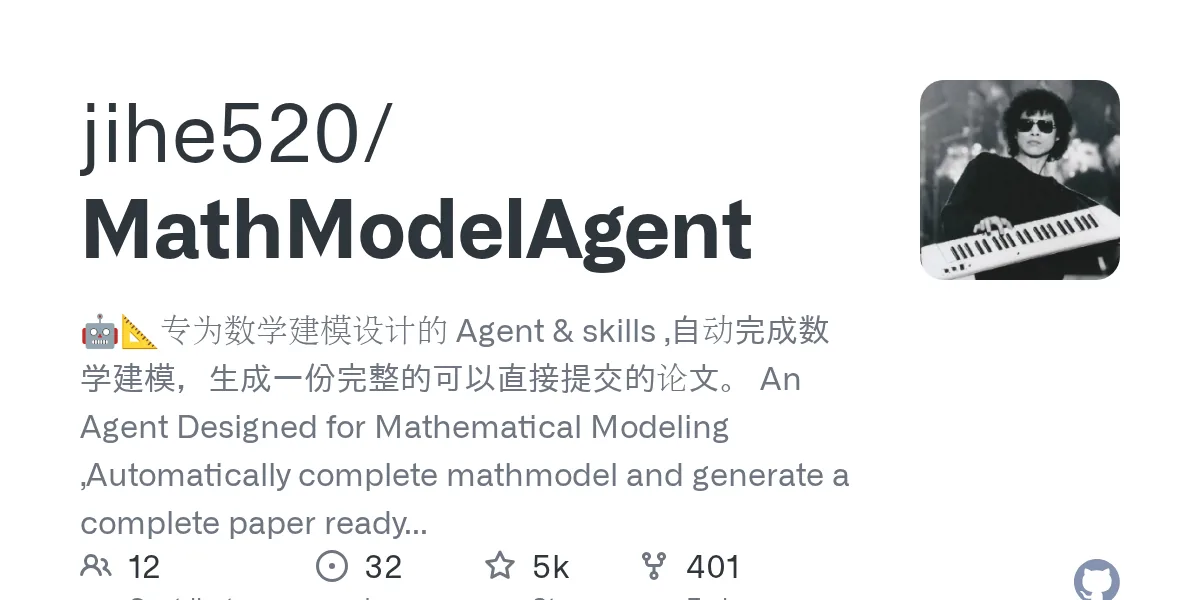
Today, on GitHub Trending, a project called MathModelAgent quietly surged to the top of the Python trending list—with 5,144 stars, it proves that when AI begins to systematically tackle the traditional challenge of “mathematical modeling,” the impact is no less than that of any major model release.
It is not another chatbot, but a complete automated workflow: from understanding the problem, selecting models, writing code, drawing charts, to typesetting and generating a submission-ready PDF paper—all without human intervention.

What Can It Do? — Full Automation of the Modeling Workflow
Open its command-line interface, enter a task description, and the backend multi-role Agent system starts running:
- Modeler analyzes the problem context and builds a mathematical model (e.g., AHP, ARIMA, neural networks, etc.)
- Coder writes reproducible solution code in Jupyter Notebook, with support for local or cloud execution
- Paper writer automatically typesets using Typst, with 17 built-in templates for major competitions (National Contest, Huashu Cup, MCM/ICM)
Throughout the process, it automatically detects errors, reruns, and corrects results. Finally, it goes through a nine-step acceptance process (including text leakage detection, numerical consistency validation, and PDF visual inspection) to ensure the output paper meets submission standards.
Up and Running in Three Steps, Launch with 10 Lines of Commands
Whichever environment you prefer, the project offers a clear path:
Docker method (least hassle): just three commands
1
2
3
git clone https://github.com/jihe520/MathModelAgent.git cd MathModelAgent docker-compose upLocal deployment: requires Python, Node.js, and Redis; suited to users who want to dig deeper
Desktop version: download the installer, enter your model API Key, and it’s ready to use out of the box
After launching, visit http://localhost:5173, enter /1start-mathmodel complete this mathematical modeling task on the left, wait a dozen or so minutes, and a complete competition paper will be generated in the backend/project/work_dir directory.
Technical Design: Lightweight but Precise
The most intriguing thing about this project is its “philosophy of subtraction”:
- The author deliberately avoids complex agent framework dependencies and adopts an agentless workflow design—each modeling step is an independent SKILL (skill module), chained together through lightweight orchestration rather than heavy framework binding
- Supports any LLM, integrated uniformly through litellm, meaning you can use Claude, GPT, domestic Chinese LLMs, or even open-source models, with controllable costs
- Four-layer fault-tolerance mechanism: limited retries → fallback model switching → evaluator supervision → feedback-driven reruns, ensuring stable and reliable output
The SKILL-based modular design keeps future iteration costs extremely low. The author explicitly states in the README that future work will focus only on optimizing the SKILL layer and will no longer develop the underlying harness framework—this restraint actually makes it easier for the community to reuse and extend.
Who Should Try It?
- Competition students: an auxiliary tool when MCM/ICM and national contests are approaching, saving a lot of routine work time
- Modeling instructors: use it for classroom demonstrations to quickly show the full real-world modeling workflow
- Researchers: reference its workflow design approach to build their own domain-specific Agents
Compared with similar projects, it lacks an overly complex UI or plugin ecosystem, but it wins on its high degree of “end-to-end” completion. If all you need is a modeling paper you can submit, it may be the open-source project on GitHub that currently comes closest to that goal.
In the AI era, when algorithmic capability is no longer the only barrier, how to efficiently organize knowledge and form reproducible workflows is the real moat.
MathModelAgent is trying to answer this question—it does not chase flashiness, but instead earnestly compresses something that traditionally takes three days of work into completion within one hour.
Open source and free, but the author reminds users: For personal learning only; please do not use commercially.