
A New Category That Appeared Within a Month
AI decision models—a class of models that don’t write text and only answer typed questions—went from nonexistent to everywhere in a month. The usage pattern: feed it a state and a set of typed questions, and it returns a choice, a score, or a yes/no with a probability attached.
- TypeSafe AI released Jev on September 15, calling it a “System One model,” echoing Kahneman’s fast, intuitive thinking.
- OpenAI announced the Decisions API at DevDay, opening it to public beta on October 6.
- Cribl released cribl-decision, an open-source LoRA adapter that can run locally (small weights appended to an existing model to reshape its output into a specific format).
- Names such as Laya are already showing up in open-source toolchains.
- Jev is priced at $42 per billion input tokens, with response times of 70 to 500 milliseconds.
For security operations centers (SOCs), the appeal is direct: typed outputs with calibrated probabilities can be thresholded for automatic handling; the cost is low enough to run on every alert; and the answer space is fixed in advance, so every decision can be logged, replayed, and compared against actual outcomes.
Cheapness Is What Actually Changed This Time
The original article’s estimate: an enterprise sees about 450,000 alerts a year, each fed a few thousand tokens, putting the model bill at roughly around $100 a year. That makes the economic rationale for “only look at high-severity alerts” disappear entirely.
On how thresholds land in practice, the article gives a concrete set of numbers: if the probability that an alert is benign is above 0.97, auto-close it; below 0.6, treat it as a suspected incident and escalate; the middle range goes to a human. TypeSafe also recommends stricter thresholds for irreversible actions—such as disabling an account, rather than adding a comment to a ticket.
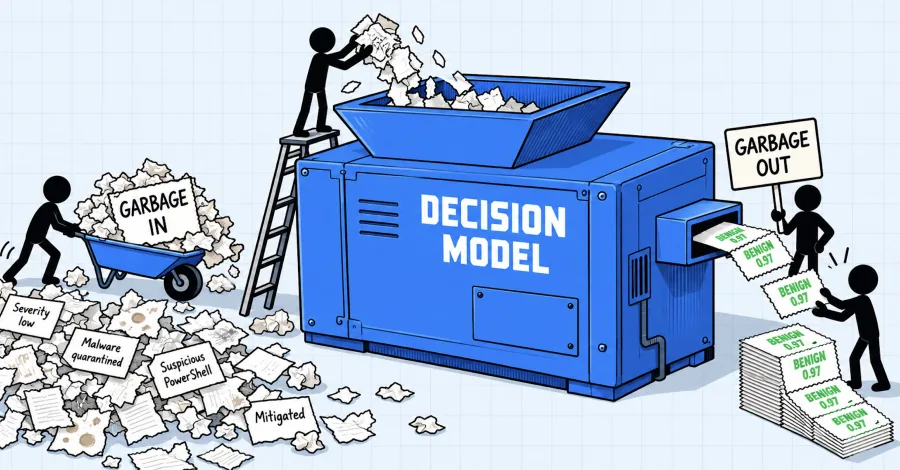
But the article repeatedly hammers one premise: calibration is only a promise about a distribution. When a model says 90%, it means “among inputs that look like this one, it is right about 90% of the time.” If the input is only an alert title and a severity field, the model is calibrated only for that kind of alert; it knows nothing about that host.
The Contrasting Number: 51% of “Mitigated” Machines Were Still Infected
The article cites its AI SOC Report 2026, covering 25 million alerts on the customer side in 2025:
- 82,000 alerts triggered real-time endpoint memory scans, of which about 2,600 machines had active infections;
- Of those 2,600, 51% had previously been marked “mitigated” by EDR;
- Nearly 1% of all real incidents originated from the lowest-severity alerts, which at 450,000 alerts/year works out to about 54 incidents, close to one per week.
What the 51% figure means is this: for an alert that says “malware detected, quarantined, low severity,” a decision model will most likely close it with high confidence—and it hasn’t made a wrong call; the input fed to it was wrong. Cribl says this plainly in its own model card: the model may be overconfident and is sensitive to the wording of the prompt and candidate options.
Identity alerts open the gap even wider: in the 2025 data, 74% of identity alerts were classified as probably benign; only about 2% of impossible-travel alerts were confirmed as real intrusions, and about 30% of those were triggered by VPN use. The author calls the practice of first turning alerts into a set of facts “Security Context Engineering.”
| Solution | Provider | Date | Form | Key parameters |
|---|---|---|---|---|
| Jev | TypeSafe AI | Released September 15 | System One model, returns typed answers with probabilities | $42 per billion input tokens; 70–500 ms response |
| Decisions API | OpenAI | Announced at DevDay, public beta October 6 | API | Not disclosed in the original |
| cribl-decision | Cribl | Not disclosed in the original | Open-source LoRA adapter, can run locally | Not disclosed in the original |
Who Should Use It, and Who Should Wait
The teams that should start using it are those with high alert volumes and existing ticketing and orchestration workflows. They can start with low-risk decisions that don’t involve irreversible actions, set the auto-close threshold in a high-confidence range such as 0.97, and make sure every decision is stored and later compared against real outcomes.
Two types of teams should wait. First, teams where environmental context still exists only in the heads of senior analysts—the model won’t know that Dave in finance always logs in from Portugal, or that the build server fires the same alert on every release; that kind of context can’t be bought, and it quickly goes stale as assets and personnel change. Second, teams that still can’t get minute-level forensic data: first fill in “what ran, what did it do, is it still there, and who was it,” then talk about decisions.
Final Thoughts
Decision models change both the cost structure and the audit approach of the SOC, and that layer of change is real. But the more accurately it judges, the more it amplifies bias in the input—the 51% of “mitigated” machines are the proof. First forensics, then decisions: in the model era, ignoring this just gets more expensive, it doesn’t become obsolete.