Key Event: Jensen Huang Explains Windows’ Foundational Role in the GPU Ecosystem at Microsoft Launch Event
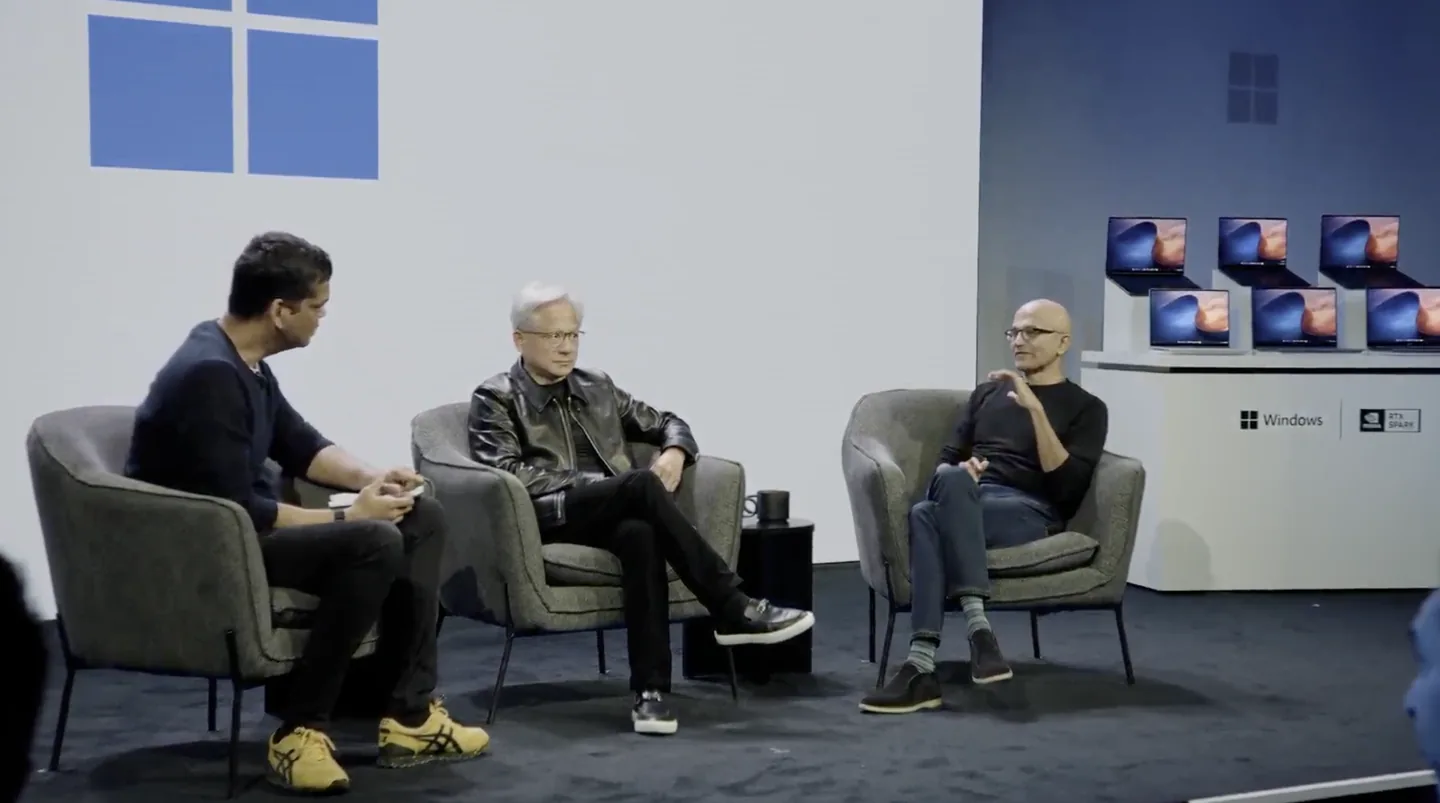
On October 8, Microsoft held a Surface product launch event, where NVIDIA CEO Jensen Huang made a special appearance as the finale, sharing the stage with Microsoft CEO Satya Nadella and Windows lead Pavan Davuluri. During the conversation, Huang reflected on the era when Windows 95 was born and offered a far-reaching assessment:
- Key Event: Windows 95 was the first to integrate DirectX, unifying the Windows graphics programming interface
- Industry Impact: The DirectX standard created the necessary conditions for the birth of the GeForce brand and the CUDA architecture, laying the groundwork for the development of deep learning
Huang stated unequivocally: “Without Windows, there would be no GeForce; without GeForce, CUDA would never have come to be, and technologies like deep learning would be out of the question.”
Hardware Transformation: From Proprietary Technology to Microsoft Standards
1995 was a watershed year for graphics display hardware. At the time, the mainstream market approach was a combination of “2D display card + 3D accelerator card,” requiring developers to write adapter code for different vendors’ hardware—resulting in high development costs and a fragmented ecosystem.
NVIDIA’s initial attempt was the NV1, launched in 1995—the first solution to integrate 2D and 3D functions onto a single chip. However, the NV1 used quadratic surface technology rather than the industry-standard triangle rendering, making it incompatible with the DirectX/D3D standard. This made it difficult for game developers to adapt, and sales ultimately fell flat.
This setback prompted NVIDIA to make a critical strategic adjustment: abandoning its insistence on a proprietary technical path. The 1997 release of the RIVA 128 became the turning point—
- For the first time, Microsoft’s D3D (Direct3D) was made the highest priority for driver development
- Achieved the cost-performance advantage of single-card integration
- Was among the first to support the AGP (Accelerated Graphics Port) interface, with significantly higher bandwidth than PCI
The success of the RIVA 128 laid the user and technology foundation for NVIDIA’s subsequent GeForce brand (launched in 2000).
Key Data Comparison: Technical Path Differences Between NV1 and RIVA 128
| Feature | NV1 (1995) | RIVA 128 (1997) |
|---|---|---|
| Core Technology | Quadratic surface rendering | Standard triangle rendering |
| DirectX Compatibility | Incompatible | Fully compatible with D3D |
| Interface Standard | Proprietary | AGP (Accelerated Graphics Port) |
| Market Outcome | Poor sales | Quickly gained market foothold |
Practical Takeaways: Lessons from the Technology Ecosystem
Who this is for: Developers interested in graphics computing and parallel computing should understand the standardization value of the Windows ecosystem at the hardware abstraction layer (DirectX). CUDA’s widespread adoption depended on the “driver standard first” model established by DirectX.
Who should wait: Users seeking cutting-edge CUDA features (such as the latest compute capabilities) will need GPUs with newer architectures; newcomers to hardware development can keep an eye on NVIDIA’s continuously optimized driver versions for Windows Direct3D.
Final Thoughts
Huang’s retrospective reveals a key logic in technological evolution: platform ecosystem standardization has greater penetrative power than isolated technological innovation. Windows 95 unified the graphics API through DirectX, giving GPU vendors a clear target and ultimately unleashing the potential of parallel computing—an impact that continues to this day.