
Extracting Large Model Circuits Directly from Weights
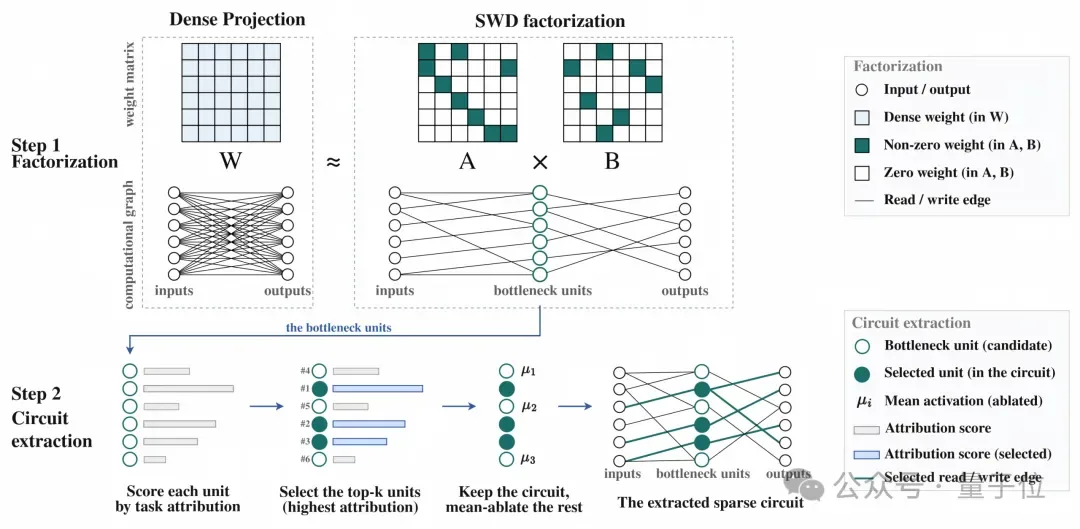
IQuest Research, in collaboration with Safe AI Forum, the University of Oxford, Stanford University, and Tsinghua University, has proposed Sparse Weight Decomposition (SWD), aiming to bypass the traditional path of “training a substitute network to understand a model” and instead extract intervenable task circuits directly from pre-trained weights.
In mechanistic interpretability research, a task circuit refers to a set of internal computations that have a causal effect on a model’s capability: the capability persists when only they are retained, and performance degrades when they are removed. Prior methods such as Transcoder and sparse feature modules typically required learning new representations to approximate a given layer or module of the original model, then performing attribution and ablation on the new units. These approaches are effective but require additional data and optimization, and can conflate the original model’s behavior with approximation errors from the substitute module.
How SWD Constructs “Sparse Paths”
SWD’s core idea is to approximately decompose a dense weight matrix $W$ into two sparse matrices $A$ and $B$, such that $W \approx AB$. The shared intermediate dimension forms bottleneck units: each unit first reads a scalar from the input direction, then writes toward the output direction, functioning as a rank-one read-write path. A rank-one matrix can be understood as the minimal matrix update constructed from one input direction and one output direction.
The method uses a small amount of calibration text to generate layer inputs and optimizes the output error before and after decomposition. During求解, it alternately updates the two factors, uses hard thresholding to control the number of non-zero connections, and re-fits the retained weights. After decomposition, researchers can score, rank, select, and ablate bottleneck units without training separate neural surrogate networks. Unlike SVD, whose components typically have dense read-write directions, SWD emphasizes that connections within each unit must also be sparse, so retaining only a few units still substantially reduces the number of active connections.
Key Results: Less Than 1% of Data, Scaling to 27B
The paper reports three core findings:
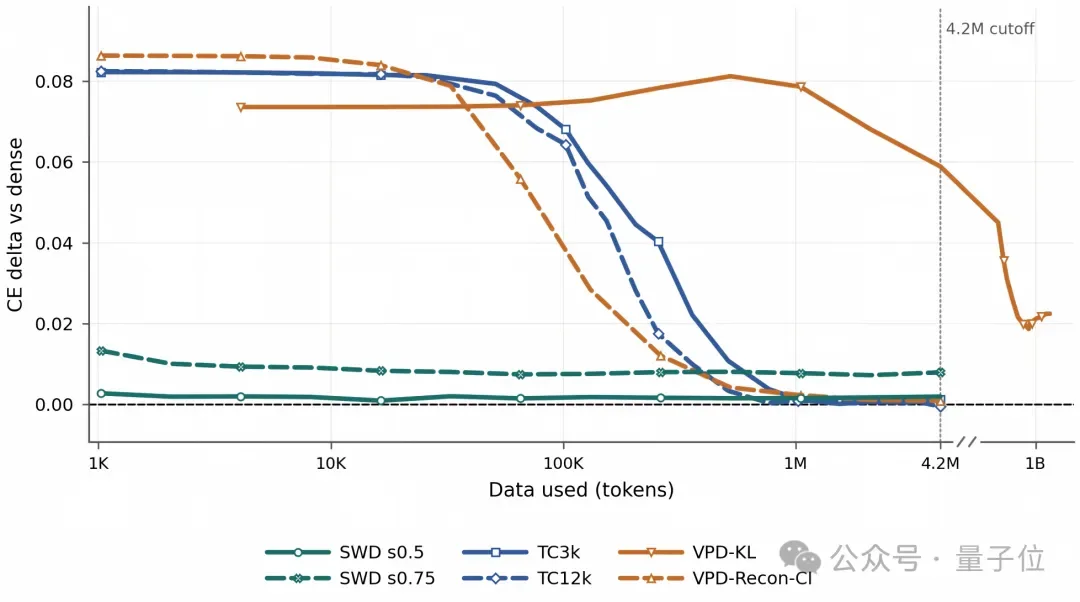
- In single-matrix replacement fidelity matching experiments, SWD used less than 1% of the data required by training-based baselines such as Transcoder.
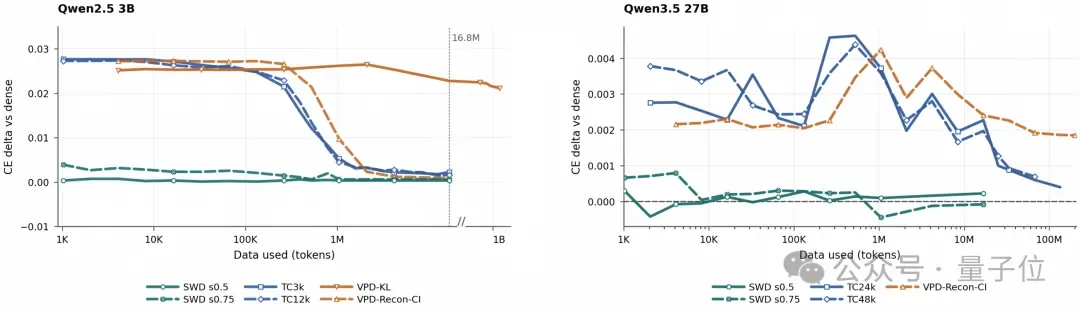
- In task circuit experiments on GPT-2, Qwen2.5, and Qwen3.5-27B, SWD typically achieved the same sufficiency and necessity targets using fewer bottleneck units and active connections.
- The method scales to Qwen3.5-27B and also covers all 48 attention and MLP weight matrices in GPT-2 Small, with a zero-data variant provided.
The team measured how closely the replaced model approximates the original using held-out text cross-entropy difference (CE delta), supplemented by KL divergence and activation reconstruction error. In the GPT-2 Small layer 8 mlp.c_proj experiment, SWD entered the low-error regime with only thousands of calibration tokens, while training-based baselines required roughly $10^6$ optimizer-replay tokens. A similar trend appeared across Qwen2.5-0.5B, 1.5B, 3B, and Qwen3.5-27B.
From Single Matrices to Full Models and Semantic Units
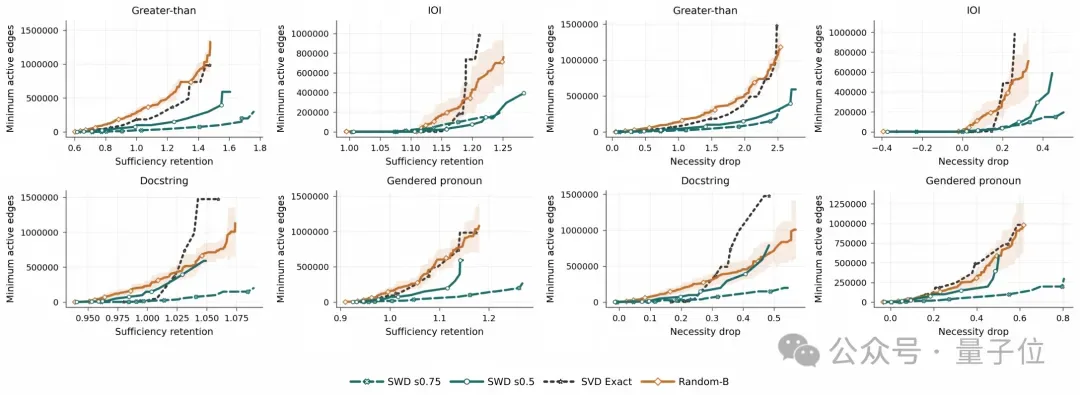
For circuit extraction, the team first ranks candidate units via first-order task attribution, then constructs top-k nested circuits and performs sufficiency and necessity tests on a held-out set. On four tasks in GPT-2 Small—GreaterThan, IOI, Docstring, and Gendered Pronoun—SWD consistently used fewer units and connections than Transcoder and VPD-Recon-CI to reach equivalent targets; this advantage held even after switching to zero ablation and extended to the Qwen series of models.
In full-model experiments, researchers replaced all 48 attention and MLP weight matrices across the 12 Transformer blocks of GPT-2 Small with SWD decompositions, preserving embeddings, LayerNorm, non-linearities, and the output head. Since errors accumulate across layers, they fixed the sparse structure and fine-tuned only the retained factor values, yielding SWD-FT: with the number of connections held constant, the model’s CE dropped from 3.90 to 3.44, slightly outperforming the sparse pre-training baseline’s 3.45 under a similar non-zero parameter budget—the former used approximately 20.6 million tokens, while the latter required 28.84 billion.
The paper also demonstrates zero-data SWD: without any calibration text, it directly minimizes the Frobenius error in weight space. Results show it produces weight matrices closer to the originals; the activation-calibrated version better preserves typical text behavior at high sparsity levels. Even without calibrated activations, the zero-data variant can still extract meaningful task circuits.
Industry Implications and Future Directions
SWD’s value lies not only in saving training data, but in shifting the object of interpretability from “another learned surrogate module” back to the original checkpoint. It provides sparse weight paths that are scorable, ablatable, and editable—and in the GreaterThan task, it surfaces highly attributed units associated with numbers, years, and quantities. A single bottleneck direction was also used to selectively boost the logit margin of “down” relative to “left” in the prompt “The opposite of up is,” with negligible effect on unrelated prompts.
For the general technical audience, this means mechanistic studies of large models may be moving closer to engineering practice: there is no longer a need to retrain complex surrogate representations for every layer and every checkpoint. Whether this approach can become mainstream will depend on its stability across more models, more tasks, and more stringent safety scenarios. But based on the paper’s results, directly searching for sparse causal circuits on the weight side is emerging as a significant new branch for understanding and manipulating the internal computations of large models.