
A 12-year-old computer topples a 12-year-old record
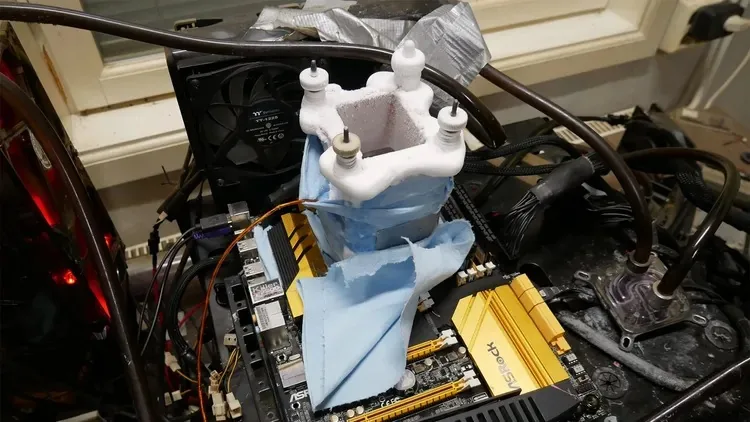
IT之家 October 19 news: Overclocker Luumi used liquid nitrogen to push an Intel Core i5-4670K to 6301.00 MHz, breaking the Cinebench R11.5 multi-core record on HWBot with a score of 10.8 cb—the previous record it displaced had stood for 12 years.
First, the hard facts:
- Published: IT之家 report on October 19 (2026)
- New record: Cinebench R11.5 multi-core 10.8 cb, only in the Core i5-4670K subcategory
- Frequency change: 3.4 GHz base / 3.8 GHz turbo at stock, validation file records 6301.00 MHz (about 6.3 GHz)
- Platform: ASRock Z97 OC Formula motherboard, ADATA XPG 4GB DDR3 memory, Corsair AXi 1600 PSU
- Cooling: liquid nitrogen
- Price and open weights: not applicable here; no pricing or model weight information
Old chip, tiny memory, and a bottle of liquid nitrogen take the crown
Core i5-4670K is a product of the Haswell era: 4 cores and 4 threads, 22 nm process, 6 MB cache, HD 4600 integrated graphics, 84 W TDP. The original article specifically notes that back in its day, if you wanted 4 cores and 8 threads, you had to pay extra for an i7. The K in the model name stands for “unlocked multiplier,” meaning the multiplier can be adjusted freely, rather than relying only on raising the base clock to overclock.
Liquid nitrogen overclocking is another world: liquid nitrogen at close to -196°C keeps the processor temperature down, pushing frequencies into ranges that air and water cooling cannot reach—at the cost of being completely unsuitable for long-term or daily use. Cinebench R11.5 is a rendering benchmark based on the Cinema 4D engine, while HWBot is the score archive for competitive overclockers; submitting a record requires an attached validation file—so the 6301.00 MHz figure comes from the validation record, not a verbal claim.
The most striking contrast in this story is that this is not the world record for all quad-core processors in Cinebench R11.5, but only the top spot in the specific Core i5-4670K subcategory. In other words, competitors are using the same model of chip, so what is being compared is tuning, cooling, and luck on the day—not the thickness of your wallet. The fact that the previous record stood for 12 years also says something: there simply aren’t many participants in these retro-hardware subcategories.
The original article also notes that a HWBot community user remarked how rare it is to see a result on the front page that uses neither an X3D processor nor an RTX 5090 graphics card. Also noteworthy is just how modest this setup is: an old motherboard plus 4GB DDR3 memory. In an era of huge memory capacities and flagship GPUs, specs like these would barely register—but it took the record.
Key data comparison
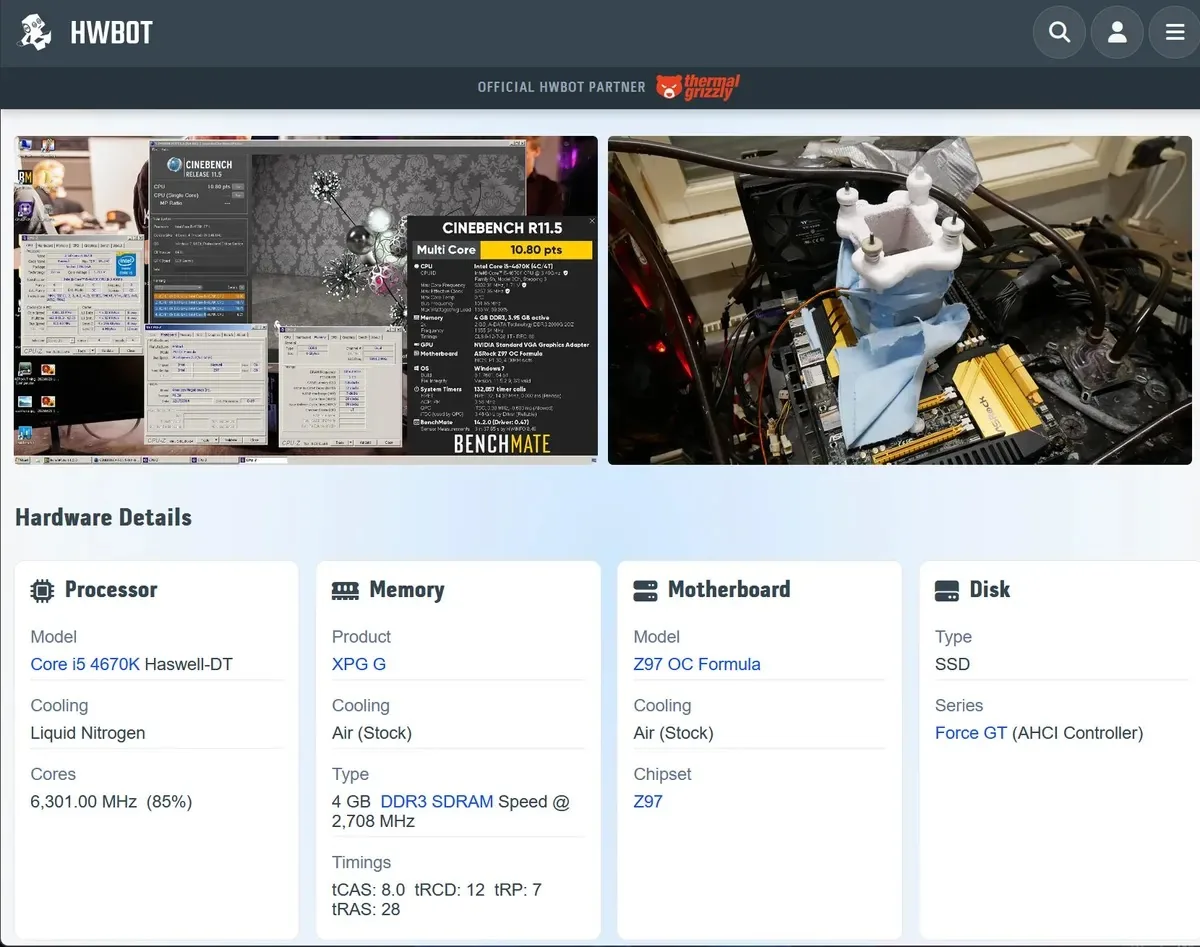
| Item | Data |
|---|---|
| Processor | Core i5-4670K (Haswell, 4 cores/4 threads, 22 nm) |
| Stock frequency | 3.4 GHz base / 3.8 GHz turbo |
| Overclocked frequency | 6301.00 MHz (about 6.3 GHz) |
| Cinebench R11.5 multi-core | 10.8 cb |
| Cache / iGPU / TDP | 6 MB / HD 4600 / 84 W |
| Memory | ADATA XPG 4GB DDR3 |
| Motherboard / PSU | ASRock Z97 OC Formula / Corsair AXi 1600 |
| Cooling | Liquid nitrogen |
Who should follow suit, and who should wait
- Who should follow suit: overclocking enthusiasts who still have an old Haswell-era platform and DDR3 memory on hand. HWBot’s subcategories are friendlier to old hardware, and there are few competitors with the same model. As long as you’re willing to tinker with voltage and cooling and submit a compliant validation file, making the leaderboard is not out of reach.
- Who should wait: anyone who wants this machine to keep handling today’s everyday workloads. Four cores and four threads are now a below-entry-level spec, and liquid nitrogen is only effective for the instant the benchmark runs; if you really want a better experience, switching platforms will pay off far more than adding a cooling rig to an old processor.
Final thoughts
The threshold for a record is not always set by the newest and most expensive hardware; HWBot’s subcategories happen to leave a door open for old hardware. The number 10.8 cb itself is not astonishing—what it really shows is that overclocking is still a craft where tuning and patience win.