Core Announcement
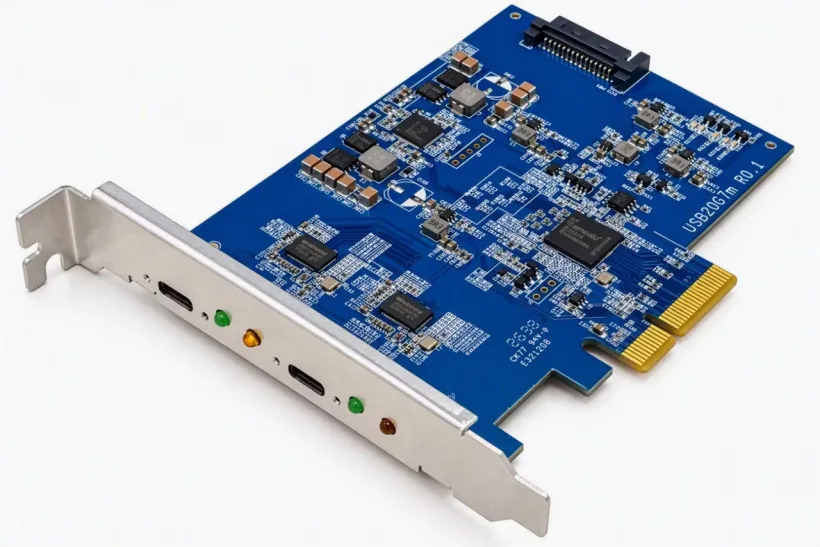
Infineon announced on September 30, 2026 (local time) the launch of a reference design for a PCIe Add-In Card (AIC) supporting USB 3.2 Gen 2×2 (20Gbps) Type-C interface, aiming to accelerate industrial adoption of this high-speed interface.
Key facts:
- Release date: September 30, 2026 (local time)
- Target interface: USB 3.2 Gen 2×2 (20Gbps dual-lane USB-C)
- Uplink interface: PCIe Gen4 ×4
- Downlink interfaces: Two USB-C ports (36W PD output each)
- Cable reach: 5 meters with passive copper cable at full 20Gbps rate
- Target applications: Industrial machine vision, long-reach high-speed data acquisition
The reference design is publicly available to system integrators and OEMs. No pricing information for final products was disclosed, as this is a reference platform for partners to build upon.
Technical Specifications and Component Breakdown
The reference card addresses the two primary barriers to USB 20Gbps adoption: signal integrity over distance and complex power delivery requirements.
Uplink connectivity: PCIe Gen4 ×4 provides theoretical bandwidth of ~64Gbps (8Gbps per lane × 4 lanes), comfortably exceeding the 20Gbps USB requirement to avoid uplink bottlenecks.
Main controllers: An ASMedia (祥硕) USB4 host controller ASM4242 handles USB protocol processing and device enumeration, while Infineon’s EZ-PD CCG7 power delivery controller manages power negotiation and monitoring. The two controllers work in tandem under the USB Power Delivery 3.0 specification.
Downlink ports: Both USB-C receptacles support 36W power delivery (varying voltage modes per USB Power Delivery 3.0), enabling power-hungry peripherals to operate without separate power supplies.
Cable compatibility: Officially supports 5-meter passive twisted-pair cable at full 20Gbps rate—a counterintuitive detail: USB 20Gbps is typically associated with short-reach (≤3m) active cables due to severe signal attenuation, whereas this design demonstrates passive copper cable reliability at doubled reach, cutting cable cost by roughly 33–50%.
Solving Industrial-Scale Challenges
Infineon noted that although USB 20Gbps doubles the bandwidth of its predecessor (USB 3.2 Gen 1 ×2 at 10Gbps), signal degradation, timing skew, and power delivery complexity have hindered adoption in industrial environments where long cable runs and electromagnetic immunity are non-negotiable.
The reference design mitigates these issues through:
- PCB-level impedance-matched differential traces
- Fine-grained current and thermal monitoring via CCG7
- Link equalization algorithms in ASM4242 to compensate for insertion loss
While specific error correction mechanisms were not detailed, the company stated the solution “clears reliability barriers for long-reach, high-speed, high-power transmission in machine vision applications.” This implies a unified interface for simultaneous data transfer, power delivery, and synchronization—simplifying wiring and improving system robustness in factory automation.
Recommendations for Deployers
Ready to deploy now: System integrators building machine vision solutions; production lines requiring connections to multiple high-bandwidth cameras (line-scan or high-frame-rate area-scan) within 5 meters; current USB 10Gbps deployments planning expansion where existing cable length limitations exist.
Wait longer: Projects requiring transmission beyond 5 meters; use cases needing single-port power exceeding 36W; scenarios where USB 20Gbps-capable endpoints (e.g., cameras with native 20Gbps output) are not yet commercially available.
Final Thoughts
This reference design marks a meaningful step toward transitioning USB 20Gbps from short-reach consumer applications to reliable industrial deployment. With PCIe Gen4 uplink and dual 36W PD downlink now standardized in reference platforms, industrial automation and imaging systems are poised for a新一轮 high-speed interface upgrade cycle.
By lowering the engineering barrier, Infineon’s move accelerates ecosystem adoption—though real-world reliability will ultimately depend on extensive field validation by end users.