Inception released Mercury 3 on October 19, calling it the most capable diffusion-based LLM to date. The pitch is narrow and specific: frontier-adjacent quality at real-time speed.
- Availability: live on the Inception API Platform, plus OpenRouter, Baseten and Vercel. OpenAI API compatible, so existing stacks drop in without rewrites.
- Scale: more than 40x the total parameters of Mercury 1.
- Context: 1 million tokens, up from 260K on Mercury 2.5.
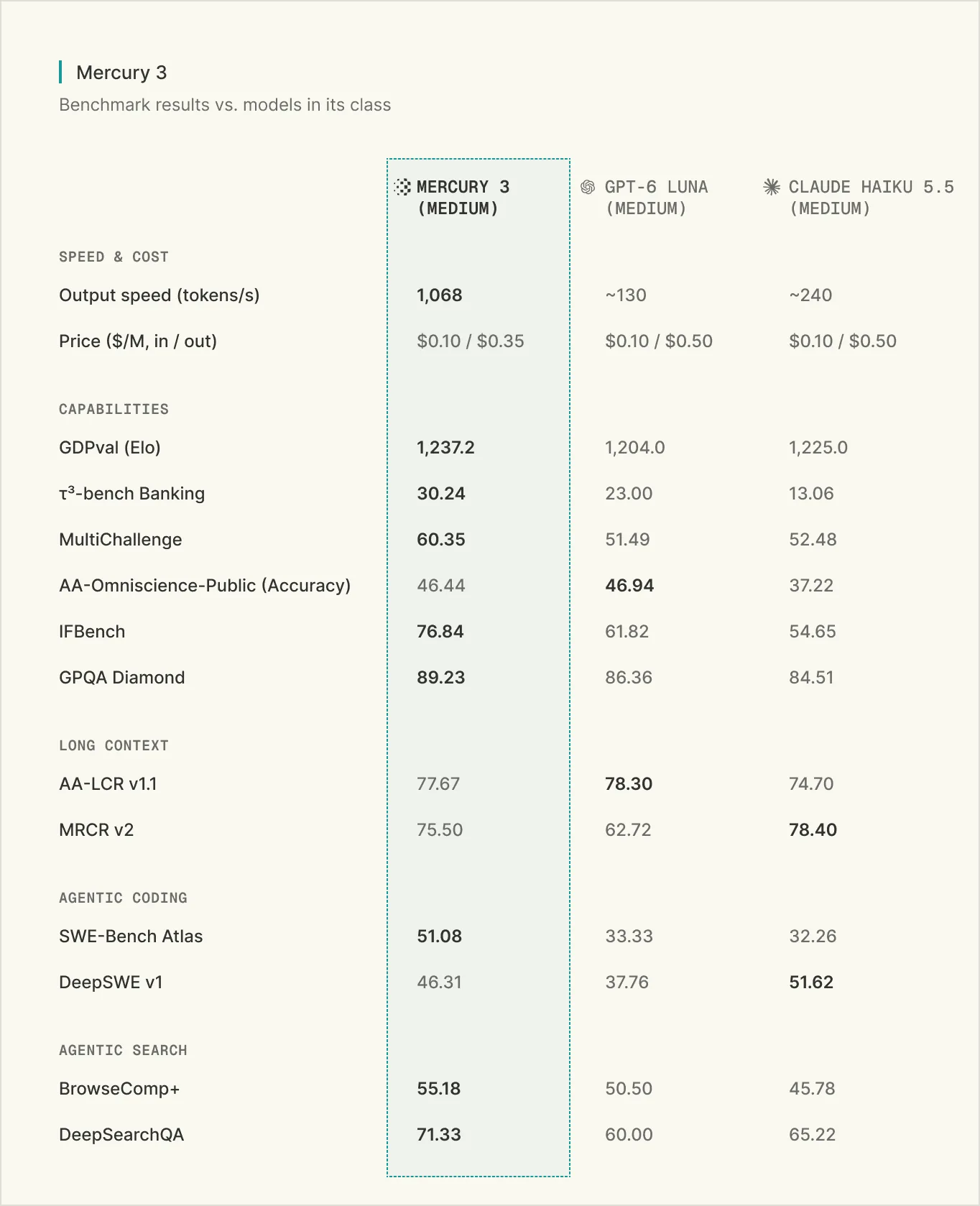
- Speed: 1,068 tokens per second on NVIDIA GPUs.
- Price: $0.20 per million input and $0.70 per million output tokens, halved at launch to $0.10 / $0.35. Cached tokens take another 90% off the input price.
- Trial and deployment: 100 million free tokens on the API; enterprise deployments add dedicated capacity, autoscaling, compliance controls and configurable data retention. No model weights were announced.
One line of background: autoregressive models write one token after another, while diffusion models treat the whole answer as noise to be denoised in parallel, pushing through many tokens per pass — which raises the throughput ceiling.
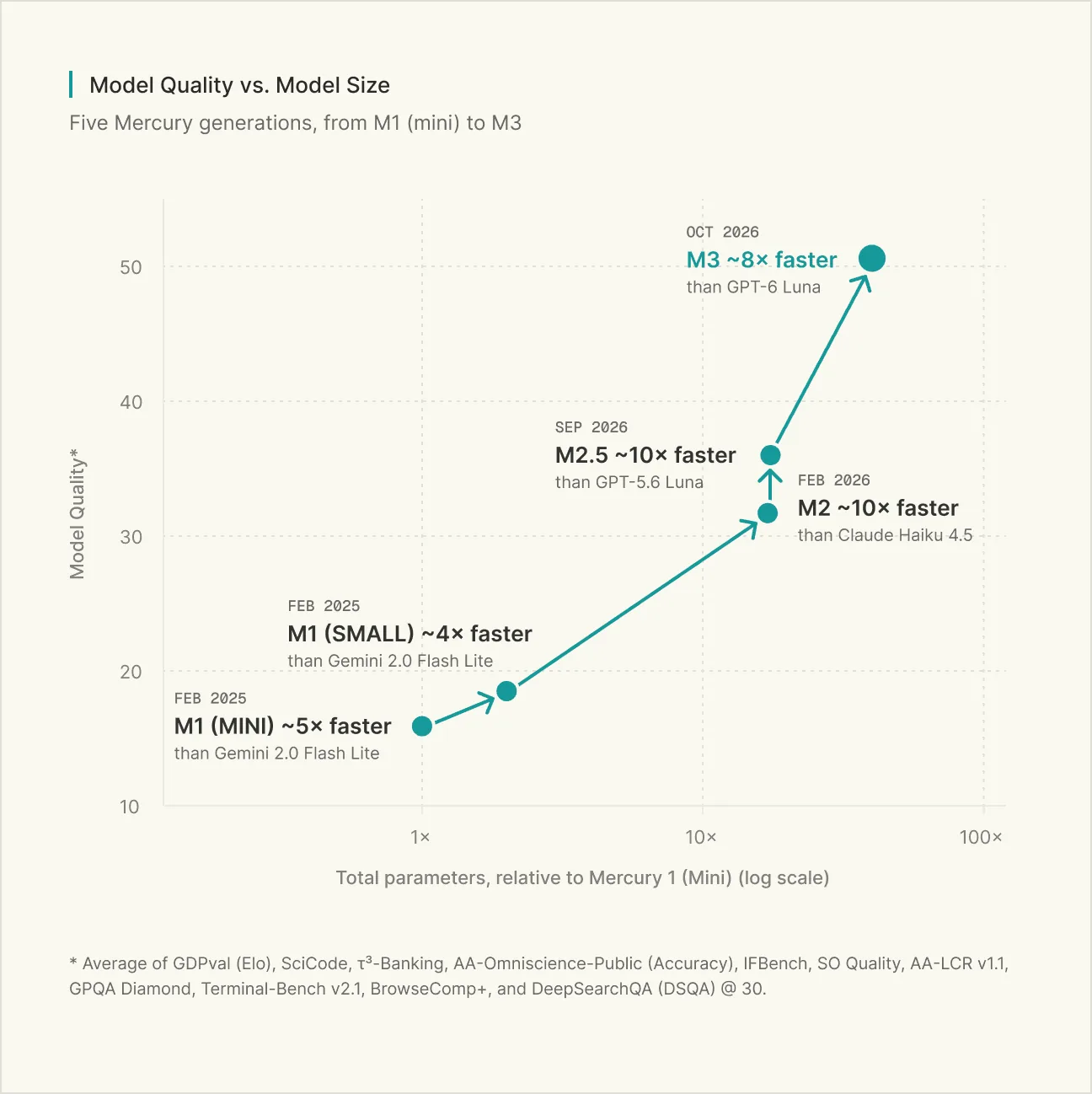
40x the parameters, 3x the smarts, same speed

Inception says intelligence on standard benchmarks rose about 3x from Mercury 1 (mini) to Mercury 3 while parameters grew more than 40x — and the model stayed “just as fast.” That is the load-bearing claim: the scaling laws that held for autoregressive models, the company argues, hold for diffusion too. Against the speed-optimized GPT-6 Luna and Claude Haiku 5.5, Mercury 3 is on par or better on a range of benchmarks while running 4–8x faster.
The more interesting number is a counterintuitive one. On 50 live Mind2Web navigation tasks inside Inception’s production web-agent harness, Mercury 3 completed 50% — half the tasks failed. But that was significantly better than GPT-6.1-Sol, using the same token volume and the same number of agent steps, at a fraction of the per-token cost. Speed here buys extra attempts, not accuracy.
Partner reports focus on latency. Octen AI measured search at roughly 80ms in its Sense API tests, with generation as the bottleneck; Mercury 3 delivered a median generation time of 0.9 seconds and a median end-to-end response of 2.2 seconds. RevisionDojo uses it for live tutoring, with hints, marked answers and definitions returning in about a second — a drop-in swap for its existing stack. Lorikeet, which builds support agents for regulated businesses, says Mercury 3 beat other models on latency in early testing while scoring higher on evals and in production.
Two companion products shipped alongside: Mercury Voice, tuned for the extreme low latency of voice and for time to first answer token rather than end-to-end latency, already used by Audivi AI, Altur and OpenCall; and Mercury Decide, a high-volume classification model that beats Jev on benchmarks including JevBench and LegalBench.
Specs and pricing at a glance
| Item | Mercury 3 | Reference |
|---|---|---|
| Parameters | 40x+ Mercury 1 | ~3x intelligence gain claimed |
| Context | 1M tokens | Mercury 2.5: 260K |
| Speed | 1,068 tokens/s on NVIDIA GPUs | 4–8x faster than GPT-6 Luna / Claude Haiku 5.5 |
| Input price | $0.20 per 1M tokens | Launch price $0.10 |
| Output price | $0.70 per 1M tokens | Launch price $0.35 |
| Caching | 90% off input price | — |
| Free tier | 100M tokens | API trial |
Who should switch, who should wait
Worth trying now: latency-sensitive workloads — voice and chat support, live tutoring, browser and search agents — and teams already on an OpenAI-compatible stack who want to attack cost per token. The launch discount plus 100 million free tokens makes evaluation cheap.
Worth waiting: anyone who needs open weights or on-prem deployment, since only hosted API and enterprise capacity were announced; and teams with accuracy-critical deep reasoning work. A 50% completion rate on navigation tasks is a reminder that agent benchmarks are still demos, not service levels — run your own eval set before moving production traffic.
Final word
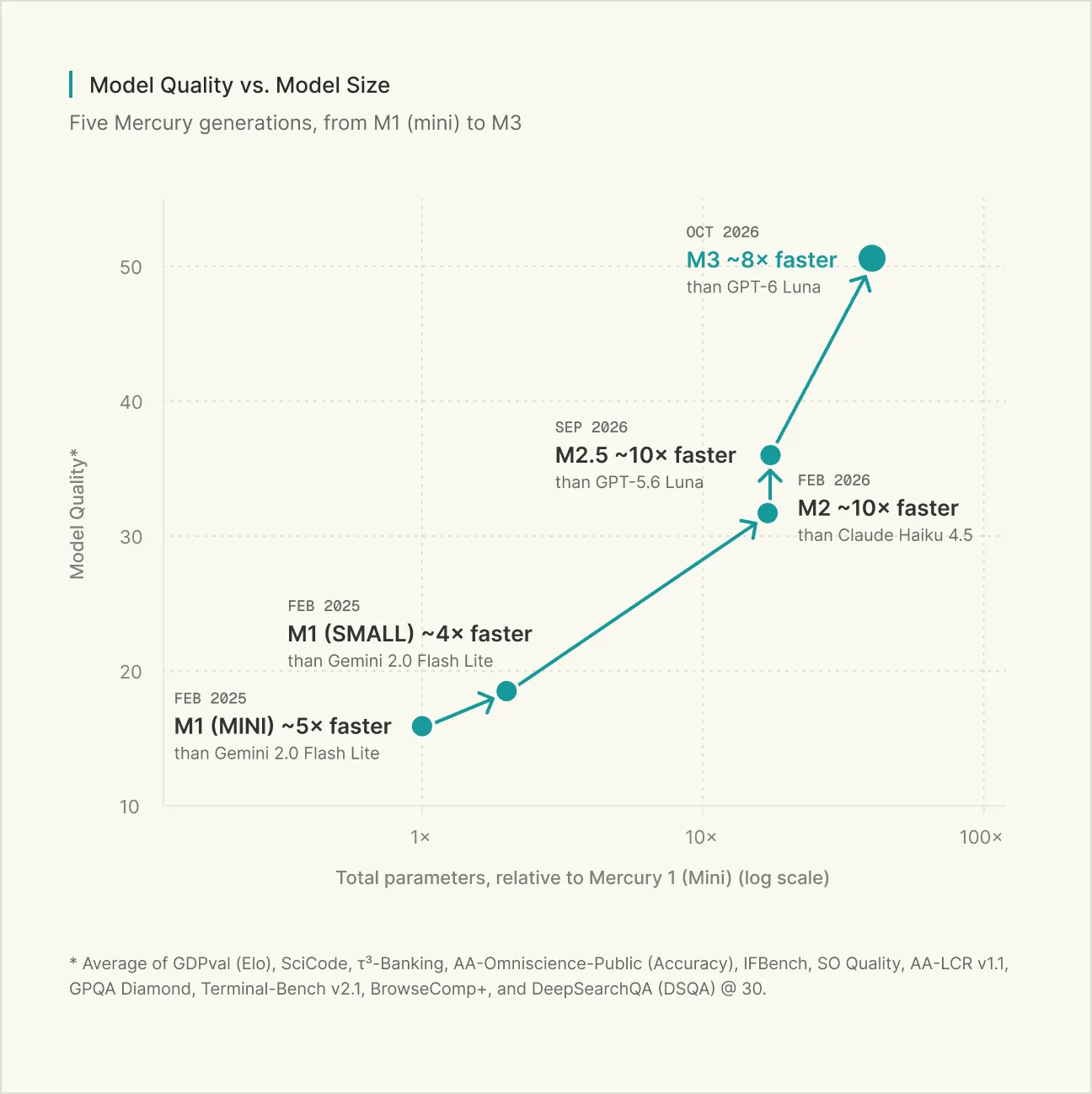
Mercury 3 matters less as another fast model than as an answer to whether diffusion scales — Inception says yes, with 40x the parameters at unchanged speed. That opens a path to real-time AI that does not simply buy latency with more inference spend. The next signal to watch is not a leaderboard but how many production teams actually move their main traffic over.