Digging for Clues in Overlapping Audio
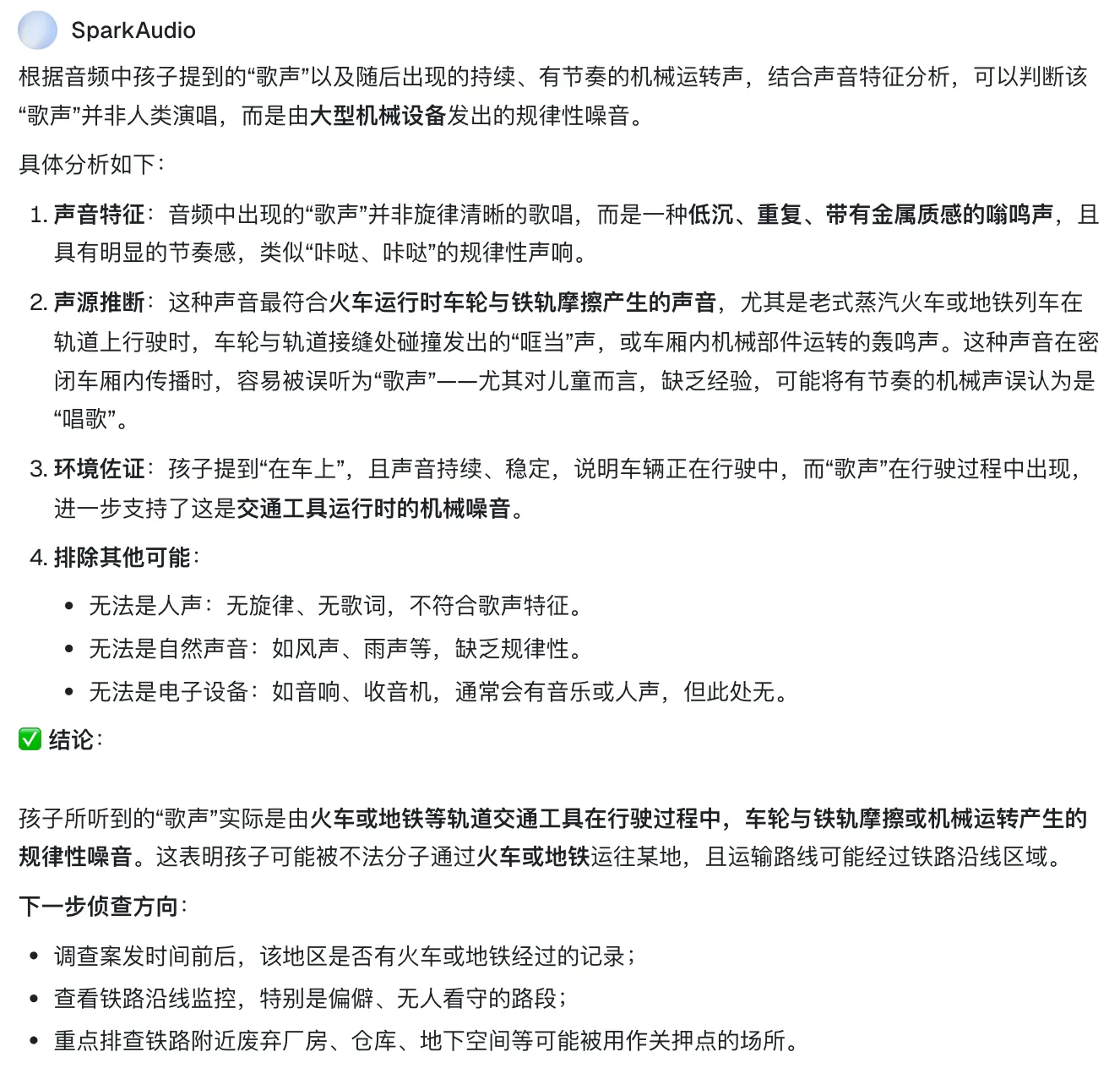
In a demo, SparkAudio 1.0 analyzed audio with several overlapping sound sources within seconds and concluded that the surroundings of a kidnapped child were dominated by the regular noise of large machinery, possibly on a train or subway. The model did not assume the “singing” the child mentioned came from a person or an instrument; instead it combined humming, mechanical noise and the child’s remark about “being in a vehicle” to infer the scene. It did not, however, analyze a short warning tone also present in the clip.
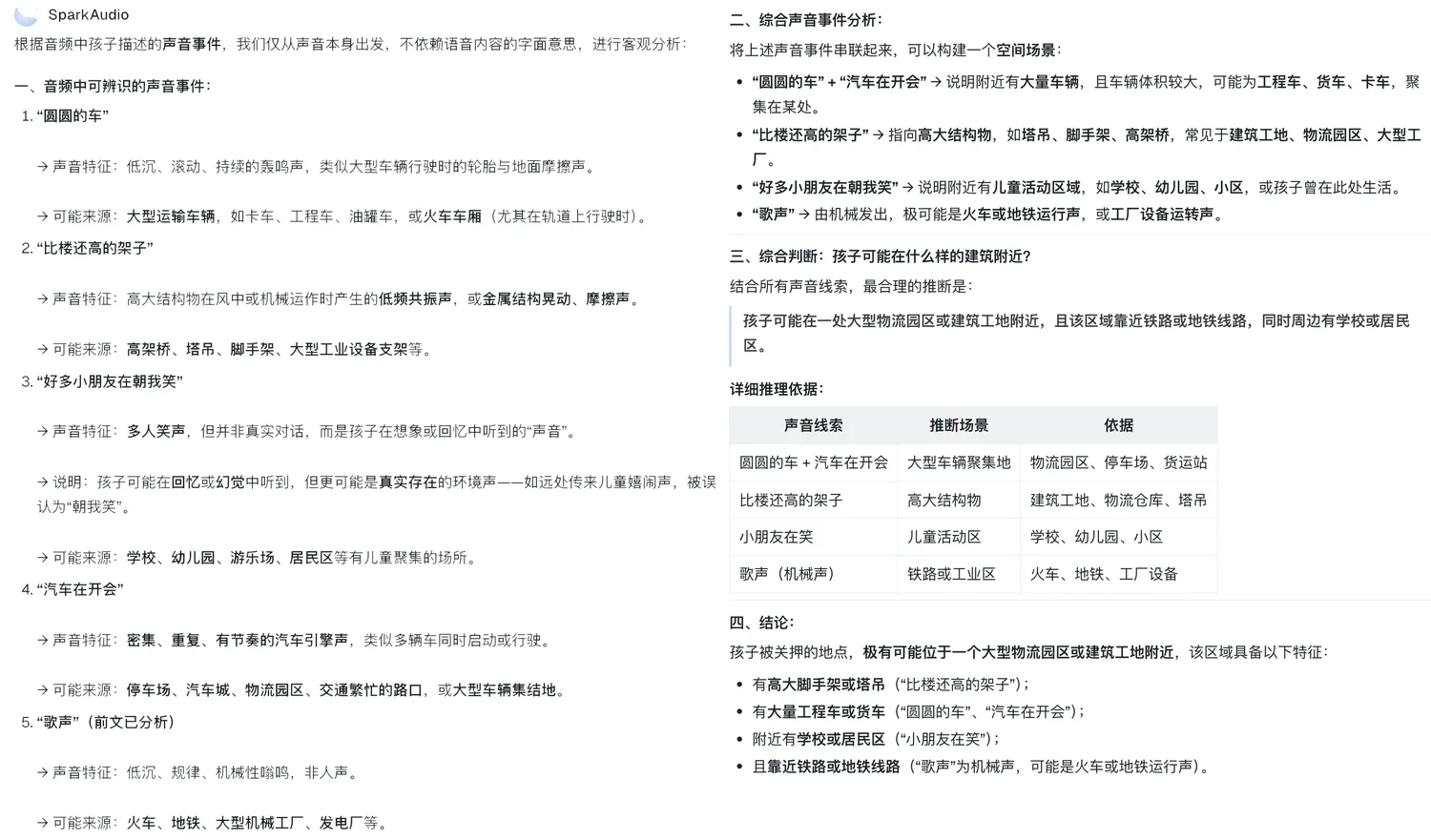
In a second clip, the model mapped car sounds and mechanical equipment onto the child’s abstract descriptions such as “cars having a meeting” and “round cars,” then listed key features of the child’s location in its conclusion. Notably, it did not combine the two clips into an overall judgment.
The Foundation Model and Three Core Techniques
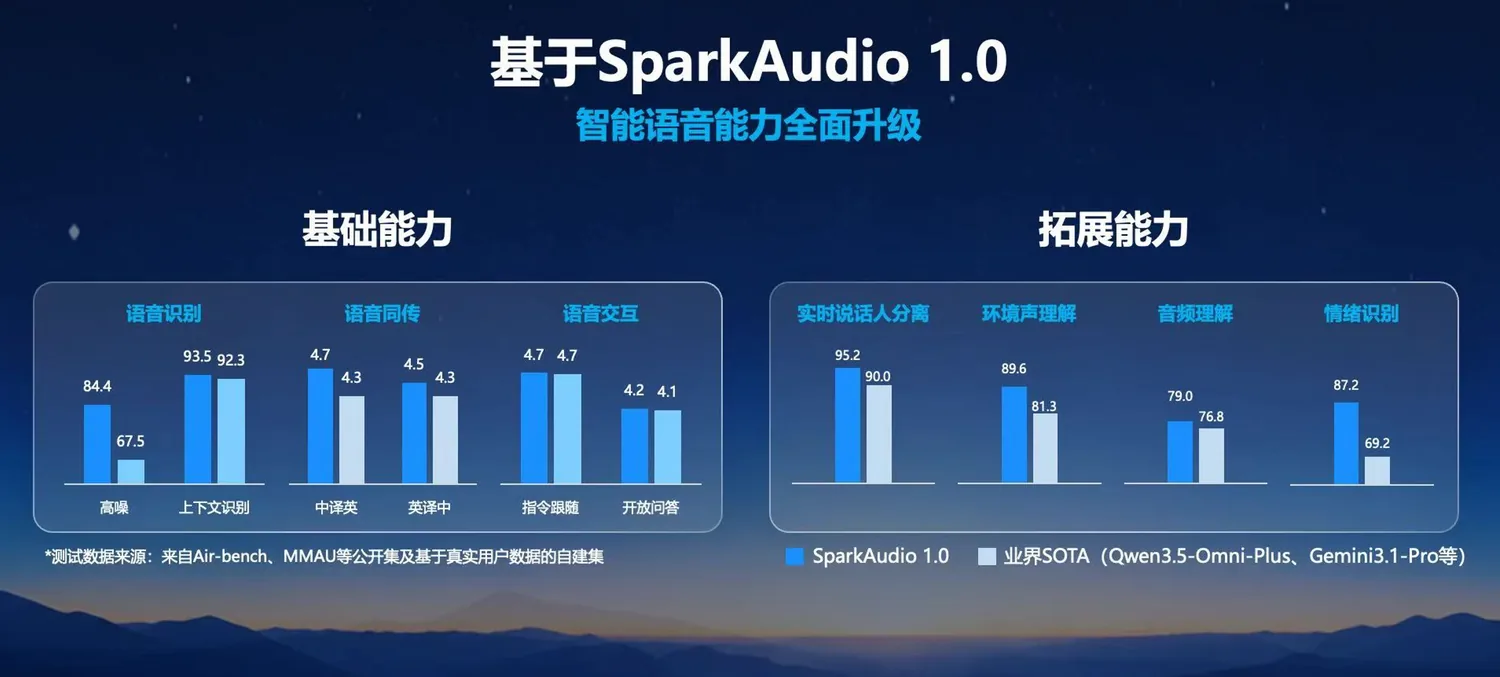
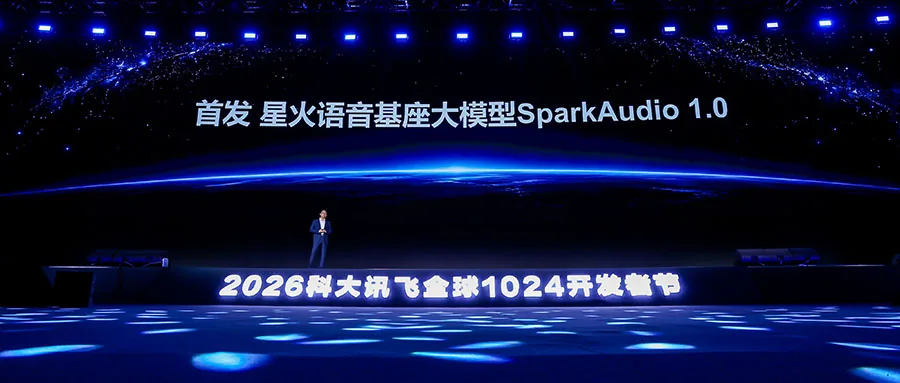
SparkAudio 1.0 is a speech foundation model released by iFLYTEK during its 2026 Global 1024 Developers’ Festival and trained on fully domestic computing power. It accepts text and speech as dual-modality input and outputs text, handling speech transcription, multilingual translation, multi-dialect recognition, environmental sound recognition, speaker separation, emotion analysis and complex audio question answering. According to iFLYTEK’s published benchmark results, SparkAudio 1.0 outperforms several state-of-the-art closed-source models and matches them on instruction following.
To strengthen representation, cut end-to-end latency and reduce inference compute, iFLYTEK adopted three core techniques: the semi-supervised audio decoder SemiEnc, dynamic segmented end-to-end modeling S-S2S, and dual-paradigm collaborative decoding CoDec.
Task-Specific Models and Product Rollout
On top of the foundation model, iFLYTEK built three task-specific speech models: Spark-ASR-2.0 for speech recognition, Spark-LiveTranslation for simultaneous interpretation and Spark-Audio-Realtime for voice interaction. Spark-ASR-2.0 has been integrated into iFLYTEK Input Method 16.0; Spark-LiveTranslation raised its measured MOS score from 4.4 to 4.6 and will gradually arrive on iFLYTEK Hear and iFLYTEK AI Glasses.
iFLYTEK says SparkAudio 1.0 has been deployed across its product line, covering software such as iFLYTEK Input Method and iFLYTEK Hear, and hardware including iFLYTEK Translator, iFLYTEK AI Recording Ring, iFLYTEK AI Glasses and iFLYTEK smart office notebook.