
Key Highlights
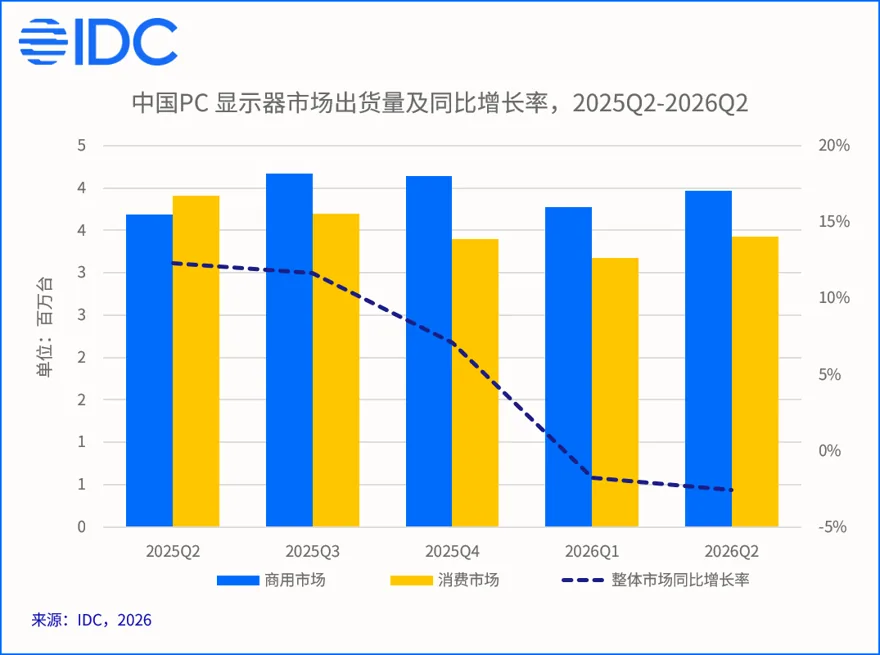
IDC released its H1 2026 China PC Monitor Market Quarterly Tracker on September 18, 2026, revealing critical market metrics:
- Release Date: September 18, 2026
- Reporting Period: January–June 2026
- Total Shipments: 14.3 million units (−2.2% YoY)
- Commercial Segment: 7.7 million units (+5.7% YoY)
- Consumer Segment: 6.6 million units (−10.1% YoY)
Critical Turning Point: Despite overall decline of only 2.2%, the growth rate gap between commercial (+5.7%) and consumer (−10.1%) segments exceeds 15 percentage points, signaling the industry’s shift from synchronized booms/busts to structural differentiation.
Diverging Paths: Commercial Resilience vs. Consumer Weakness
Commercial growth was driven primarily by government and large enterprise desktop procurement. However, SME purchasing sentiment remains weak, leading to a 5.4% YoY decline in SME monitor shipments, highlighting internal segmentation within the commercial cohort.
In contrast, the consumer market continues to struggle. While gaming monitors remain a battleground, H1 2026 shipments grew only 1.0% amid overall macro weakness. This divergent trajectory—commercial growth against consumer double-digit decline—reflects fundamentally different drivers: enterprise spending tied to IT budgets and equipment refresh cycles, versus consumer discretionary spending tied to personal finance sentiment.
Furthermore, demand tends to front-load in desktop procurement, meaning the current tailwind for monitors will narrow. Combined with August 2026 price announcements from multiple manufacturers, commercial monitor shipment momentum may face disruption in H2 2026.
Cost Pressures and Profit Margins
Rising display driver chip and power supply chip costs continue to elevate BOM. However, intense end-market competition limits OEMs’ upstream bargaining power, making it difficult to pass price increases downstream and compressing profit margins for整机厂商.
In response, OEMs have simultaneously accelerated mid-to-high-end product launches while reducing low-end offerings—balancing profitability with market presence. OLED, Mini LED, and dual-mode monitors entered a concentrated new-product period in H1 2026, driving 1.0% YoY growth in gaming monitor shipments and raising their market share to 38.6%.
The Premium Market Window
With high-end panel capacity scaling up, the RMB 2,000+ price segment is entering a growth inflection point. IDC data shows OLED products now account for over 50% of shipments above RMB 2,000. OLED, Mini LED, and multi-mode monitors are emerging as key battlegrounds for premium positioning.
IDC forecasts China’s OLED monitor shipments will double in 2026, confirming the technological transition is now reflected in volume data rather than just speculation.
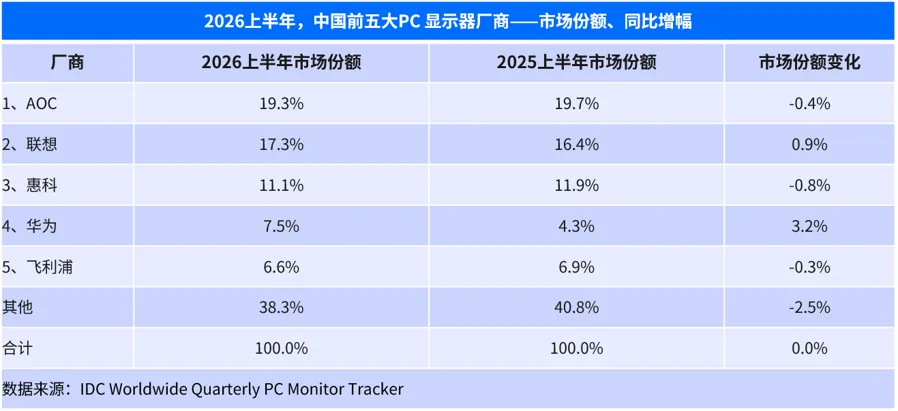
Vendor Market Share (H1 2026)
| Brand | Market Share | YoY Change |
|---|---|---|
| AOC | 19.3% | −0.4% |
| Lenovo | 17.3% | +0.9% |
| Huake | 11.1% | −0.8% |
| Huawei | 7.5% | +3.2% |
| Philips | 6.6% | −0.3% |
Note: Data reflects only vendors mentioned in the source material; “+” indicates year-over-year increase, “−” indicates year-over-year decrease.
Who Should Act Now?
- Buyers ready to proceed: Enterprise IT procurement managers and SME purchasing teams should leverage current commercial market momentum (+5.7% growth) to complete integrated monitor upgrades before the desktop procurement cycle draws to a close.
- Buyers advised to wait: Budget-conscious home users without specific performance needs should observe post-H2 2026 pricing stabilization post-upstream cost pass-through, as reduced low-end product supply may narrow value-for-money options.
In Conclusion
Market differentiation reflects deeper demand stratification: enterprise buyers prioritize stability and TCO, while consumers weigh experience and emotional resonance. As the “all-or-nothing” growth phase ends, precise market positioning—not broad appeal—will define competitive advantage.