On October 15, Hygon Information released its earnings forecast for the first three quarters of 2026 (January–September 2026). The hard numbers are as follows:
- Total operating revenue: RMB 14.28 billion–15.58 billion, expected to increase 50.47%–64.17% year over year
- Net profit attributable to shareholders of the parent company: RMB 2.71 billion–2.98 billion, expected to increase 38.16%–51.93% year over year
- Net profit after deducting non-recurring items: RMB 2.45 billion–2.71 billion, expected to increase 34.86%–49.17% year over year
- The above are cumulative forecast ranges, not final audited figures
Hygon Information focuses on high-end processors used in servers, workstations, and other computing and storage equipment, with products including Hygon general-purpose processors (CPUs), among others. Net profit after deducting non-recurring items refers to profit excluding one-off gains and losses and is used to gauge the profitability of the core business.
Another flash report released the same day: Sugon’s non-recurring-adjusted profit growth reaches 105%
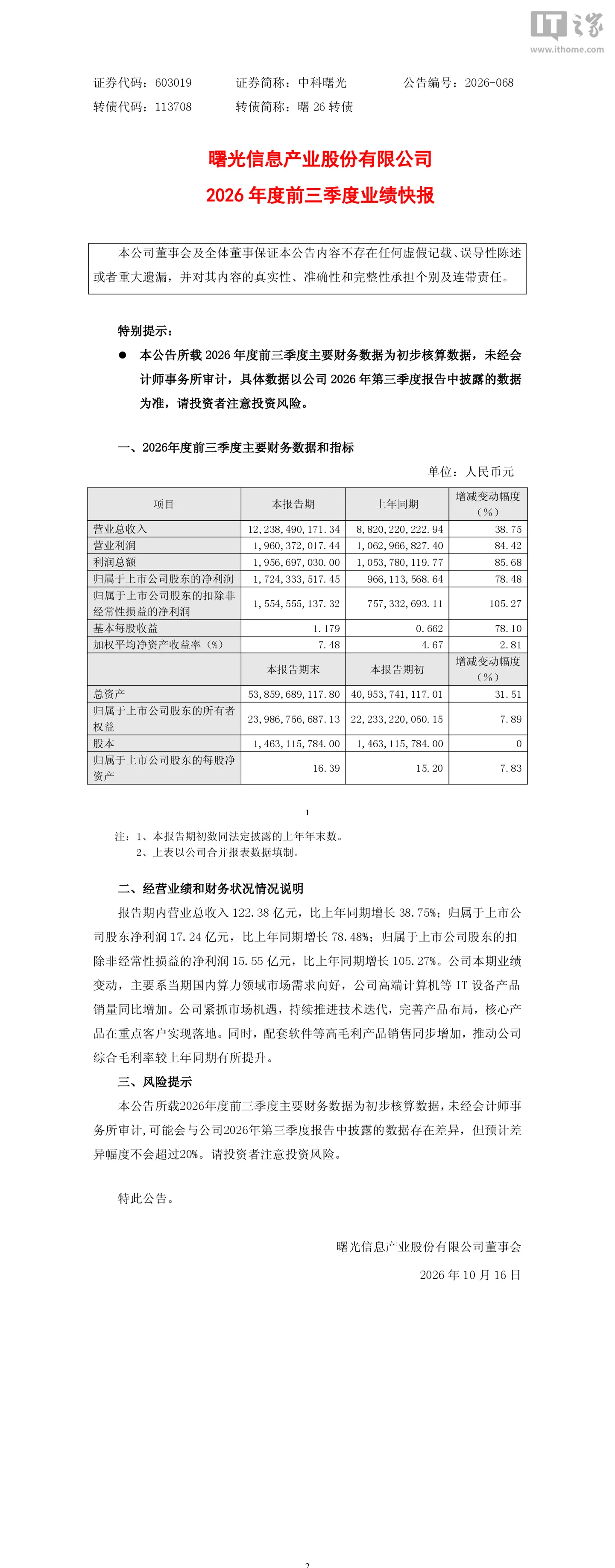
The headline and summary of this flash report point to Hygon Information, but the body presents Sugon’s preliminary earnings figures—this mismatch is the most easily overlooked detail in this disclosure. Sugon’s first three quarters:
- Total operating revenue: RMB 12.238 billion, up 38.75% year over year
- Net profit attributable to shareholders of the parent company: RMB 1.724 billion, up 78.48% year over year
- Net profit after deducting non-recurring items: RMB 1.555 billion, up 105.27% year over year
- Basic earnings per share: RMB 1.179 (stated as 1.18 in the body text), up 78.1% year over year
- Weighted average return on equity: 7.48%, up 2.81 percentage points year over year
The most striking contrast is the adjusted profit growth rate: Sugon’s net profit after deducting non-recurring items rose 105.27% year over year, far outpacing its 78.48% growth in net profit attributable to the parent, indicating that growth came mainly from the core business. By contrast, Hygon Information’s upper bound for attributable net profit growth is 51.93%, below its upper bound for revenue growth of 64.17%, meaning revenue is growing faster than profit.
Both companies attributed the growth to demand: domestic demand in the computing power sector is improving, and sales of high-end computers and other IT equipment increased year over year; the companies advanced technology iteration and improved product portfolios, with core products gaining traction among key customers; sales of supporting software and other high-margin products increased, driving a year-over-year rise in overall gross margin. Sugon also noted that the preliminary report figures have not been audited by an accounting firm and may differ from the third-quarter report, with the expected difference no more than 20%.
Comparison of the two companies’ first-three-quarter data
| Metric | Hygon Information (forecast) | Sugon (preliminary report) |
|---|---|---|
| Total operating revenue | RMB 14.28 billion–15.58 billion | RMB 12.238 billion |
| Revenue YoY | +50.47%–+64.17% | +38.75% |
| Net profit attributable to parent | RMB 2.71 billion–2.98 billion | RMB 1.724 billion |
| Attributable net profit YoY | +38.16%–+51.93% | +78.48% |
| Net profit after deducting non-recurring items | RMB 2.45 billion–2.71 billion | RMB 1.555 billion |
| Non-recurring-adjusted profit YoY | +34.86%–+49.17% | +105.27% |
| EPS / ROE | Not disclosed | RMB 1.179 / 7.48% |
Who should read this, and who should wait a bit longer
- Readers tracking the domestic computing power and Xinchuang (domestic IT innovation) supply chains will find these two sets of data a direct reference on the demand side: procurement of servers and high-end computers is still expanding.
- Those considering investment decisions may want to wait for the official third-quarter reports: Hygon Information has only issued a forecast range, with a RMB 1.3 billion gap between the upper and lower revenue bounds; Sugon has also noted that its figures are unaudited and could differ by as much as 20%.
Final thoughts
Forecasts and preliminary reports are only a prelude; the final answer will come in the official third-quarter reports. The strength of domestic computing power demand is already laid out quite plainly by these two sets of numbers. The next question is whether the growth can continue into the fourth quarter and next year.