
Core Event: Huawei Unveils Full Agentic Computing Strategy
Huawei officially launched its Agentic-era computing and ecosystem strategy at HUAWEI CONNECT 2026 on September 19, 2026. Key factual highlights:
- Launch date: September 19, 2026
- Core platforms: Kunpeng/Ascend compute stack, Huawei Cloud, HarmonyOS 7
- Key tools: CANNbot, Model Agent, MindStudio Agent, Solution Agent
- Compute openness: Ascend community provides 10,000-card cluster; registered users can apply for 100 card-hours per task
- Ecological investment: 5 billion RMB committed over the next three years
- Weight openness: Ascend became PyTorch community’s first officially supported Chinese compute platform on July 28, 2026
Ascend Ecosystem: Crossing the Tipping Point with Five Computing Paradigm Shifts
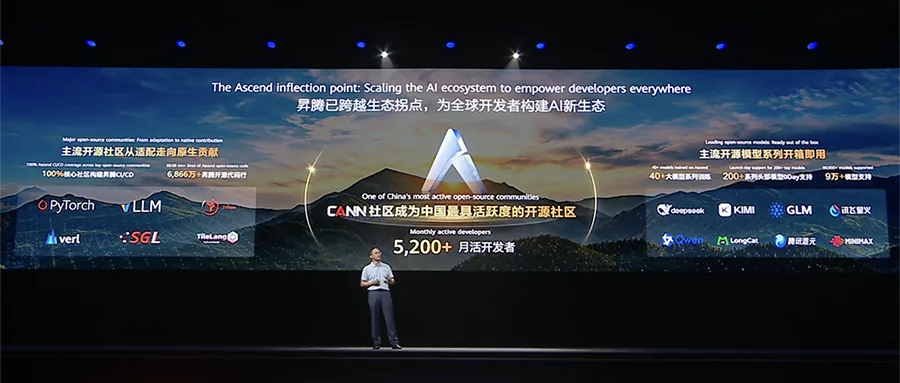
Huawei’s Chief Strategy Officer for Computing, Zhu Zhaosheng, announced Ascend has crossed the ecosystem tipping point. The CANN community became China’s most active open-source community in June 2026, with over 5,200 monthly active developers, and non-Huawei developers now outnumber Huawei developers. The community sees over 30,000 new code lines merged daily.
Ascend now supports 40+ pre-trained models—China’s sole AI compute platform supporting pre-training—and became PyTorch’s first officially supported Chinese platform in July 2026—a development exceeding most industry expectations.
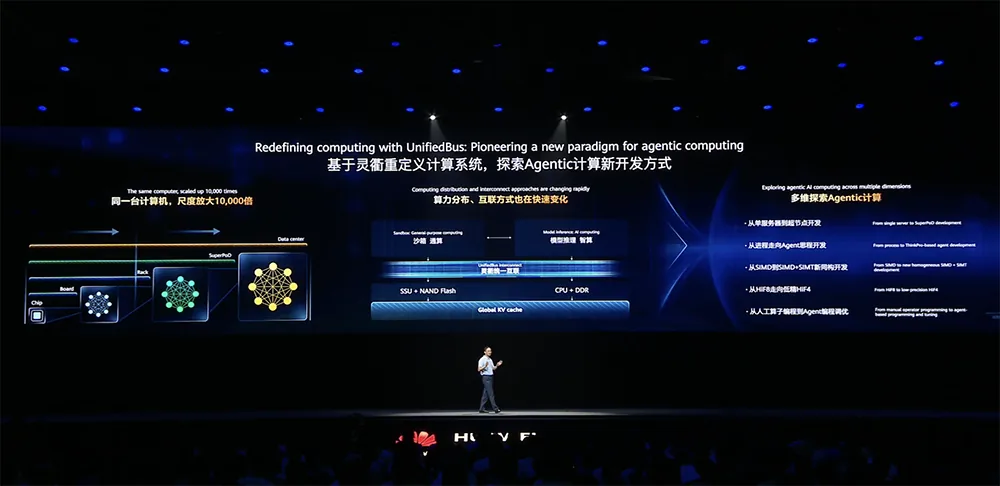
Five paradigm shifts for Agentic computing:
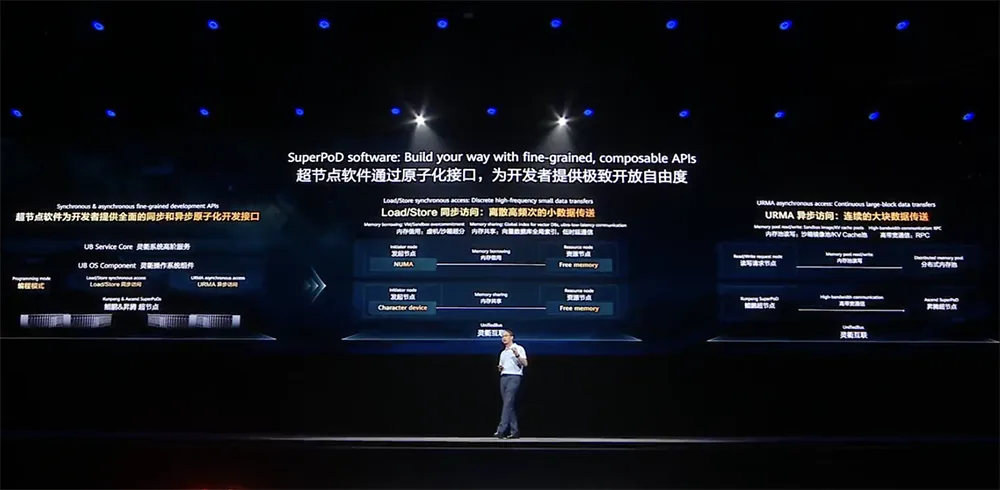
- From single-server to supranode development: Supranode delivers extreme openness via atomic interfaces, supporting Load/Store synchronous and URMA asynchronous communication for distributed shared memory pools
- From “process” to “think process”: ThinkProcess is a new abstraction for Agent开放式探索, providing state/resource abstraction across User space and Kernel space; opensourced end-2026
- From SIMD to SIMD+SIMT heterogeneous co-development: Ascend C adds Regbase programming, enabling hybrid batch-continuous (SIMD) and non-continuous (SIMT) memory access
- From HiFloat8 to lower-precision HiFloat4: HiFloat8 completed industry standard release and national standard立案 in August 2026; 100+ tech firms, universities, and research units joined its community
- From manual operator programming to Agent-based tuning: CANNbot generates Vector operators in 3 hours (previously days to weeks)
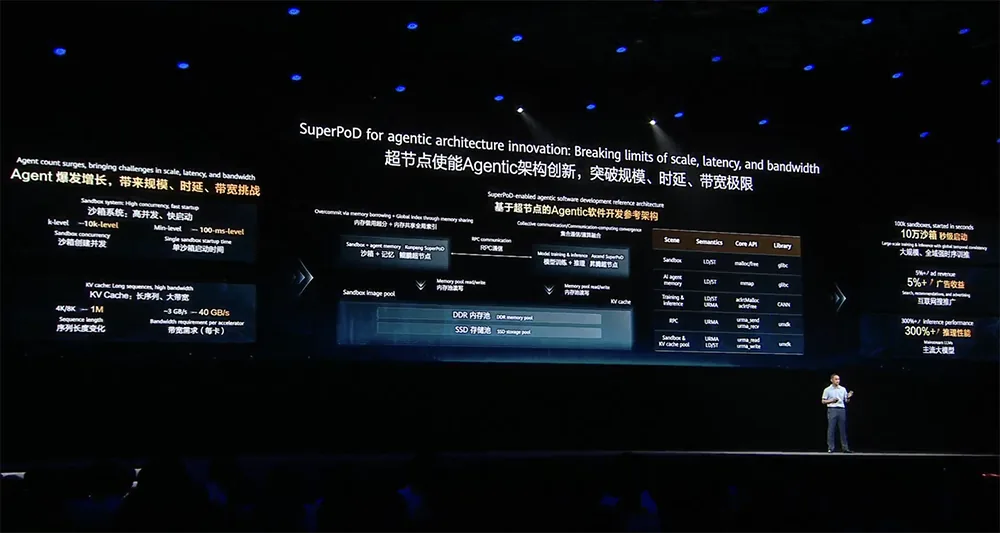
Counterintuitive data point: For today’s 500 trillion daily tokens, 100 trillion tokens require 578,700 cards at full load; with 1.3x load fluctuation coefficient, ~752,300 cards are needed. Full Agentic Infra requires ~375,000 AI cards and 350,000 general-purpose servers—a stark reminder of the infrastructure gap.
Kunpeng Memory Optimization: 30% Higher Sandbox Overcommit Without Code Changes
Kunpeng processors achieve precise cold-hot data identification (99%+ accuracy, 10 pts higher than alternatives, 10% lower compute overhead) and ultra-fast compression/paging (5% compute overhead vs. 20%+ industry average). Results:
- 30% higher memory overcommit in sandbox scenarios
- 15% faster database retrieval
- 75% memory reduction for big data workloads
A joint Chinese joint-stock bank implementation cut per-server memory from 512GB to 384GB.
Huawei Cloud & HarmonyOS OS: Agent Toolchain and System-Level Synergy
Huawei Cloud proposed an “Innovative productivity × Open ecosystem” framework featuring AgentArts (reduces infrastructure duplication), code-wise coding agent (matching HarmonyOS syntax), DocZip (modular document capabilities), and AI Shell (one-click cloud deployment).
HarmonyOS 7 delivers three system upgrades: Agent-friendly system architecture (end-cloud协同 large model for flexible compute scheduling), HarmonyOS Agent Framework 2.0 (opening system capabilities via Skills), and system agent XiaoYi (deeper OS integration as intelligent hub). StarLink interconnection achieves 250MB/s aggregate multi-path rate with hundreds-of-millisecond connection time.
Developer Support and Adoption Recommendations
Huawei Ascend community provides 10,000-card cluster via two mechanisms:
| Resource Access Method | Description |
|---|---|
| Free token application | 100 card-hours per task for registered users |
| Points-to-card program | Earn points via issue/PR submission, redeem for compute |
Development recommendations:
- Ready to try now: Teams already using PyTorch can leverage Ascend’s 100-card-hour free tier for quick validation; HarmonyOS developers should adopt MindStudio Agent for rapid precision tuning
- Wait longer: Large-scale Agentic Infra builders should monitor supranode general-purpose compute and LingQu interconnection protocol maturity; HiFloat4 remains pre-staging for training workloads
Final Note
From single-server to supranode, from process to think process, from manual operators to Agent tuning—Huawei is systematically redefining AI-era technical paradigms. With external contributors surpassing internal developers and PyTorch embracing Chinese compute, Ascend has evolved from tech follower to rule-setter: the next decade of AI computing will be built on open source and open standards.