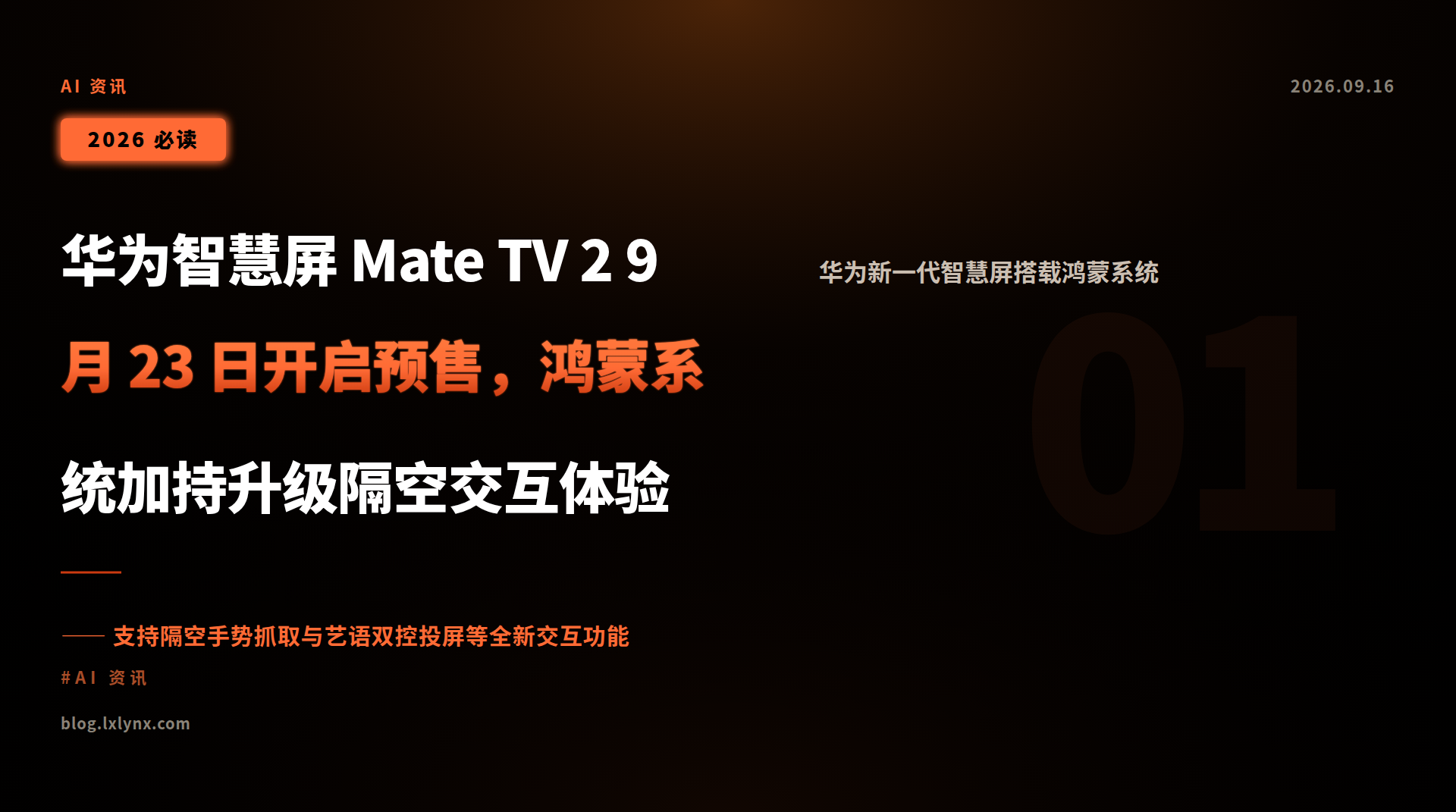
Huawei Mate TV 2 Confirmed for Pre-sale on September 23
Huawei Mall has confirmed that the Huawei Mate TV 2 will open pre-sale on September 23 at 10:08. This marks the next-generation upgrade of the Mate TV series, carrying forward core interactive features while enhancing system, display quality, and smart experiences. Key facts:
- Launch timing: Pre-sale opens September 23 at 10:08
- New version: Mate TV 2 series, available in 98-inch and 110-inch variants
- Operating system: Runs on HarmonyOS (previous Mate TV used HarmonyOS 6.1)
- Core interactivity: Continues support for Lingxi floating touch, Lingxi pointing remote, and Lingxi stylus accessories
- Twin-chip architecture: High-end models feature dual-chip design for multitasking performance
System and Interaction Upgrades
The most notable improvement lies in the system upgrade—from HarmonyOS 6.1 to HarmonyOS (exact version not disclosed), granting users enhanced distributed computing capabilities and algorithmic optimizations from the latest HarmonyOS ecosystem. Official pre-launch teasers confirm the following self-developed interaction technologies:
- Lingxi floating touch: Air-based interface navigation without physical contact
- Lingxi pointing remote: IR remote with accelerometer and gyroscope for on-screen cursor control
- Lingxi stylus support: Touch stylus compatibility for direct screen annotation
New features introduced:
- Air gesture capture: Users grasp or drag on-screen regions in mid-air for capturing screenshots or moving content, simplifying cross-device workflows
- Art-language screen casting: Voice commands like “cast phone screen to TV” trigger one-tap wireless projection without manual device selection
Combined with the 98/110-inch versions’ support for native 3D and 2D-to-3D conversion, the “Stereoscopic Vision” system delivers end-to-end 3D optimization.
Hardware Configuration and High-End Variants
While full technical specs remain undisclosed, hardware timelines align with industry reports:
| Size | Backlight | 3D Support | Chip Architecture |
|---|---|---|---|
| 98-inch | Super Mini LED | Native 3D + 2D-to-3D | Dual-chip |
| 110-inch | Super Mini LED | Native 3D + 2D-to-3D | Dual-chip |
Note: Super Mini LED uses microscopic LED particles for superior contrast and black-level control, rivaling OLED without burn-in risk; dual-chip typically means primary SoC for system operations plus dedicated GPU/NPU for tone mapping and frame interpolation.
Notable counterpoint: Unlike previous Mate TV models that did not specify Mini LED usage, Mate TV 2 explicitly combines Super Mini LED with dual-chip on 98/110-inch variants, narrowing the hardware gap with flagship-tier competitors.
HarmonyOS multi-path downloading further accelerates large app installation by splitting bandwidth across secondary devices, improving user-side efficiency.
Who Should Buy and Who Should Wait
Buy now if: You use Huawei smartphones, tablets, or notebooks and prioritize seamless cross-device gestures, voice-driven casting, or high-end 3D movie viewing. The 98/110-inch models suit design professionals or home theater enthusiasts expecting OLED-like picture without risks of burn-in.
Consider waiting if: Budget sensitivity is your top concern—pricing has not been disclosed. Additionally, since the exact HarmonyOS version and HarmonyOS NEXT compatibility status remain unconfirmed, mainstream app compatibility may evolve post-launch; early adopters should weigh ecosystem maturity against feature novelty.
Final Thoughts
Mate TV 2 signals Huawei’s push to tier its smart display lineup with dual-chip and Super Mini LED as high-end differentiators. As HarmonyOS expands, the industry-wide trend toward cursor-free interfaces intensifies—but real-world satisfaction will ultimately hinge on system stability and third-party app maturity rather than hardware specs alone.