
AI Coding Agentfor HarmonyOS Officially Launched
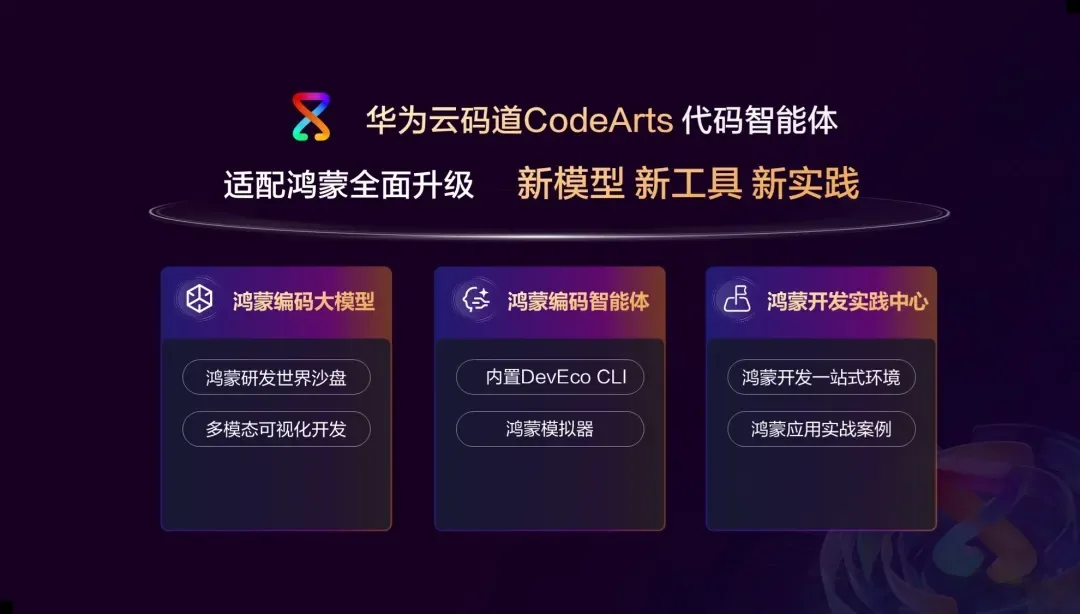
On September 21, 2026, Huawei Cloud announced a full upgrade of its CodeArts code intelligence agent, debuting three core capabilities for HarmonyOS developers: the HarmonyOS-specific coding large language model, the Huawei Cloud CodeArts HarmonyOS intelligent agent, and the HarmonyOS Developer Practice Center. This marks the world’s first—and currently the only—AI coding agent purpose-built for the HarmonyOS ecosystem. Available immediately to developers, no waitlist or permission-based access is required.
Key facts:
- Launch date: September 21, 2026
- Version type: HarmonyOS-native upgrade (not fine-tuning of a general model; trained via proprietary “HarmonyOS Enhanced Training System”)
- Target users: Native HarmonyOS application developers (using ArkTS)
- Availability: Live now via cloud service
- Open-weights: Not applicable—service is delivered via SaaS, not model weight release
Deep Optimization from Code Generation to Compilation
The HarmonyOS coding large language model derives its strength from HarmonyOS-native training data. Built on Huawei Cloud’s proprietary “HarmonyOS Enhanced Training System,” it ingests over one million original HarmonyOS assets—including open-source samples, Huawei APIs, development guidelines, and UI/UX layout templates—enabling deep alignment with ArkTS and Huawei’s declarative, distributed application development paradigm. (ArkTS is HarmonyOS’s TypeScript-based, statically typed language extended for UI declaration and runtime efficiency.)
Performance highlights:
- Training data coverage: 100,000+ high-fidelity HarmonyOS samples; 100% coverage of high-frequency component patterns
- Code generation accuracy: Over 80% reduction in error rate per 1,000 lines of generated code
- First-time compilation success:度提升 by over 78%
- Token efficiency: Over 20% reduction in tokens consumed per task
Notably, the 78% improvement in first-time compilation success presents a key industry reversal: most AI coding tools optimize for syntactic generation speed or style但 often produce code incompatible with target platform APIs, forcing developers into iterative debugging loops. Here,Huawei’s emphasis on embedded API semantics and规范 compliance enables the model to “write right the first time,” reducing downstream manual rework.
The HarmonyOS intelligent agent further closes the loop from writing to running: it embeds the DevEco CLI (HarmonyOS’s official command-line tool), enabling direct invocation of on-device emulators—allowing real-time preview and debugging, an industry-first. Developers can dynamically select target device form factors (smartphones, tablets, etc.) without additional effort. Built-in capabilities include the HarmonyOS knowledge base, third-party library migration assist, and mini-program-to-HarmonyOS service conversion, supported by continuously updated documentation and best practices.
Hands-on Environment: From Learning to Cloud Deployment
The HarmonyOS Developer Practice Center addresses a persistent friction point: the gap betweenlearning and application. Rather than copying tutorials into blank projects, developers now see integrated case-study + repository + clouded sandbox workflows in one interface, enabling in-browser development, compilation, packaging, and testing—no local environment setup required.
Practical learning pathways span beginner, intermediate, and enterprise-grade scenarios, curated by internal technical experts and ecosystem partners. For example, newcomers can clone a UI template and achieve a compilable prototype in minutes; enterprise teams can leverage reference architectures for complex, multi-device services.
Who Should Adopt Now—and Who Should Wait?
Adopt immediately if you:
- Use DevEco Studio for native HarmonyOS development
- Are migrating existing mini-programs to HarmonyOS (e.g., for Huawei’s AppGallery ecosystem)
- Prioritize rapid prototyping and want to minimize debugging overhead
Wait if you:
- Focus exclusively on Android/iOS cross-platform apps without current HarmonyOS plans
- Require offline-capable tools and cannot rely on cloud-based compute
Final Outlook
HarmonyOS-specific coding intelligence signals a pivotal shift: AI-assisted development is maturing from generic code synthesis to “platform-aware engineering." Huawei’s focus on compile-time compliance—rather than merely syntactic correctness—underscores a broader trend where production-readiness, not just creativity, becomes the KPI for enterprise AI tools.