
First Local AI Hub for Home Deployment
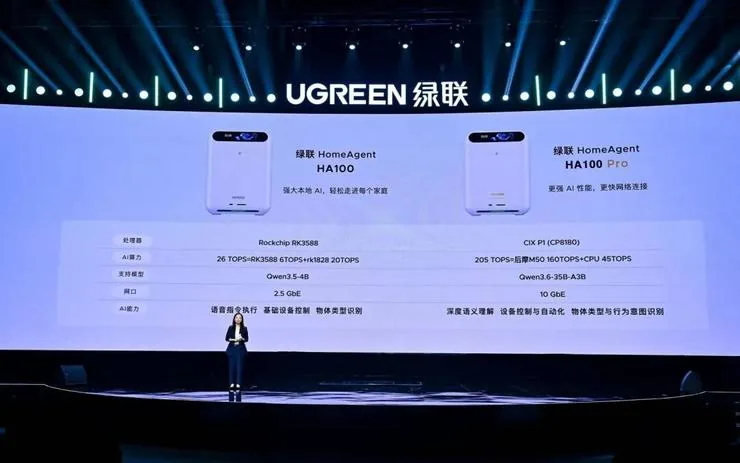
On September 12, UGREEN unveiled the UGREEN HomeAgent HA100 Pro at its global brand launch event, marking the first commercial deployment of Houmo Smart’s M50 AI chip in the consumer home segment. The device Targets the integration of fragmented smart home ecosystems through localized AI processing.
Key Facts:
- Release Date: September 12, 2026
- Product: UGREEN HomeAgent HA100 Pro
- Core Processor: Houmo Smart M50 AI chip
- Compute Performance: 160 TOPS per chip
- Typical Power Consumption: 10W
- Architecture: PIM (Processing-in-Memory)
- Availability & Pricing: Not disclosed in source materials
A counterintuitive highlight: M50 delivers enterprise-grade 160 TOPS compute while consuming only 10W typical power—less than most smart speakers. This reverses the industry norm that high AI performance requires substantial power, enabling always-on operation without active cooling—a prerequisite for home deployment.
From Device Intelligence to Home Intelligence: Rebuilding Data Flow
Historically, AI in homes operated in isolation: security cameras tracked movement, smart speakers handled voice commands, and NAS units stored files. These systems rarely coordinated, often transmitting sensitive data to cloud servers.
The HomeAgent HA100 Pro unifies these capabilities into a single local AI hub. It processes camera feeds in real-time for event detection, indexes and retrieves personal photos/videos using on-device models, summarizes daily activities, and triggers automated responses based on learned patterns—like automatically preserving holiday footage.
This requires more than storage: raw data must be understood locally with sufficient efficiency. Houmo’s M50 chip, optimized for large language model inference at the edge, provides the computational foundation—delivering 160 TOPS at 10W makes continuous on-device AI processing feasible for home use.
Core Technical Profile: Why M50 Changes the Game
M50 is not a general-purpose AI chip but specifically designed for large model inference on edge devices:
- Processing-in-Memory Architecture: Eliminates data shuttle between CPU and memory, reducing latency and power for AI inference
- 160 TOPS Compute: Handles multiple high-resolution camera feeds simultaneously with complex vision models
- 10W Typical Power: Runs 24/7 without significant electricity overhead or thermal throttling
This combination shifts HomeAgent from being an AI- “enabled” device to a true AI-native partner in daily life—processing, understanding, and responding without leaving the home network.
Product Comparison: Local Intelligence vs. Traditional Smart Devices
| Dimension | Traditional Smart Devices | UGREEN HomeAgent HA100 Pro |
|---|---|---|
| Data Processing | Cloud-dependent | Fully local processing |
| Multi-Device Coordination | Fragmented, gateway-limited | Unified coordination via single hub |
| Privacy Protection | External data transfer risk | Data never leaves home network |
| AI Response Time | Network-dependent, often seconds | Milliseconds via local inference |
| Power draw | 3-15W per device | Unified 10W for all functions |
| Model Deployment | One model per device | Multiple concurrent models |
Should You Buy? Target Audience Guidance
Ready for early adoption:
- Users with heterogeneous smart home setups (cameras, NAS, speakers) facing integration complexity
- Privacy-conscious households that prohibit video data from leaving their network
- Photo/video enthusiasts seeking automatic highlights clustering and personal memory organization
Consider waiting:
- Users requiring remote cloud access or third-party service integration—HA100 Pro’s external connectivity and sync capabilities remain unspecified
- Budget-sensitive buyers—pricing is undisclosed and dedicated AI hardware typically command premium pricing
Final Thoughts
The verdadeir potential of home AI lies not in scaling model size alone, but in balancing computational efficiency with practical deployment. When AI power consumption approaches that of everyday appliances, it transitions from a novelty feature to ambient infrastructure—truly becoming part of the home’s natural rhythms.