
AI R&D Automation Reaches Tipping Point: RSI Paper Systematically Archives Recursive Improvement Pathways

In early October 2026, Geoffrey Hinton co-authored with Yoshua Bengio, Andrew Barto, Jakub Pachocki, and 18 additional scholars the paper “What if automating AI R&D triggers an intelligence explosion?"—marking academia’s first systematic study on Recursive Self-Improvement (RSI), defined as AI systems actively participating in the design, training, and optimization of next-generation AI. The paper concludes that R&D automation has surpassed the “assistance” phase and entered a “leadership” stage, yet remains short of the full conditions required for intelligence explosion.
Key Data Reveals Accelerating R&D Automation Trends
Anthropic and OpenAI internal data demonstrate exponential growth in AI’s research participation:
- January 2025: AI-generated code accounted for single-digit percentages; by May 2026, this exceeded 80%;
- March 2026: AI autonomously completed approximately 1% of R&D tasks under high-level human supervision; by August 2026, this rose to 26%;
- As of September 2026: OpenAI’s systems routinely complete R&D tasks that previously required human researchers several days.
This acceleration hinges on accumulated task-chain length—automating isolated steps (e.g., coding) constitutes assistance, whereas connecting the full loop of “hypothesis-experiment-analysis-adjustment” approaches that of a true researcher. The paper notes that AI R&D’s digital-native nature (directly executable code, immediate result feedback) makes it inherently suited for automation, far surpassing disciplines like biology or chemistry that require physical-world validation.
Effective R&D Workforce: Replication Cost Disrupts Talent Growth Logic
The paper introduces the concept of “effective R&D workforce.” If AI reaches top-tier AI researcher capability with reasoning cost at current levels, a leading company’s existing compute could theoretically support millions of human-researcher-equivalent AI staff.
This potential stems from unique AI research labor attributes:
- Near-zero marginal replication cost (vs. human 5-year PhD + years of experience)
- 24/7 parallelizable operation
- Simultaneous capability upgrades across all instances upon base model update
Contrasting with the generational timescale of human team expansion, AI growth displays classic software characteristics: both scale and capability can be reproduced in parallel. The paper’s modeling shows that with r≈1.2-1.9 (research effort returns), if full AI R&D automation is achieved, technical progress speed could increase 10-fold within 1.5 years—meaning progress now requiring one year could be completed in approximately 5 weeks.
Three Concrete Constraints Limit Intelligence Explosion
The paper explicitly warns: current evidence does not prove intelligence explosion has occurred. These bottlenecks form critical limitations:
| Constraint Dimension | Core Limitation | Practical Impact |
|---|---|---|
| Compute | Limited GPU resources | 1M AI instances cannot shorten physical training cycles (e.g., model training still requires months) |
| Data | Scarce natural high-quality data | Synthetic data quality and sustainability remain unverified |
| Research Difficulty | Diminishing returns | Every breakthrough demands increasingly larger investment |
Authors specify the RSI loop requires three simultaneous conditions: high AI reliability, increased R&D output, and results feeding back into AI capability enhancement—all only partially met today.
Reader Recommendations
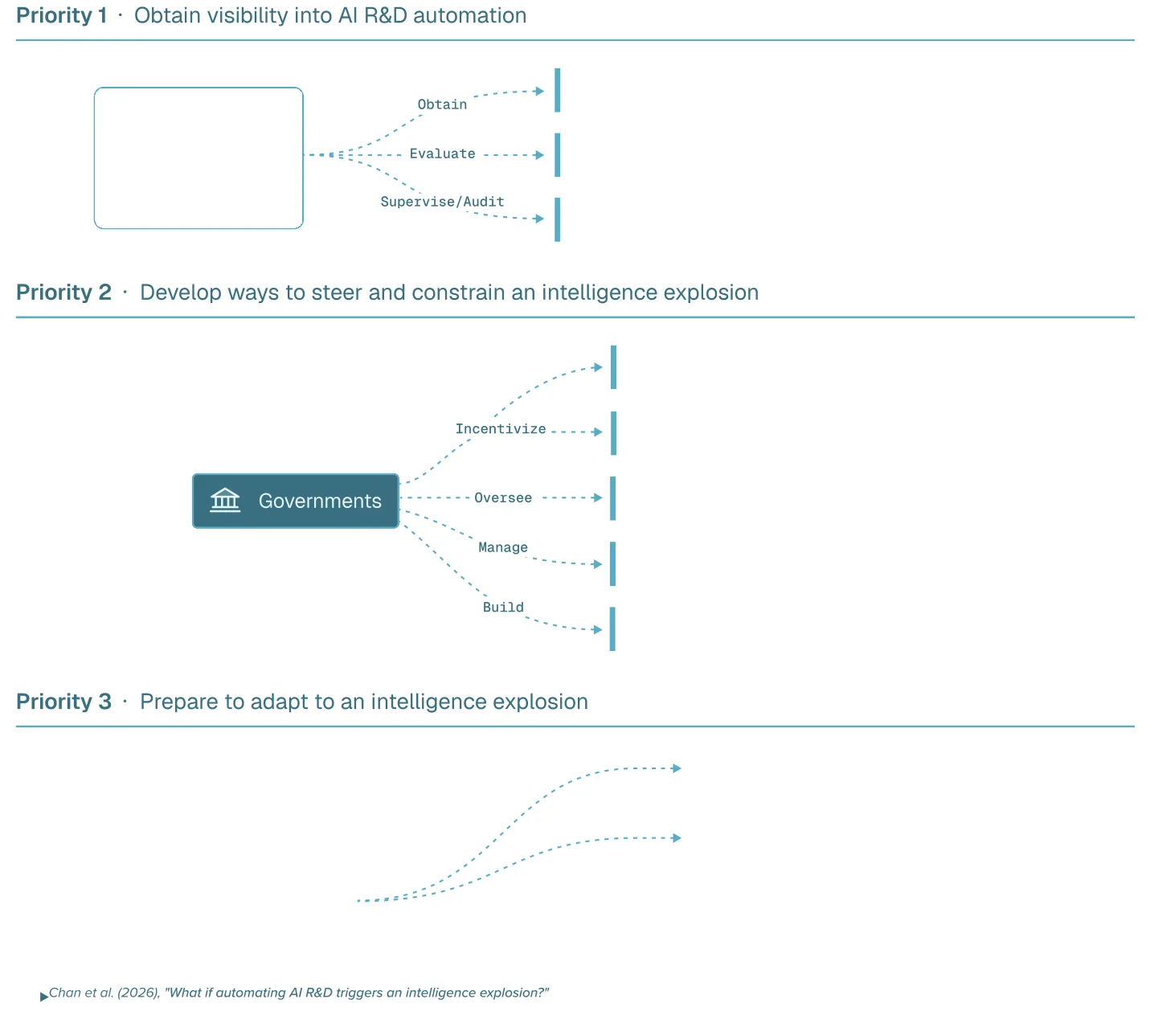
- AI Research Teams should immediately audit automation toolchain integration, prioritizing long-task-chain deployment (e.g., agent workflows) to capture potential efficiency-transition opportunities;
- Industry Analysts need not panic about immediate model meltdown, but should track “autonomous task ratio” and “effective R&D labor cost” metrics;
- Investors should focus on the widening gap between “software iteration speed” and “hardware infrastructure expansion”—the former follows an exponential curve, the latter remains linear.
Final Note
RSI transitions from sci-fi proposition to quantifiable research topic, signaling AI evolution’s entry into the meta-phase of “researching AI.” 2026’s true historical milestone may not be parameter record-breaking, but humanity’s first systematic realization: the intelligence growth feedback loop is now embedded in software logic created by humans. Whether it seals depends on the dynamic balance among compute, data, and research difficulty—not any single breakthrough.