
Core Announcement & Timeline
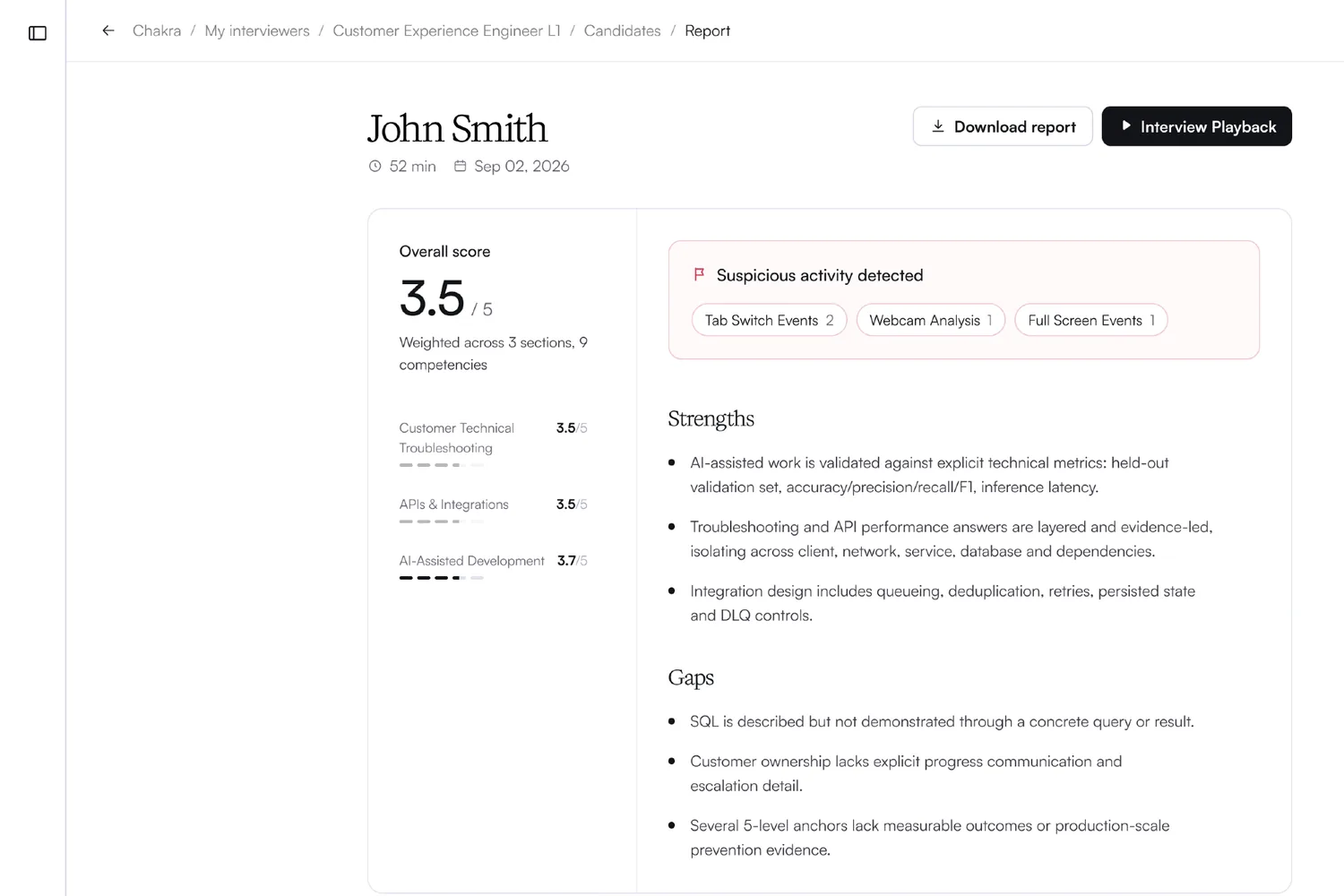
HackerRank has officially launched Chakra, its AI-powered interview system, to enterprise customers following approximately six months of beta testing. Key facts:
- General availability: Released on Monday, October 5, 2026
- Test scale: Over 500,000 interviews conducted during beta
- Early adopters: Snowflake, Snorkel, Capgemini, plus internal HackerRank testing
- Access model: Available exclusively to existing HackerRank business customers
- Role definition: Designed to score candidates—not make final hiring decisions, which remain with humans
Interview Mechanics & Novel Capabilities
Chakra redefines the interview experience by simulating actual job tasks rather than abstract coding puzzles. Candidates receive a real-world code repository task and work within an integrated AI assistant enabled canvas. Chakra observes the working process and dynamically asks follow-ups—such as why one approach was chosen, or how solutions adapt under new constraints.
Shift in evaluation focus: From output correctness to process insight. CEO Vivek Ravisankar states: “The previous modality evaluated the output. Now, because of AI, anybody can produce an artifact. The question becomes whether employers can understand the thinking behind it.”
The system measures three hard-to-capture signals:
- Critical thinking
- Judgment
- AI fluency—how well candidates frame problems for AI, assess outputs, and steer toward solutions
Chakra also compresses hiring timelines. What previously required three rounds—recruiter screen, take-home assessment, and engineer follow-up—now happens in a single interview.
Counterintuitive Finding: Lower Cheating Rates
Industry assumptions predicted AI access would increase cheating. Instead, HackerRank observed the opposite: suspicious-activity flags were 70–80% lower in Chakra interviews compared to traditional assessments, with variation by geography and seniority.
Ravisankar explains that open AI access removes the incentive to secretly deploy external tools during the session—a behavioral shift worth noting for hiring teams considering proctoring environmental changes.
Strategic Pivot from Legacy Product

Launched at TechCrunch Disrupt 2012, HackerRank built its business on coding challenges, serving over 3,000 business customers—including Amazon, NVIDIA, Clay, and Replit—and a 30+ million developer community.
Yet Ravisankar argues the traditional model no longer measures engineering ability effectively. He compares the internal transition to Apple’s move from iPod to iPhone: the old product retains value, but the new direction defines the future. “Chakra is going to be the headline,” he says, “it’s going to be the way that we’re going to move forward.”
Implementation Guidance
- Adopt early if: Your team conducts high-volume technical screening; evaluates candidates on AI-augmented workflows (e.g., full-stack, ML engineering); or lacks capacity for multi-round interviews
- Wait if: Your hiring pipeline is small or unstable; strict legal/compliance oversight is required before AI intervention; or you haven’t defined evaluation rubrics for judgment-based criteria
Parting Thoughts
Chakra’s purpose isn’t to replace human judgment but to shift human effort—freeing engineers from repetitive scoring to focus on cultural fit and role alignment. The core tension remains: consistent criteria don’t guarantee bias-free outcomes, and algorithmic fairness requires ongoing validation. Technology changes the format, but human wisdom still decides who to hire.
Regulatory compliance, including New York City’s bias audit mandate for automated employment tools, is built into the system, per Ravisankar.