
Key Event: AI 3D Company Meshy Achieves Explosive Growth

Key fact: In under two years, 3D generation company Meshy grew annual recurring revenue (ARR) from $1 million to $100 million, a pace close to—or even ahead of—the AI industry’s “supernova” company benchmark. ARR, or annual recurring revenue, is a core metric for gauging a SaaS company’s ability to sustain recurring payments.
Key timeline and data:
- Growth period: Under 2 years
- Starting point: $1 million ARR
- End point: $100 million ARR
- Comparisons:
- ElevenLabs (voice generation): Reached $100 million ARR in about 20 months
- HeyGen (video generation): Reached $100 million ARR in 29 months
- Meshy: Faster than HeyGen
Parallel Tracks: Division of Labor and Contrast Between General and Specialized Models
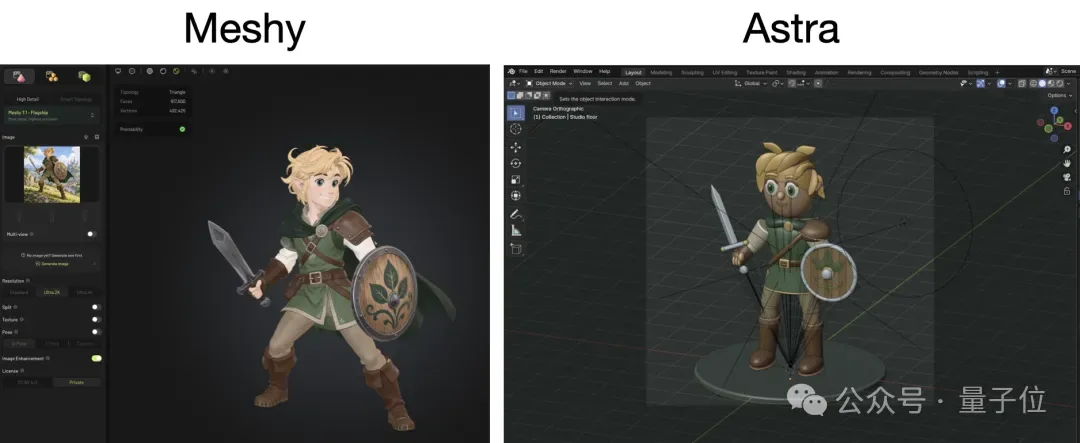
After GPT-6 Astra launched, general large models drew widespread attention for their ability to operate Blender, and can generate basic scene structures through code. But when tasks advance to characters, complex props, and other objects with high requirements for proportion, structure, and detail, the gap between specialized and general models quickly becomes apparent.
A comparative test revealed a striking contrast:
- When tested with the same reference image of a blonde swordsman, Meshy’s generated model had individually distinct hair strands, clearly layered cloak and belts, and accurately reproduced shield patterns
- Astra’s generated model, by contrast, was abstract in style—hair like a single “helmet,” a round-eyed cartoon face, and a body assembled from geometric shapes
Meshy 7/7.1’s technical moat is evident in three areas:
- Shape: Independent structures such as the mechanical owl’s multi-layered armor plates and chest gears are preserved; Surface Detail score reaches 59.8% (other models: 49%-55%; Meshy 6 Lite: 52.7%)
- Detail: Geometry generation resolution increased from 2048³ to 4096³; Detail Richness benchmark 4K render score is 23.1% (industry-leading)
- Color and pattern: Text on an old radio’s nameplate and knob markings can be accurately recognized; end-to-end texture alignment test overall score: 66.2%
Commercial Deployment: From Tool to Core Part of the Production Workflow
Paid use cases have already clearly landed, mainly from B2B and the hardware ecosystem:
| Scenario | Value proposition | Specific examples |
|---|---|---|
| Game development | Reduces manual sculpting workload and shortens modeling cycles | 37 Interactive Entertainment: sculpting workload for complex character parts at the base-model stage reduced by |