
Event Overview
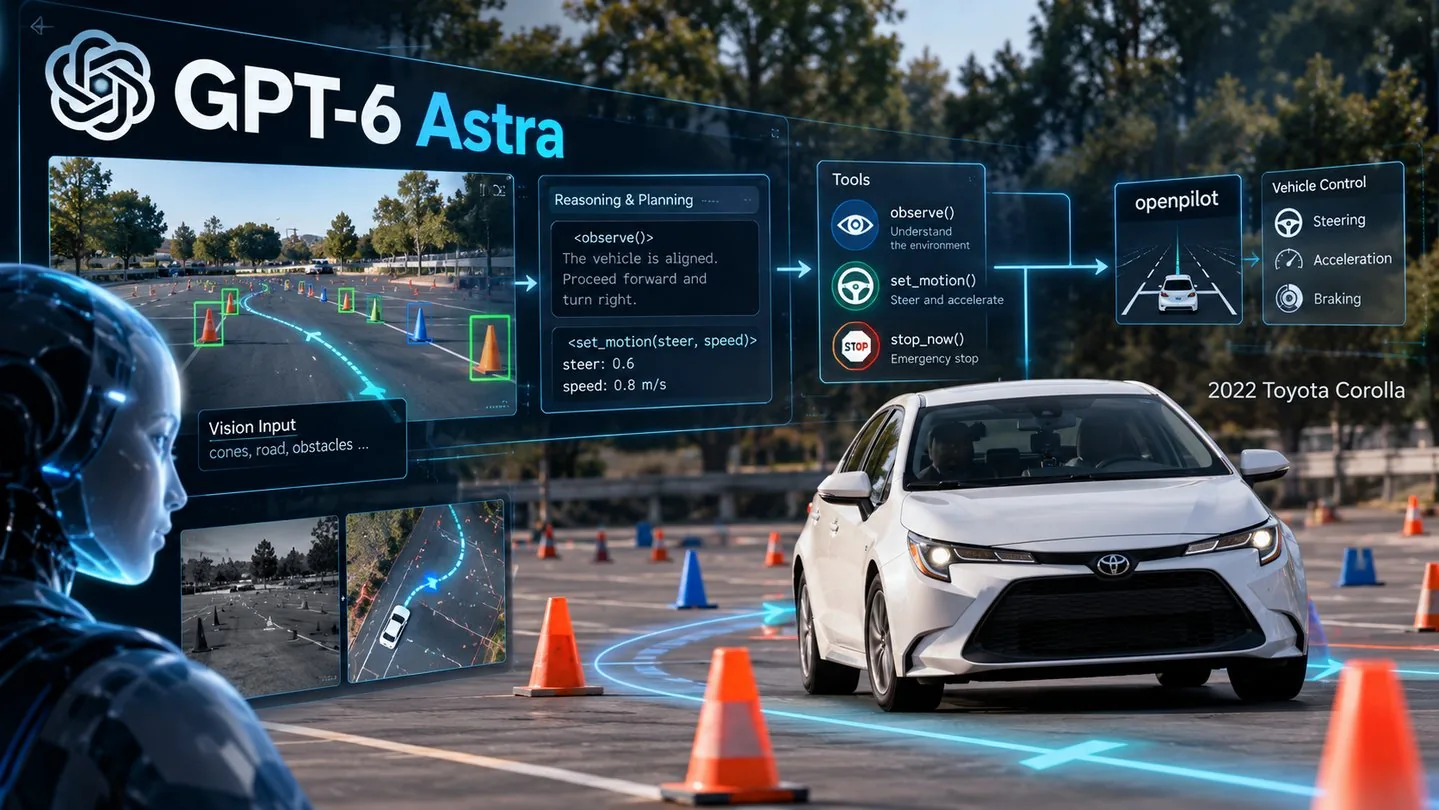
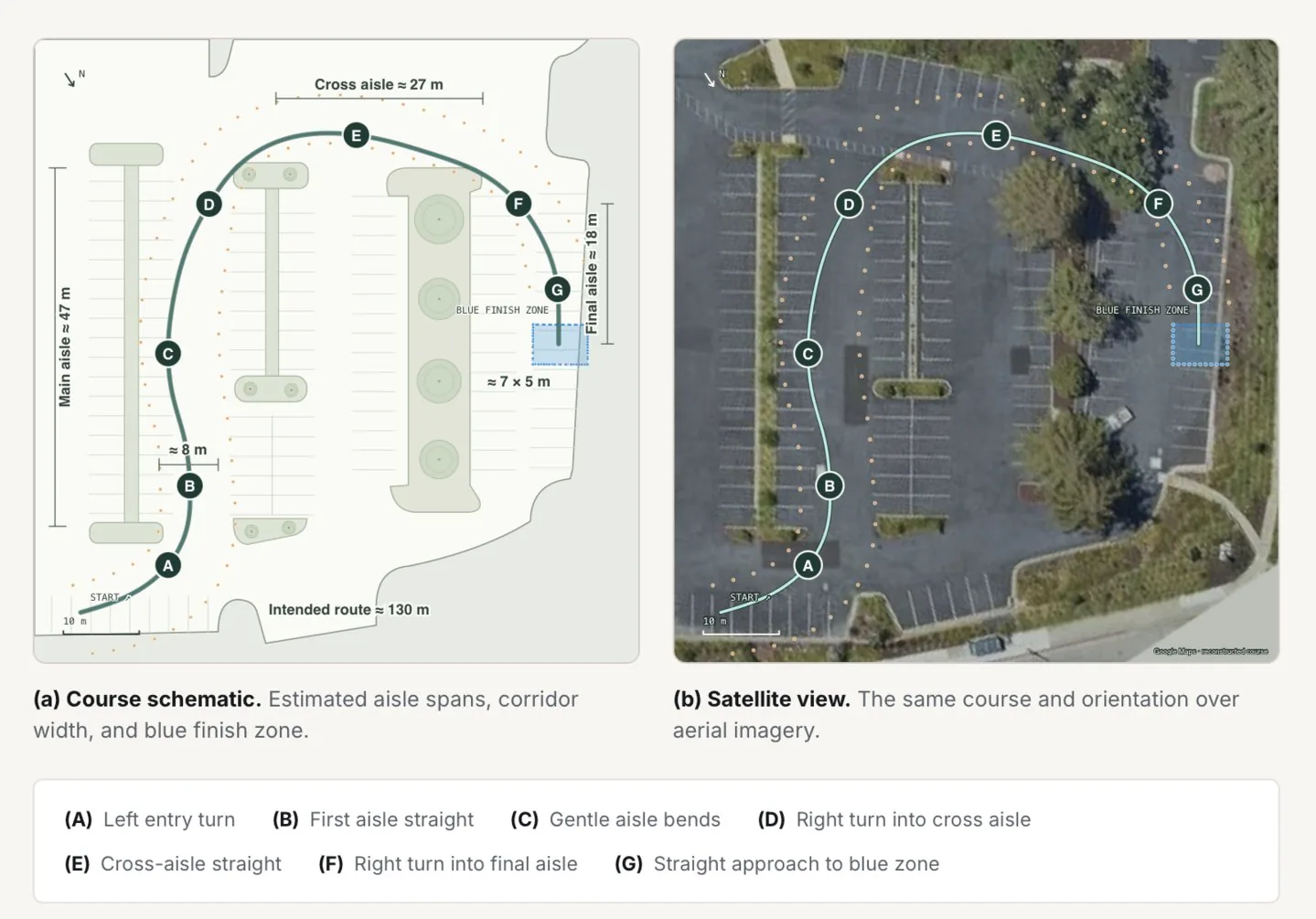
A generalist AI model has successfully controlled a real vehicle to complete a confined-area driving test for the first time. According to Titanium Media, the independent research project DrivingBench revealed that GPT-6 Astra was the only model among four to finish the entire track, covering 134.7 meters in 5 minutes and 22 seconds at an average speed of approximately 0.42 meters/second (about 1.5 km/h).
Key factual details:
- Model type: General-purpose AI, not trained specifically for autonomous driving
- Test vehicle: 2022 Toyota Corolla
- Test location: Enclosed parking lot (not public roads)
- Control system: Based on open-source openpilot system + comma four hardware
- Safety protocol: Safety driver seated with foot near brake; max speed capped at 3.5 m/s
- Test format: Single continuous-context session (not a standardized driver’s license exam)
- Single-run cost: ~$7.74 (6.6 million tokens consumed)
Technical Architecture: Brain-Execute Separation
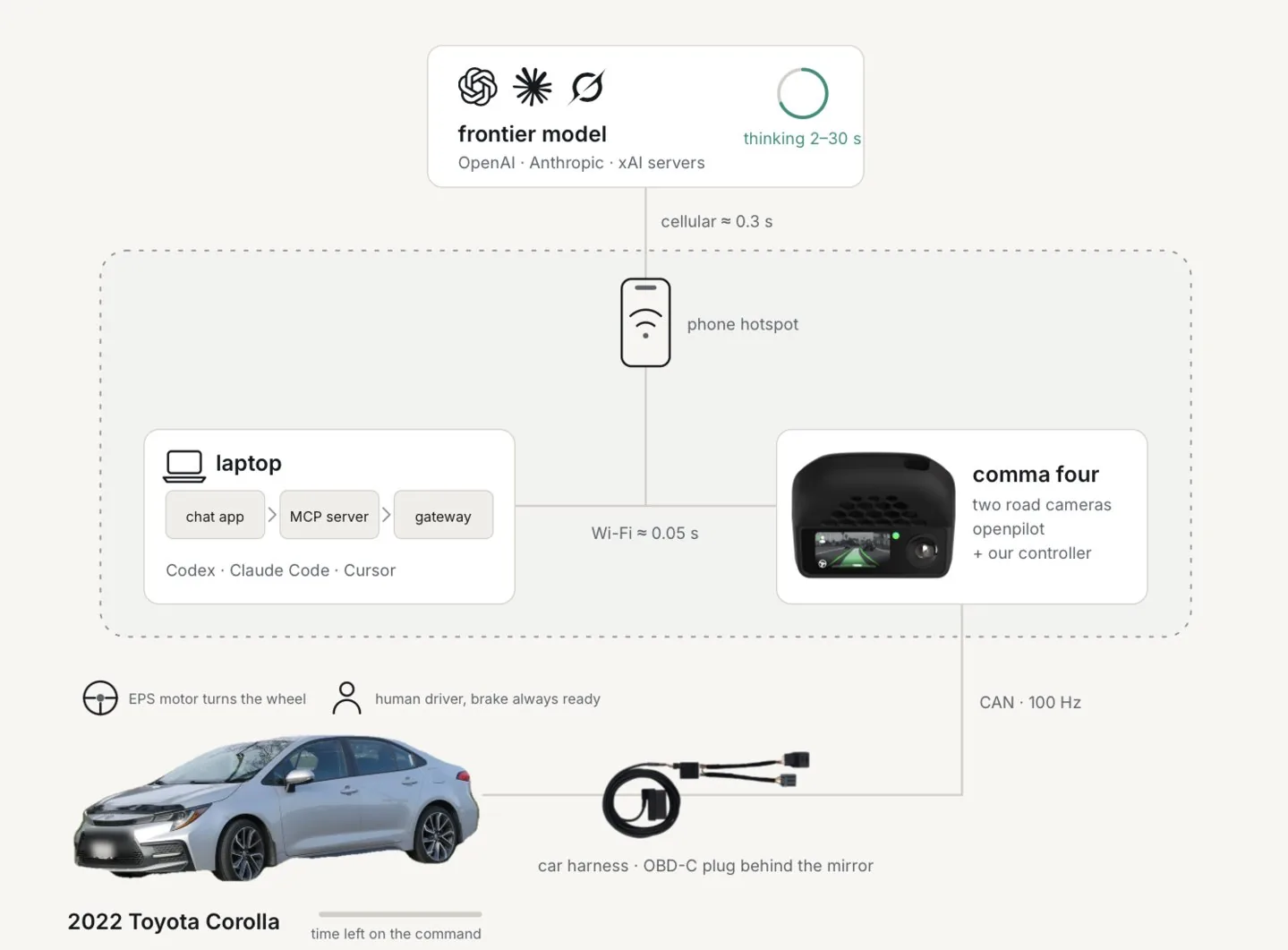
The test implements a common embodiment-AI architecture: the general model serves as the “driving brain,” while the underlying system handles execution.
Core workflow:
- Onboard camera feeds visual data; OBD-C interface retrieves CAN bus data (steering, speed, etc.)
- Data flows to the model via MCP tools; model responds using three core capabilities: observe environment, set direction/speed, or emergency stop
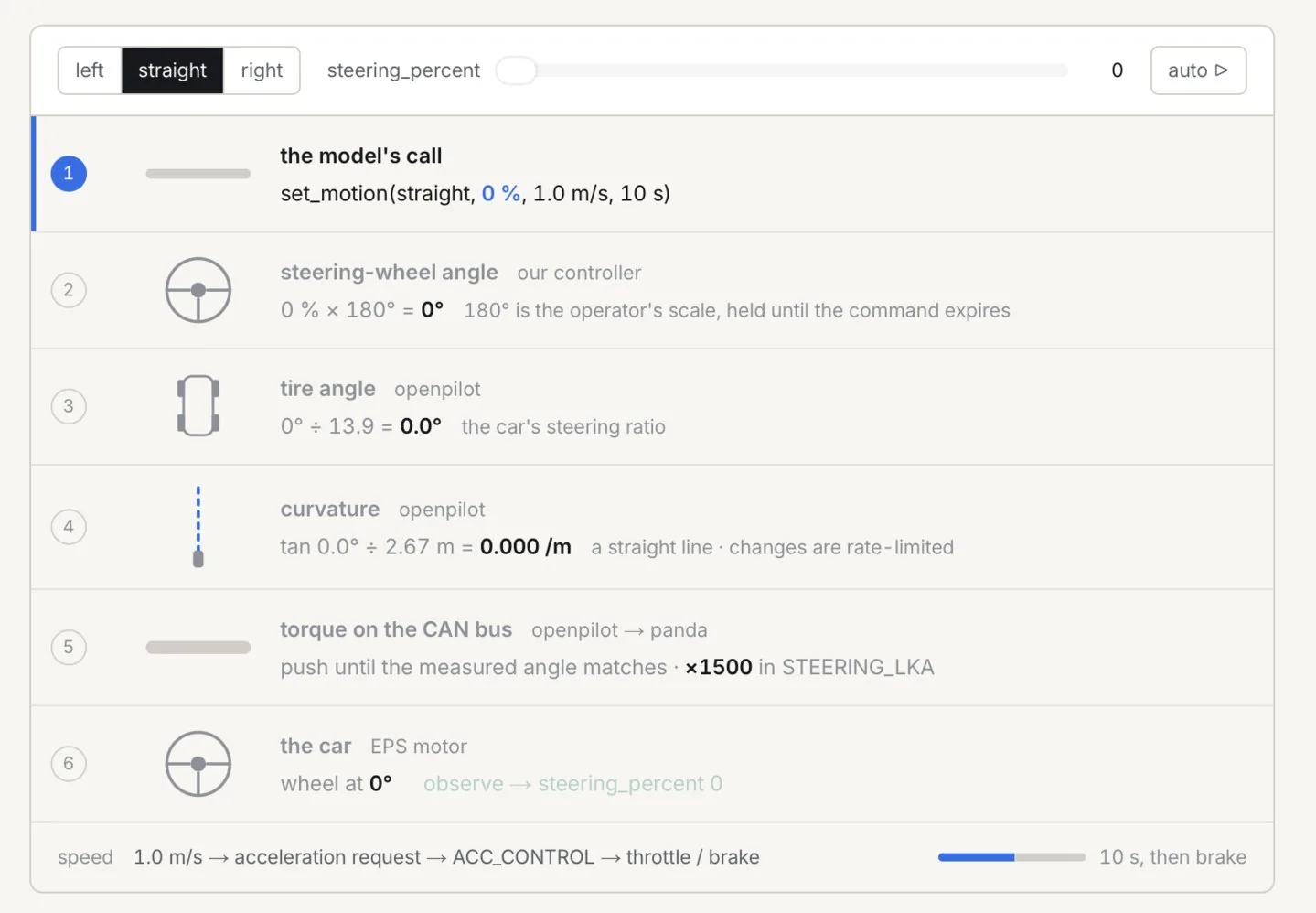
- Instructions pass through openpilot for conversion into physical controls (steering, throttle, braking)
Astra outputs decision-level commands—not torque or pressure values—much like a human driver. In the U-shaped track, it assesses curvature, then requests “turn left at 100% steering angle for X seconds,” letting openpilot handle precise actuation.
Unexpected Findings: Failure Review and Naming Effects
Most intriguing were the model’s contextual learning and safety boundary perception.
First vs. Second Run Comparison:
| Metric | First Attempt | Second Attempt |
|---|---|---|
| Distance covered | 67.3 meters | 134.7 meters |
| Completion rate | ~49% | 100% |
| Duration | 1 minute 18 seconds | 5 minutes 22 seconds |
| Max speed | 1.5 m/s | 0.8 m/s |
| Steering approach | No correction emphasis | 20 of 24 commands used 100% steering |
After the first run, researchers asked Astra to analyze its failure within the same context. The model diagnosed it had prematurely confirmed alignment and accelerated to 1.5 m/s, leaving insufficient room for later adjustments. Based on this feedback, the second run proactively reduced max speed to 0.8 m/s while increasing steering magnitude to build control redundancy.
Another secondary finding involved naming-induced safety psychology: initial model refusals to drive the real car citing physical-world risks dropped significantly after renaming MCP tools to “DrivingBench Sandbox.” The team acknowledged uncertainty whether this reflects environmental understanding or lexical response bias.
Model Performance Comparison
| Model | Completion | Performance note |
|---|---|---|
| GPT-6 Astra | 100% | Finished full 134.7m route in 5:22 |
| Claude Fable 5.1 | ≤45% | Did not complete full route |
| Grok 4.6 | ≤11% | Traversed minimal segment |
| GPT-5.6 Sol | ≤6% | Nearly no progress |
Note: Data from single-session DrivingBench runs; useful for relative comparison only.
Reader Recommendations
Target technical audiences:
- Robotics/Autonomous driving engineers: learn real-world integration of generalist AI with openpilot
- Multimodal AI teams: observe MCP tool-calling interface design patterns
Suggestions to wait:
- Enterprises expecting near-term public-road deployment: millisecond-level perception/control and endurance validation remain unsolved
- Real-world deployment requires proven handling of edge cases, sensor redundancy, and safety certification at scale
Final Note
This test confirms generalist models are extending from digital into physical domains, though 1.5 km/h speeds and confined testing remain far from urban NOA capabilities. It serves as a prototype hinting that future vehicle decision-making may not be confined to traditional autonomous driving firms—the control frontier is redrawn once models learn to understand the world.