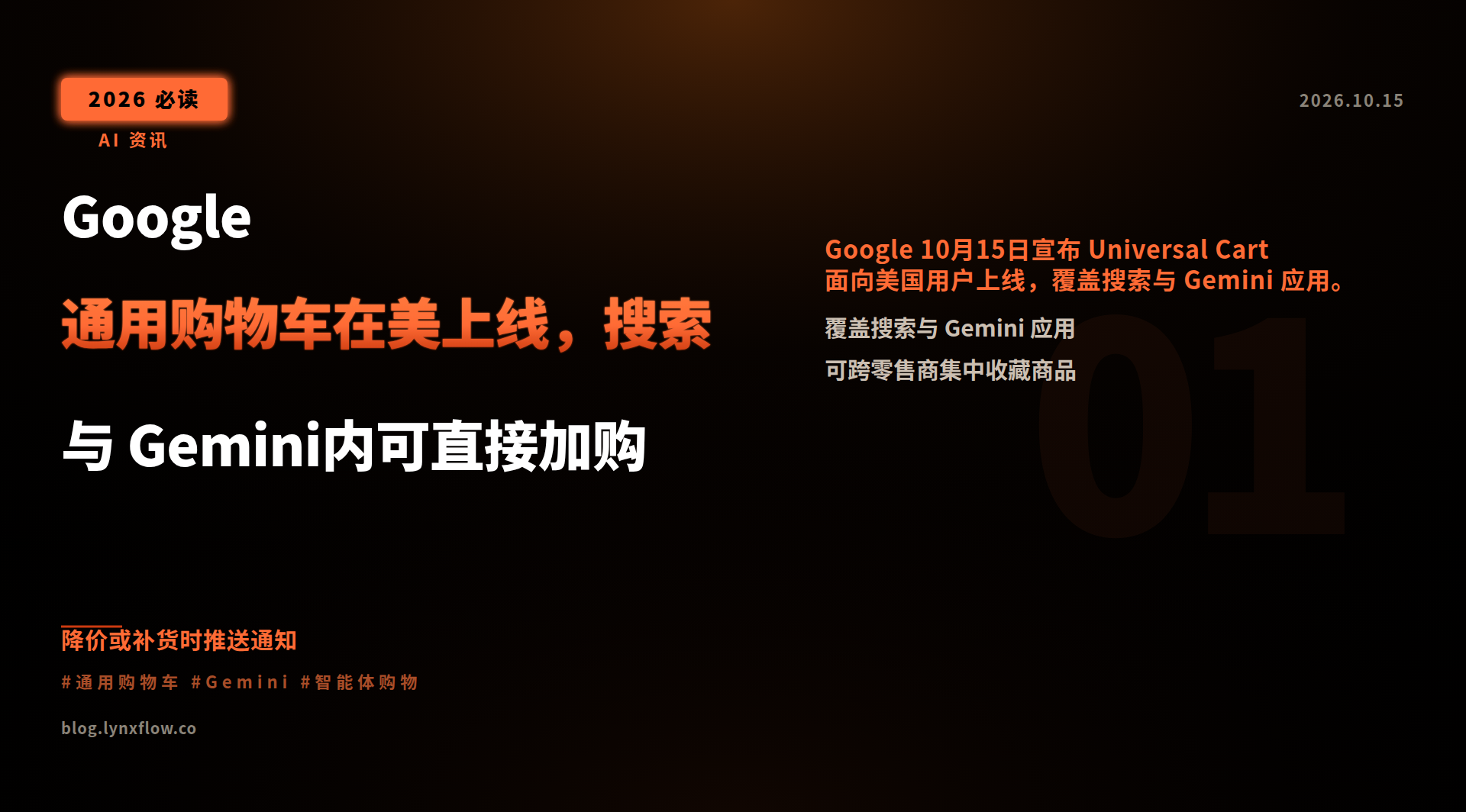
Google’s “Universal Cart” Launches in the U.S.

On Thursday, October 15, Google announced that a shopping tool called Universal Cart is open to users in the U.S. It lets users collect items they discover in Google Search and the Gemini app into a single cart and keep tracking their status. The feature was first previewed at Google I/O in May of this year.
The hard facts are as follows:
- Launch date: Thursday, October 15, 2026
- Availability: U.S. users only
- Access points: Google Search and the Gemini app, not a standalone app
- First preview: Google I/O in May 2026
- Checkout foundation: UCP, an open standard Google launched earlier this year
- Price: The source material does not mention any fees
What It Solves, and a Five-Month Gap
Universal Cart aims to solve the broken experience of online shopping. See something you like, save it to your cart, and leave; when you come back, the item and your shopping progress are still where you left them, so you don’t have to hunt down the same item again or start over. It can collect items from multiple different retailers, making it more of a hub for browsing and tracking potential purchases than a cart tied to a single store.
It also proactively does two things: first, it notifies you when saved items drop in price or out-of-stock items are back in stock; second, it offers more relevant suggestions during shopping. Google says that when helping users decide how to pay, it factors in credit card benefits and also finds relevant promo codes.
Two points are worth noting. The first is timing: teased in May, launched in October, about a five-month gap—hardly fast. This is not something that went live immediately after the demo. The second is form: Universal Cart is not a standalone shopping app; it lives directly inside Google Search and Gemini. For Google, that means putting the cart into an entry point users already open rather than asking them to install another app.
Checkout is handled by UCP (Universal Commerce Protocol), an open standard Google introduced earlier this year. In one sentence: it is a shared set of conventions that lets AI agents (intelligent programs that can perform actions on a person’s behalf) and retailers coordinate across every stage of shopping—including checkout. In other words, Google did not make checkout its own closed loop; instead, it hung it on a publicly open standard.
AI Shopping Capabilities Google Already Has
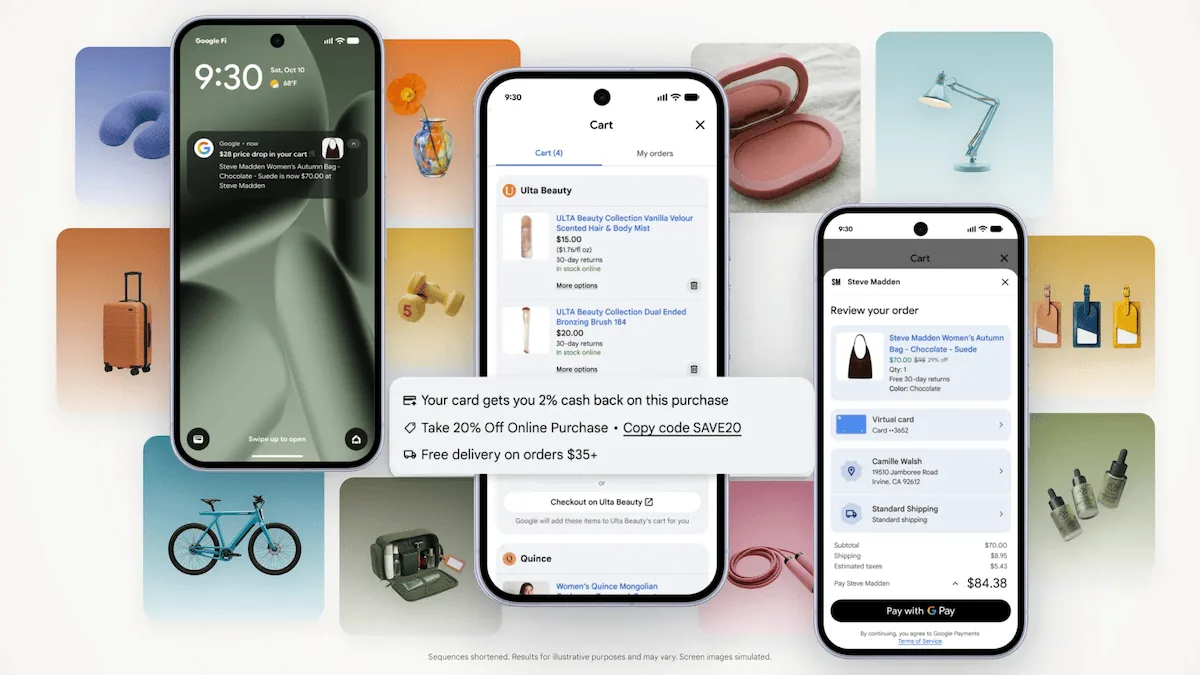
Universal Cart did not appear out of nowhere; it joins a set of features Google has already rolled out.
| Feature | What it does | Status and access |
|---|---|---|
| Universal Cart | Collects items across retailers, tracks price drops and restocks, factors in credit card benefits, and surfaces promo codes | Available to U.S. users starting October 15, across Google Search and the Gemini app |
| Conversational product discovery in Search AI Mode | Discover products through conversation | Existing feature; sits alongside Universal Cart |
| Let Google Call | Uses an AI agent to contact nearby stores and confirm whether an item is in stock | Existing feature |
| UCP (Universal Commerce Protocol) | Lets AI agents and retailers collaborate across shopping stages, including checkout | Open standard introduced earlier this year |
Google is not the only company doing this. Rivals such as Amazon and OpenAI are also adding agentic commerce features—AI agents that can handle tasks like price comparison and ordering on people’s behalf—to e-commerce. The shared motivation is quite consistent: make chatbots not just answer questions, but actually get things done.
Who Should Use It, and Who Should Wait
- Who should try it first: people in the U.S. who frequently compare prices across multiple retail sites and often add items to their cart only to never find them again. If you already use Google Search or Gemini to make shopping decisions, Universal Cart is like gathering scattered “want-to-buy lists” into one place, and it fits naturally into your existing routine.
- Who should wait: users outside the U.S., since the feature is currently U.S.-only; and people who want to use it for the entire checkout flow—checkout depends on UCP, and the source material does not say how many retailers have adopted the standard, so the actual scope of what’s available may be narrower than the feature description suggests.
Closing Thoughts
The essence of Universal Cart is to stitch together the break between “browsing” and “paying,” using a container that is already an entry point Google owns. Whether it can truly retain users depends on how many retailers are willing to adopt UCP, not on how smart the cart itself is. Notably, Google has opened checkout to a public standard rather than keeping it in its own hands—this is both a gesture and a choice to let others pave the way for it.