
Google’s Multi-Agent Scaling Paper: Architecture-Task Alignment Trumps Agent Count
Google Research, Google DeepMind, and MIT released the latest version (arXiv v3) of “Towards a Science of Scaling Agent Systems” in January 2026, systematically validating multi-agent system performance across diverse task scenarios. The study covers 260 strictly controlled configurations across 6 real Agent Benchmark tasks, 5 architectures, and 3 model families, aiming to transform multi-agent system design from engineering intuition to quantifiable science.
Core Finding: Task Structure Determines Performance, Not Agent Count

The research颠覆s the common intuition that “more agents equal better performance,” identifying task decomposability, tool density, single-agent baseline, and coordination cost—not agent count—as key determinants. Key data points:
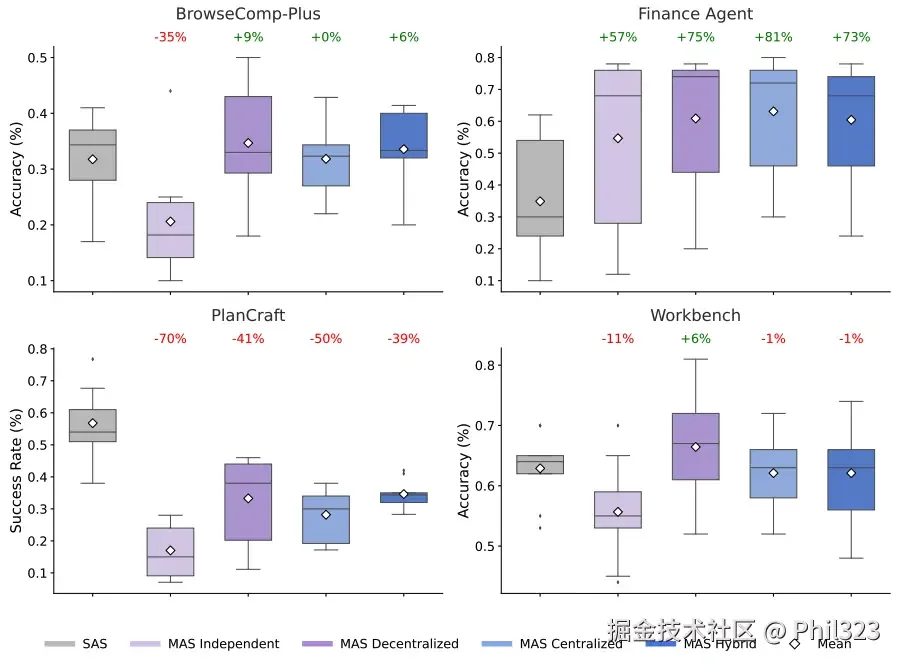
- Finance-Agent task: centralized architecture achieves +80.8% improvement as financial analysis naturally decomposes into parallel streams (regulatory, SEC filings, operations);
- PlanCraft task: all multi-agent architectures degrade by 39%–70% due to strict sequential dependencies;
- SWE-bench Verified: single-agent baseline reaches 52.2%, with all multi-agent approaches underperforming;
- Workbench: multi-agent performance nearly flat despite 16 tools, confirming tool density increases coordination overhead.
This contrast reveals: multi-agent is not a universal enhancement but a conditional technology. Aggregated across six benchmarks, multi-agent shows only -0.3% average change, with a 150-point performance spread (-58.7% to +77.2%) highlighting how architecture mismatch can fully negate model upgrades.
Six Architectures Compared: Centralized Excels in Error Control
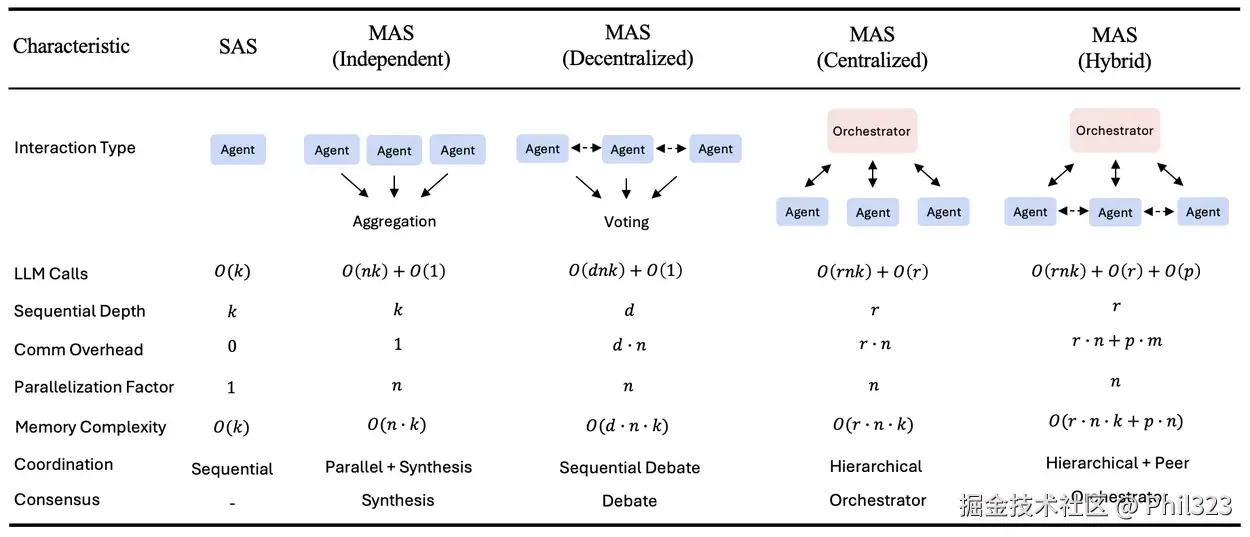
The paper quantifies coordination costs across five canonical architectures:
| Architecture | Finance Improvement | PlanCraft Change | Error Amplification | Relative Efficiency |
|---|---|---|---|---|
| Single-Agent | - | - | 1.0x | 100% |
| Independent | -35% | -70% | 17.2x | ~30% |
| Centralized | +80.8% | -39% | 4.4x | ~65% |
| Decentralized | +9.2% | -28% | 2.1x | ~28% |
| Hybrid | +15.3% | -42% | 5.8x | ~16% |
- Independent: Only result aggregation without process validation causes 17.2x trace-level error amplification;
- Centralized: Orchestrator acts as validation bottleneck, reducing error amplification to 4.4x;
- Decentralized: Highest success rate (0.477) but lowest efficiency (28% of SAS) due to high message overhead;
- Hybrid: 515% coordination overhead with 44.3 reasoning turns per task (7.2 for SAS).
Beyond 3–4 agents, fixed Token budgets severely constrain individual agent reasoning quality. Superlinear growth: Turns = 2.72 × (n + 0.5)^1.724, R²=0.974.
Practical Recommendations: Measure Single-Agent Baseline First
The paper proposes a 5-step decision framework:
- Can the task naturally decompose into parallel subtasks?
- Is the single-agent baseline below ~45% accuracy?
- Are tools numerous and state-changing?
- Does output require unified validation?
- Is the Token/latency cost justified?
Practical guidance:
- Immediately deploy multi-agent for: parallelizable financial analysis, dynamic web search, multi-source reasoning requiring cross-validation;
- Wait for: strictly sequential tasks, single-agent baseline >45%, tool-heavy state-altering workflows;
- Cost optimization: strong executor + weaker orchestrator often beats反向组合.
Final Thoughts
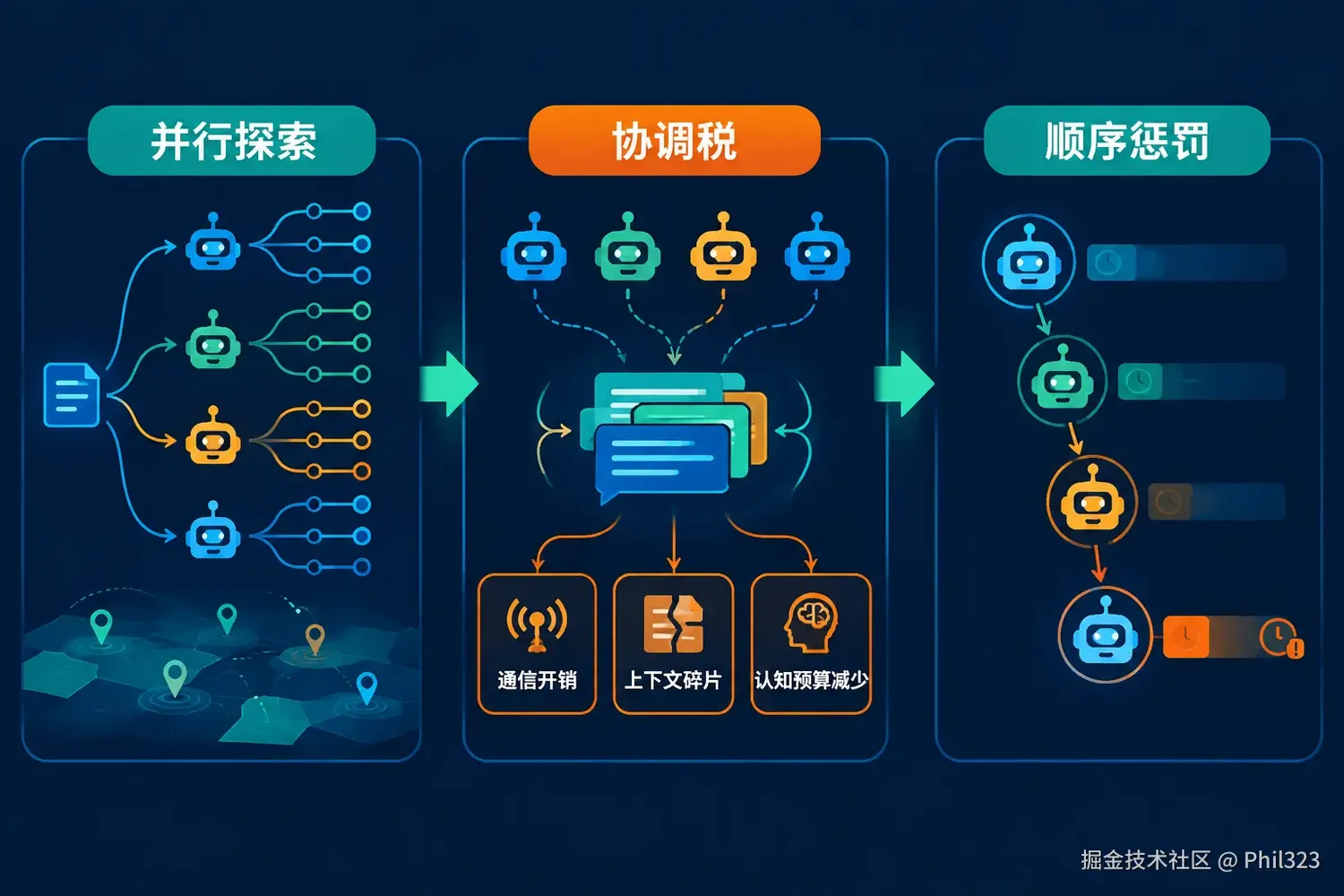
This paper marks the transition of multi-agent systems from trial-and-error engineering to quantifiable architecture design. Its real value is not rejecting multi-agent but providing a measurable framework—in an era of accessible model capabilities, architectural fit has become the true performance differentiator.