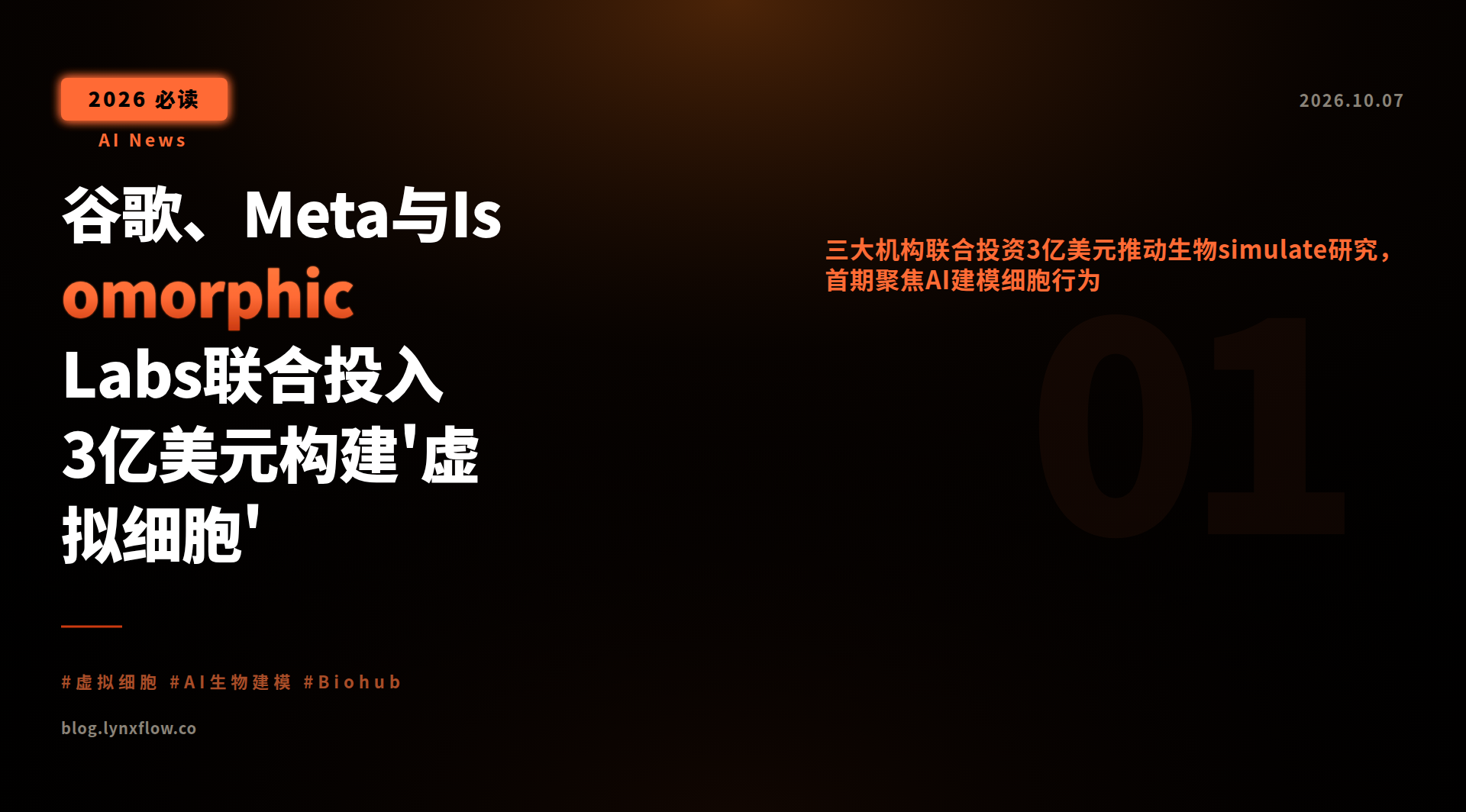
Key Event: $300 Million Launches ‘Virtual Cell’ Initiative

Google DeepMind, Meta, and AI drug discovery startup Isomorphic Labs have jointly invested $300 million in the nonprofit biomedical research organization Biohub to advance the ‘Virtual Cell’ project. The project is part of Biohub’s upcoming $1.8 billion ‘Virtual Biology’ initiative, which aims to build AI datasets that can digitally simulate cellular behavior.
Key hard facts are as follows:
- Funding scale: $300 million jointly invested in the first phase (co-funded by Google, Meta, and Isomorphic Labs)
- Lead organization: Biohub (founded in 2016 by Mark Zuckerberg and his wife Priscilla Chan)
- Additional support: The U.S. Department of Energy will invest an additional $500 million+ over the next five years; NIH will provide existing datasets and knowledge bases valued at more than $500 million
- Goal: Build high-precision cell prediction models to enable researchers to ‘ask, predict, and answer biological questions digitally’
Project Background: From Simulating Cells to Accelerating Drug Discovery
Since its founding in 2016, Biohub has been committed to preventing and curing diseases by building ‘high-precision cell prediction models.’ This collaboration marks a substantive step forward for that goal—the project will integrate data resources from multiple sources and train AI systems to simulate complex biochemical reactions inside cells.
The surprising contrast is: Although $300 million is already a massive investment, it accounts for only one-sixth of Biohub’s total ‘Virtual Biology’ budget of $1.8 billion. This means the remaining funding gap will still require substantial public and private support, and the project timeline is bound to be long.
Key Data and Resource Collaboration

According to official statements, the project will integrate the following core resources:
| Resource Provider | Contribution | Value/Period |
|---|---|---|
| Google DeepMind | AI models and computing support | Amount not disclosed separately |
| Meta | Data infrastructure and AI engineering resources | Amount not disclosed separately |
| Isomorphic Labs | Expertise in AI drug discovery | Amount not disclosed separately |
| U.S. Department of Energy | National laboratory computing resources and modeling support | >$500 million (5-year period) |
| NIH | Existing biomedical datasets and knowledge bases | >$500 million (existing investment) |
Alex Rives, the project’s scientific lead, emphasized: ‘Accurate biological prediction models will greatly accelerate scientific discovery, enabling scientists to perform experiments digitally.’ This suggests the project is not merely staying at the research stage but aims to become an actionable experimental tool.
Practical Takeaways for Readers
- Who it’s for: R&D departments at biopharmaceutical companies, computational biology research teams, and university bioinformatics labs; note that the models may require specific computing environments
- Who should wait: Medical institutions expecting short-term iterations in clinical treatment plans; the ‘Virtual Cell’ is still in the data accumulation and model training stage, and it will take time to validate before it can actually guide drug development.
Final Thoughts
‘Virtual Cell’ represents a key leap in computational biology from descriptive research to predictive modeling. Although the project faces the dual challenges of data integration and model validation, the cross-institutional collaboration model provides a new paradigm for solving complex biological systems problems.