
Google AX: A Declarative Paradigm for Intelligent Agent Scheduling
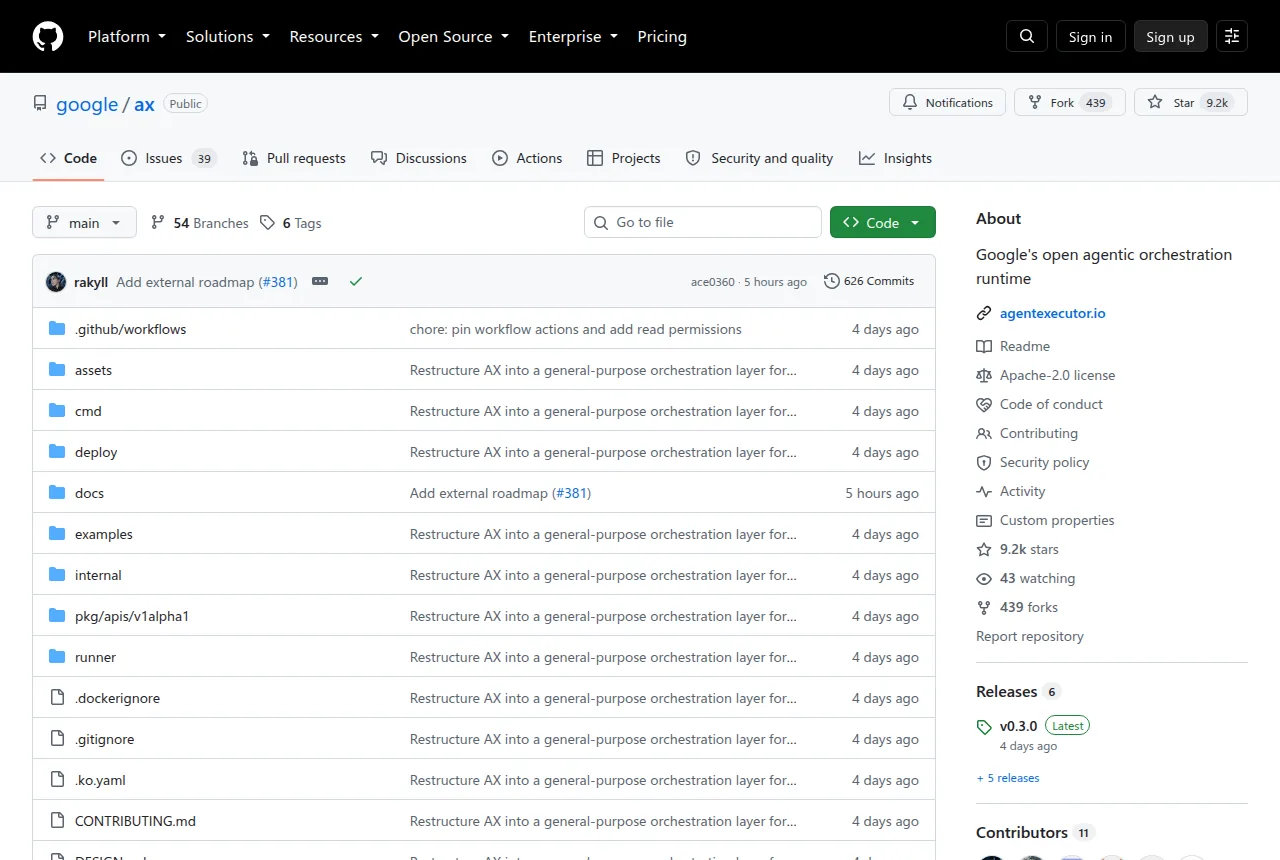
Early this morning, Google’s AX project surged on GitHub, gaining over 1,500 stars in a single day and quickly climbing the trend chart. It is an open-source intelligent agent orchestration runtime from Google, positioned as “a declarative orchestration engine for running trillions of autonomous agent tasks.” As large model agents move from single-machine demos to production clusters, AX provides a declarative paradigm akin to Kubernetes, making the management of complex agent workflows simple and reliable.
Four Core Primitives Define Agent-Era Workflows
AX’s design philosophy is remarkably clear: cover all agent workflow requirements with the minimal set of abstractions. It offers four declarative resources:
- Task: A sandbox container for individual agent tasks, with configurable CPU/memory limits and support for real-time debugging via
ax ssh - Workspace: A pre-configured agent runtime environment with code repositories, MCP servers, and skill packs, ready to use out of the box
- Gateway: An outbound traffic whitelist mechanism that prevents agents from失控 accessing external services and incurring unexpected costs
- Model: Unified binding of large model API credentials, supporting loading sensitive information from Kubernetes Secrets
All four resources are declared as YAML manifests and deployed in one go through ax apply. This design significantly lowers the configuration barrier for complex agent systems.
Up and Running in Ten Lines: Three Steps to Your First Agent Task
After installing the CLI, launching is as simple as three steps:
| |
ax watch tracks task phase transitions in real time, while ax ssh lets you dive straight into the sandbox to inspect the agent’s current state—particularly useful when debugging complex agent behaviors.
Deep Design: ANTESPACE Isolation, State Recovery, and Flexible Extension
AX’s technical highlights center on three areas:
- ANTESPACE Namespace Isolation: Similar to Kubernetes namespaces, but optimized for multi-tenant agent scenarios, supporting secure boundary separation across tasks
- Checkpoint + Resume Mechanism: State persistence is achieved via
ax suspendandax resume, allowing long-running agents to pause and resume later without losing progress - Runner Contract Design: Task containers only need to follow a simple startup protocol to integrate with the platform, and users can fully customize Runner images to accommodate special requirements
A noteworthy detail is network access control: the default Gateway policy opens no outbound traffic (unlike Kubernetes Services, where ClusterIP is reachable by default). You must explicitly specify an EGRESS-HOSTS whitelist, preventing agents from accidentally invoking external APIs and incurring unexpected costs—built right into the design.
Who Is AX For?
- Enterprise AI teams: Those running large-scale, long-duration agent tasks and requiring unified management, isolation, and audit capabilities
- LLM application platforms: As a底层 scheduling layer to carry user-side automated workflows
- Open-source project contributors: Looking to participate in the Agent Substrate ecosystem with a production-grade orchestration layer
While most competing products focus on single-agent development frameworks (such as LangChain, LlamaIndex), AX’s positioning is closer to what Kubernetes is to microservices—providing runtime guarantees for entire agent clusters. Its unique value proposition: it doesn’t teach you how to write agent logic; it solves the engineering challenges of scaling agent deployments.
Final Thoughts
AX is still in v0.1, and the official documentation explicitly notes that the API is subject to significant changes. Nevertheless, its clear architectural trade-offs already sketch out the infrastructure轮廓 of the agent era: declarative, recoverable, and strongly isolated. As we discuss the production deployment of agentic workflows, the choice of orchestration layer may well become the deciding factor.