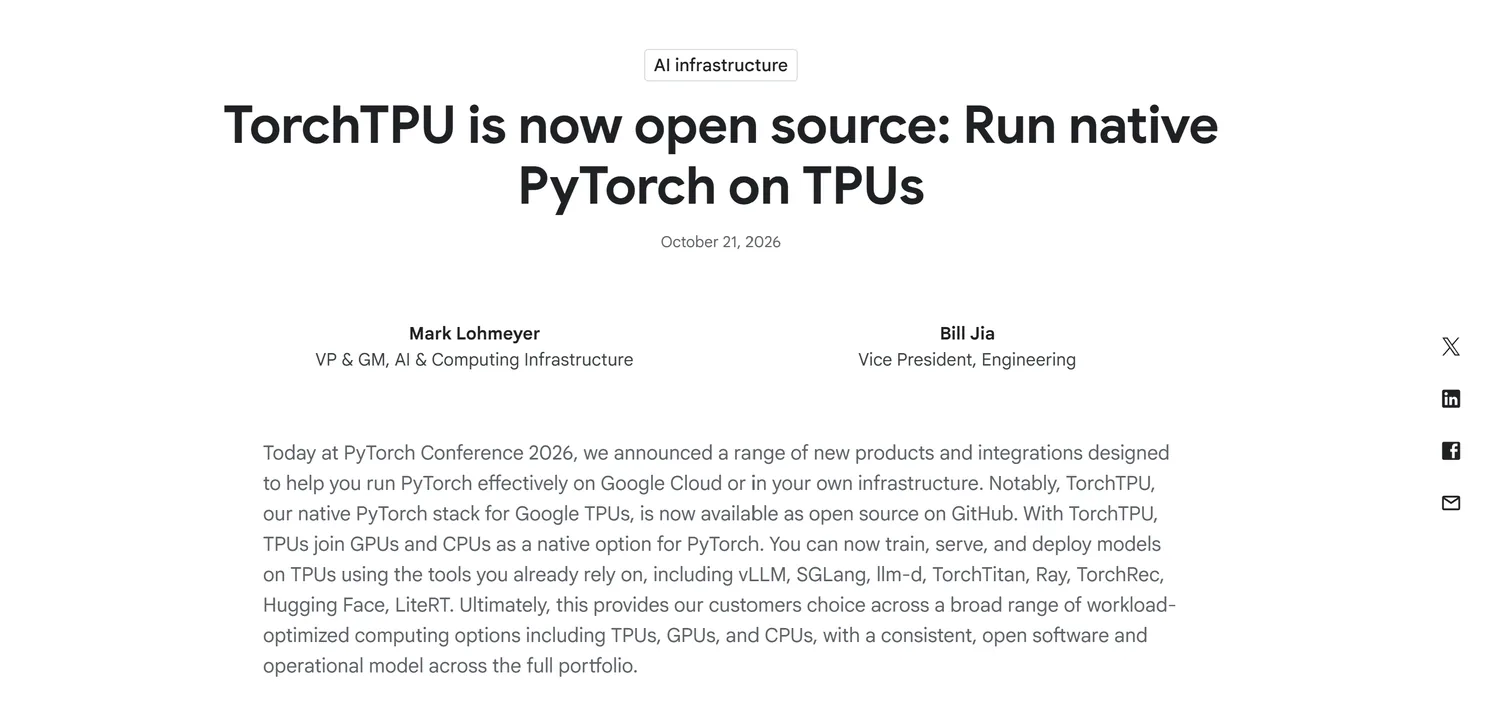
On October 21, Google announced the open-sourcing of TorchTPU, a native TPU software stack co-developed with Meta’s PyTorch team that lets developers deploy existing PyTorch models onto Google TPUs with relatively few code changes. According to TechCrunch, most AI applications today run on Nvidia GPUs, and Google’s open-sourcing move may be an attempt to break Nvidia’s dominance in the AI industry.
PyTorch is an open-source deep learning framework for developing and training AI models. It was started in 2016 by Facebook AI Research (now Meta AI) and formally open-sourced in 2017. It has since become one of the most widely used frameworks in global AI research and application development, covering large language models, computer vision and generative AI.
Around TorchTPU, Google has also connected TPUs to tools including vLLM, SGLang, llm-d, TorchTitan, VeRL, Ray, Hugging Face and LiteRT, covering scenarios such as large model training, inference, reinforcement learning, cluster scheduling and on-device deployment.
Google says its TorchTPU-based training solution has been validated on up to 8,000 Ironwood TPUs, achieving up to 52% model FLOPs utilization in a Qwen3-8B training test. On the inference side, Indian AI model company Zenteiq.ai reported more than 4x overall inference throughput improvement after adopting the related solution. For developers, existing PyTorch models can be migrated to TPUs more easily, familiar training, inference and job scheduling tools remain usable, and hardware can be chosen flexibly among TPU, GPU and CPU based on model scale, speed and cost.
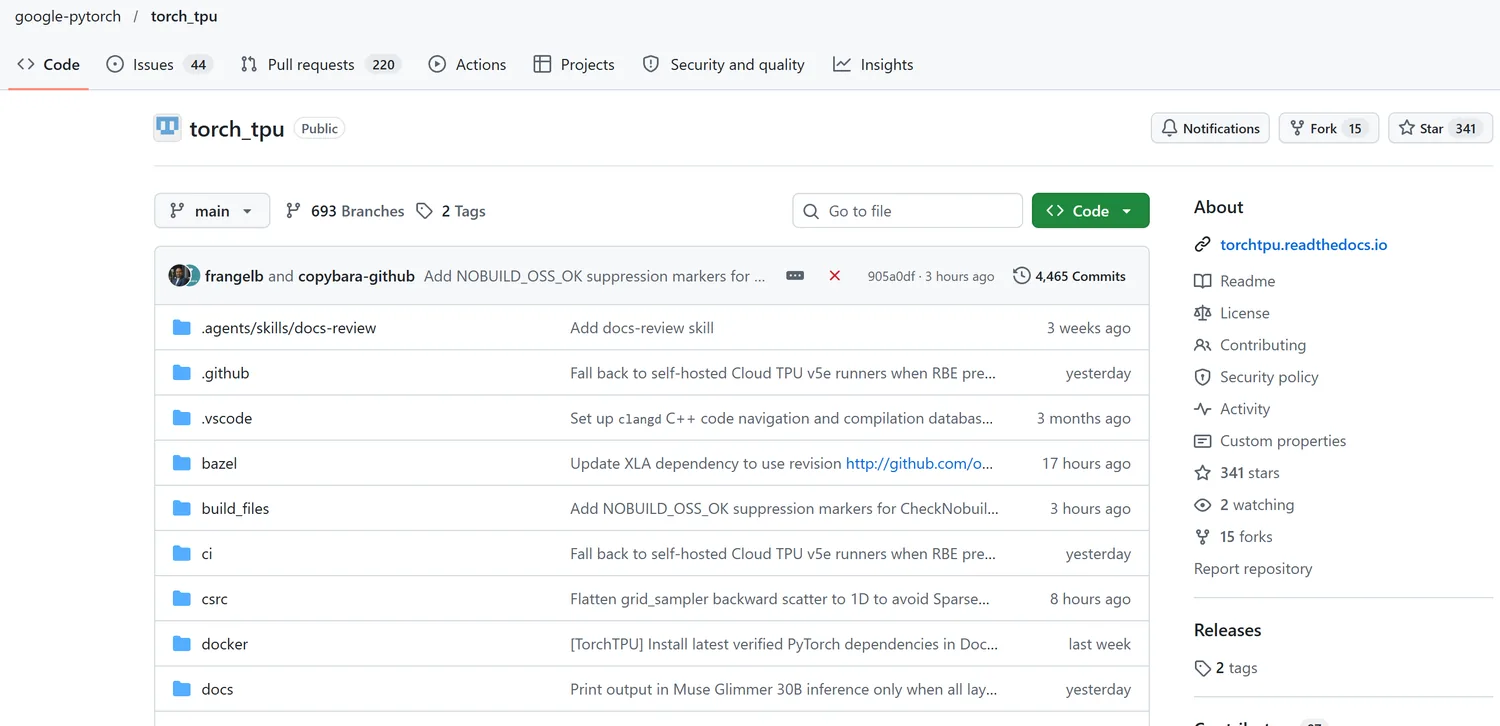
Open-source address: https://github.com/google-pytorch/torch_tpu
- TorchTPU goes open source, PyTorch models can migrate directly to TPUs
TorchTPU lets developers run models on TPUs using standard PyTorch APIs. Developers can first debug models in eager mode, then use torch.compile for compilation optimization to improve TPU utilization and reduce memory overhead. Google says TorchTPU also supports distributed computing and various diagnostic tools, reducing the work of repeatedly modifying code for different hardware.
Jana van Greunen, engineering director for PyTorch at Meta, said Meta needs to run large models, ads and recommendation systems across multiple hardware architectures, and TorchTPU allows Meta to deploy PyTorch workloads onto Google TPUs while giving direct feedback to the relevant engineering teams.
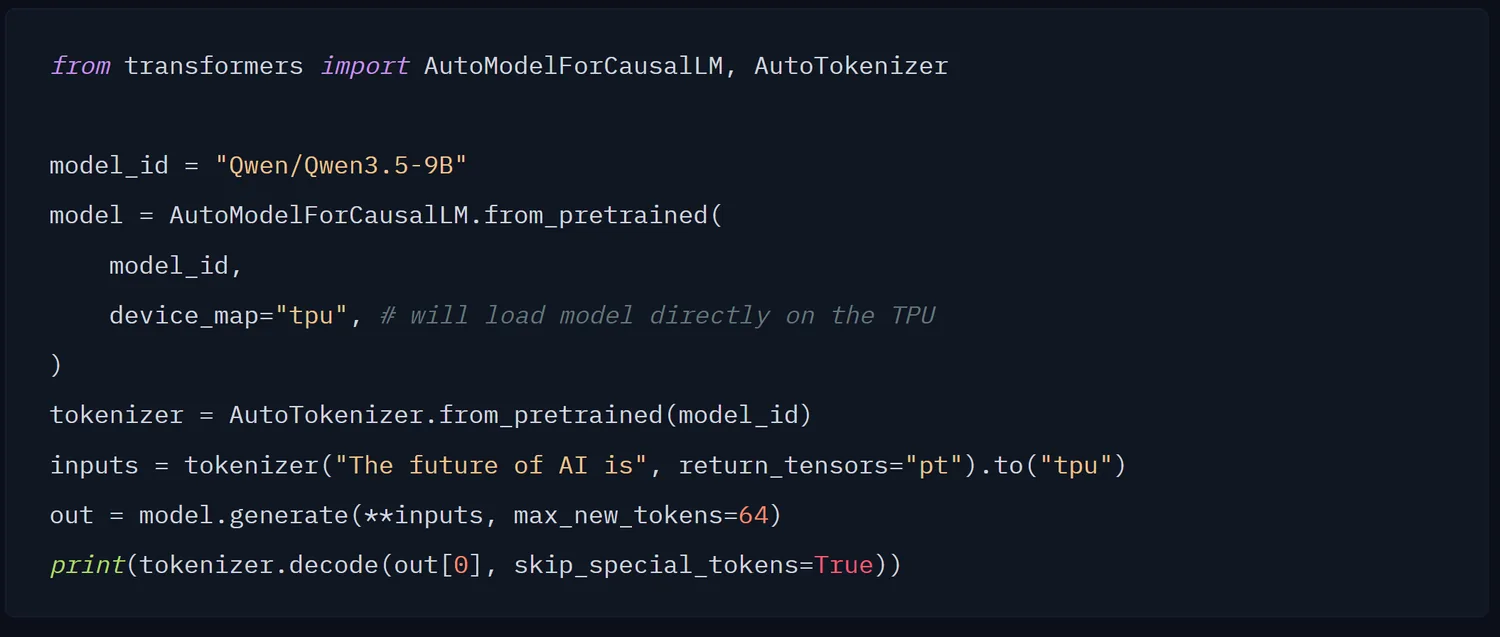
Google has also partnered with Hugging Face so that popular open-source models on Hugging Face Hub run natively on TorchTPU. In the Transformers v5 large model development library, developers only need to set device_map=tpu to deploy a model to TPUs. In the Diffusers diffusion model toolkit, developers can use torch.compile and tensor parallelism to run large generative models across multiple TPUs.
- Multiple open-source tools connect to TPUs, lowering large model inference costs
As reasoning models and agent models scale up, inference cost and latency have gradually become major bottlenecks in production environments. Google has connected TorchTPU to multiple open-source inference frameworks and, through the native routing capabilities of the Kubernetes cluster management system, helps developers schedule workloads between TPUs and GPUs.
Google focused its collaboration on three types of tools: vLLM is an inference engine for efficiently deploying large language models, SGLang mainly targets structured generation and agent workloads, and llm-d orchestrates and schedules inference services across large server clusters. The related updates cover model execution, request handling and cluster scheduling.
Google has worked with Inferact to launch a native TorchTPU-based backend for vLLM, supporting continuous batching, quantization and multi-chip parallelism while preserving vLLM’s existing model execution, request scheduling and API serving architecture, so developers do not need major adjustments to existing systems. Google also worked with RadixArk to develop a TorchTPU backend for SGLang. SGLang can reuse caches across different requests to reduce computation for repeated prompts and optimize latency and throughput for multi-step generation and agent tasks.
In addition, Google announced the release of llm-d 1.0 together with Red Hat, IBM, more than 500 contributors and 25 organizations. The project can distribute requests based on cache status and split different stages of the inference process. Version 1.0 adds multi-tenant traffic control, high-availability routing and agent-oriented session routing. On Google Kubernetes Engine (GKE), developers can use a unified llm-d endpoint to choose between GPUs and TPUs for the hardware better suited to a specific workload.
According to Sashikumaar Ganesan, founder of AI model company Zenteiq.ai, after using the GKE Inference Gateway based on llm-d to generate synthetic data, the company’s overall inference throughput increased more than 4x, with daily generated tokens on 1,000 TPU v6e accelerators rising from 1.47 billion to 5.97 billion.
- Training large models on systems with up to 8,000 TPUs, efficiency up to 52%
On the training side, Google has integrated TorchTPU with PyTorch community training, reinforcement learning and orchestration frameworks. TorchTitan is PyTorch’s native scalable distributed training reference implementation and has now completed production-grade integration with TorchTPU. TorchTitan provides pretraining recipes for multiple model types, including dense models such as Llama 3 70B and 405B, Qwen3-8B and Qwen3-32B, and MuseGlimmer 30B; mixture-of-experts models such as Qwen3-235B; and diffusion Transformer models such as the 12B FLUX.1 series.
Google says TorchTitan has been validated on 8,000 Ironwood TPUs (TPU v7x). In the Qwen3-8B training test, the TorchTPU training path achieved up to 52% model FLOPs utilization and maintained near-linear scaling on up to 8,192 Ironwood TPUs.
For reinforcement learning, Google contributed a TPU backend and end-to-end reference recipe to VeRL. The solution is based on a separated trainer-and-sampler architecture, supports running GRPO (Group Relative Policy Optimization) on mathematical reasoning datasets, and preserves the original hardware-agnostic model and algorithm code. Google also added TorchTPU support to Ray, so developers can schedule CPU, GPU and TPU resources within the same Ray workflow for data processing, training, reinforcement learning and inference, assigning different stages to more suitable accelerators.
- PyTorch models can run on phones, PCs and IoT devices
Google also announced that LiteRT has formally joined the PyTorch ecosystem. LiteRT, formerly TensorFlow Lite, is Google’s high-performance framework for on-device AI inference. Through LiteRT-Torch, developers can convert PyTorch models to LiteRT format with a single call. The solution is built on Core ATen operators, and model code can remain within the PyTorch ecosystem.
For large language models, LiteRT-Torch can export Hugging Face Transformers models to LiteRT-LM, supporting execution on Android, iOS, macOS, Windows, Linux, Web and IoT devices. On hardware support, LiteRT can invoke CPUs through XNNPack, GPUs through the open-source ML Drift, and NPUs from major chip platforms through a unified API.
Google also previewed the TPU agent suite on GitHub. The tool connects to various code orchestration tools and model combinations through plugins, helping developers deploy PyTorch models on TPUs, diagnose problems, answer user questions and tune inference performance.
Conclusion: Google courts more developers for TPUs
By open-sourcing TorchTPU, Google makes it easier for developers to migrate existing PyTorch models to TPUs while continuing to use familiar training, inference and deployment tools, thereby reducing dependence on a single hardware platform. Nvidia GPUs still have a mature software ecosystem and a broad developer base, and TorchTPU is unlikely to change that landscape in the short term. But if Google can keep improving the TPU toolchain and demonstrate advantages in performance and price, TPUs may gain more adoption in some large model training and inference scenarios.