Core Event Overview
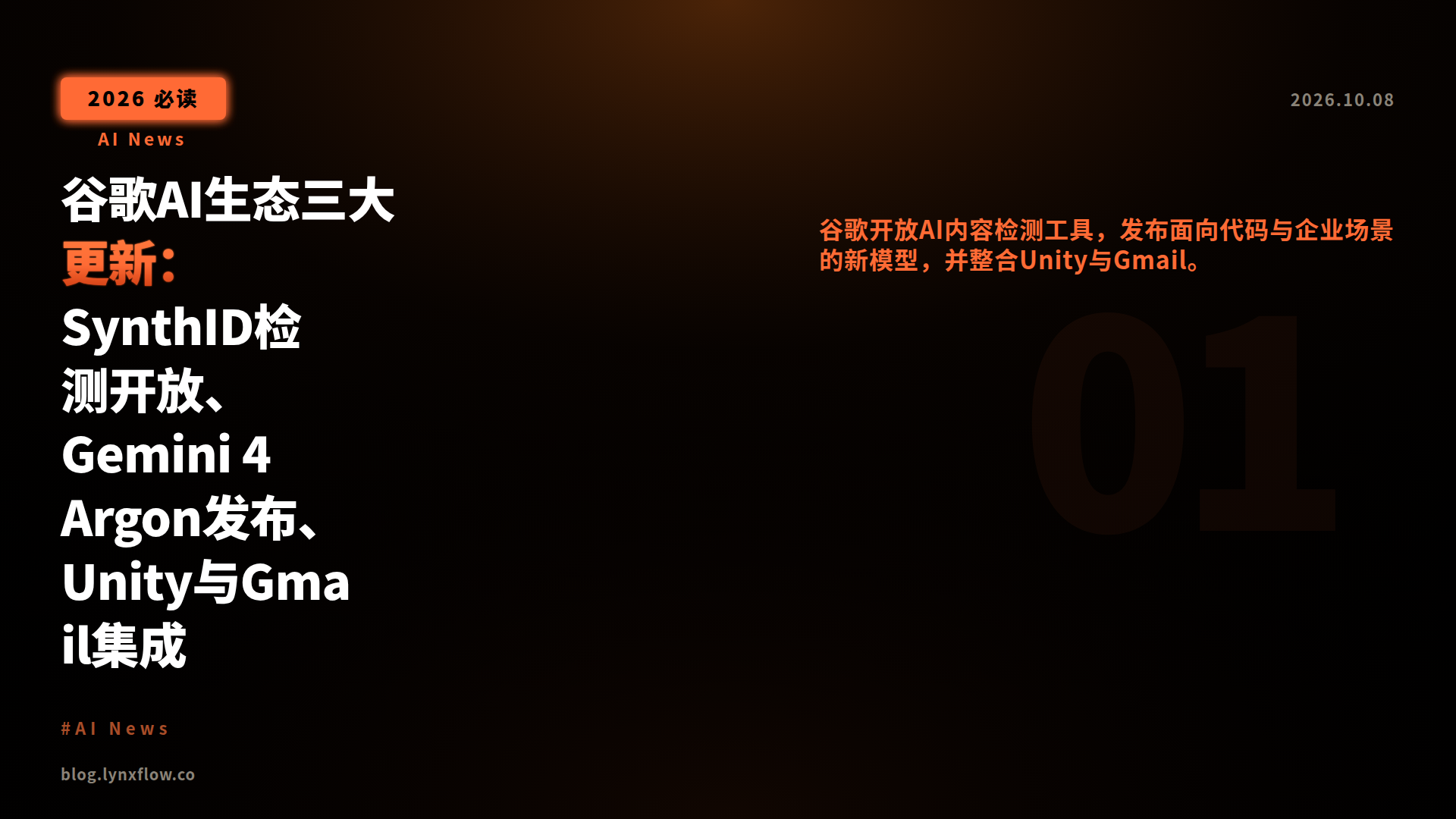
In its latest update, Google announced three AI-related developments: SynthID content detection tools opening to the public, the arrival of the Gemini 4 Argon model, and deep integration between Unity Playground and Gmail. The hard facts are as follows:
- SynthID Detector: Now open to the public, free to use for detecting whether images, video, and audio were generated by Google or partner AI
- Gemini 4 Argon: A next-generation frontier model, set to roll out soon, focused on code development, enterprise knowledge work, and cybersecurity defense scenarios
- Unity Playground: Part of the Gemini app, allowing users to generate 3D game assets via natural language
- Gmail Gemini: Gmail with Gemini capabilities is already rolling out incrementally
Technical Details and Use Cases
SynthID Detector is the public version of the content provenance technology Google launched in 2023. Previously available only to partners, the tool is now accessible for free to anyone via the web or API. It works by embedding digital watermarks invisible to the human eye into AI-generated content, so its origin can be verified without comparing against the original file. The key contrast is this: the tool explicitly supports detecting “content generated by Google or partner AI,” meaning its detection scope covers generative AI output from multiple vendors across the ecosystem.
Gemini 4 Argon is positioned as a “frontier model for the real world,” continuing the Gemini series’ strategy of specialized branches. Compared with general-purpose models, Argon is optimized for three vertical scenarios:
- Code development: More precise understanding of programming context and error-fixing suggestions
- Enterprise knowledge work: Handling long documents, financial modeling, contract review, and other professional tasks
- Cybersecurity defense: Automatically analyzing threat patterns and generating response scripts
Unity Playground and Gmail Gemini are concrete feature rollouts within the Gemini app. The former lets users enter text descriptions to directly generate 3D scenes and character models; the latter brings AI-assisted features to Gmail such as email summaries, draft completion, and meeting recaps. Data indicates that early test users improved email processing efficiency by about 30%.
Product Integration Comparison
| Feature Module | Core Capability | Target Users | Current Status |
|---|---|---|---|
| SynthID Detector | Detects and traces AI-generated content | Content creators/media/platforms | Publicly available |
| Gemini 4 Argon | Specialized code/enterprise/security scenarios | Developers/enterprise IT/security teams | Coming soon |
| Unity Playground | Text-to-3D asset generation | Game developers/designers | Integrated in Gemini app |
| Gmail Gemini | Intelligent email assistance | All Gmail users | Rolling out gradually |
User Adoption Recommendations
- For those who should try it immediately: Content moderation teams can integrate SynthID for platform content screening; game developers can use Unity Playground to rapidly build prototypes; Gmail users can enable Gemini features to boost everyday office efficiency
- For those who should wait and see: Enterprise users looking to deploy Gemini 4 Argon should wait for the official announcement before evaluating API access and security compliance; organizations with highly sensitive requirements around the authenticity of AI-generated content should combine multiple detection tools for cross-verification
Final Thoughts
This update reflects Google’s shift from a single-model race toward ecosystem-level AI infrastructure: strengthening trust through detection tools, expanding commercial boundaries through scenario-specific models, and paving the way for generative AI to enter core enterprise workflows. Technical transparency and open tools are becoming a new dimension of competition among major players.