
Key Facts at a Glance
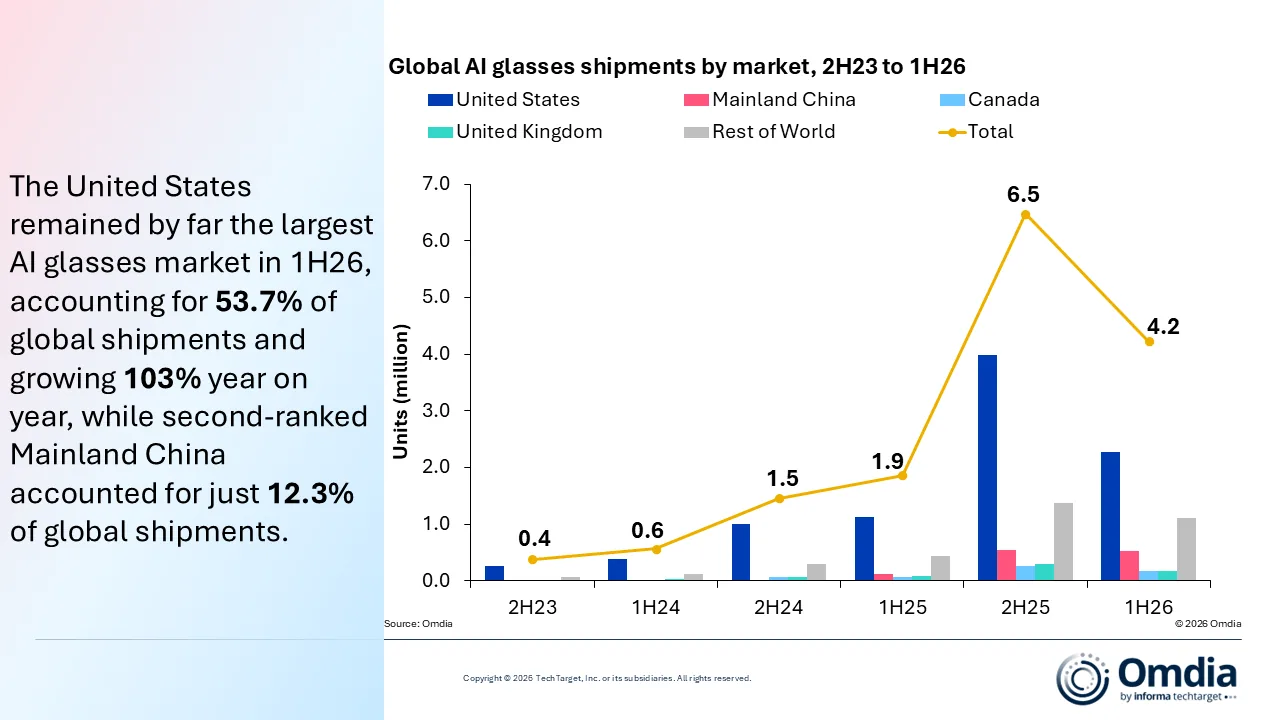
Omdia released its global AI glasses shipment data on September 22, 2026 (UK time):
- Total H1 2026 Shipments: 4.2 million units (+127% YoY)
- Primary Growth Drivers: Meta’s sustained momentum and explosive growth in China
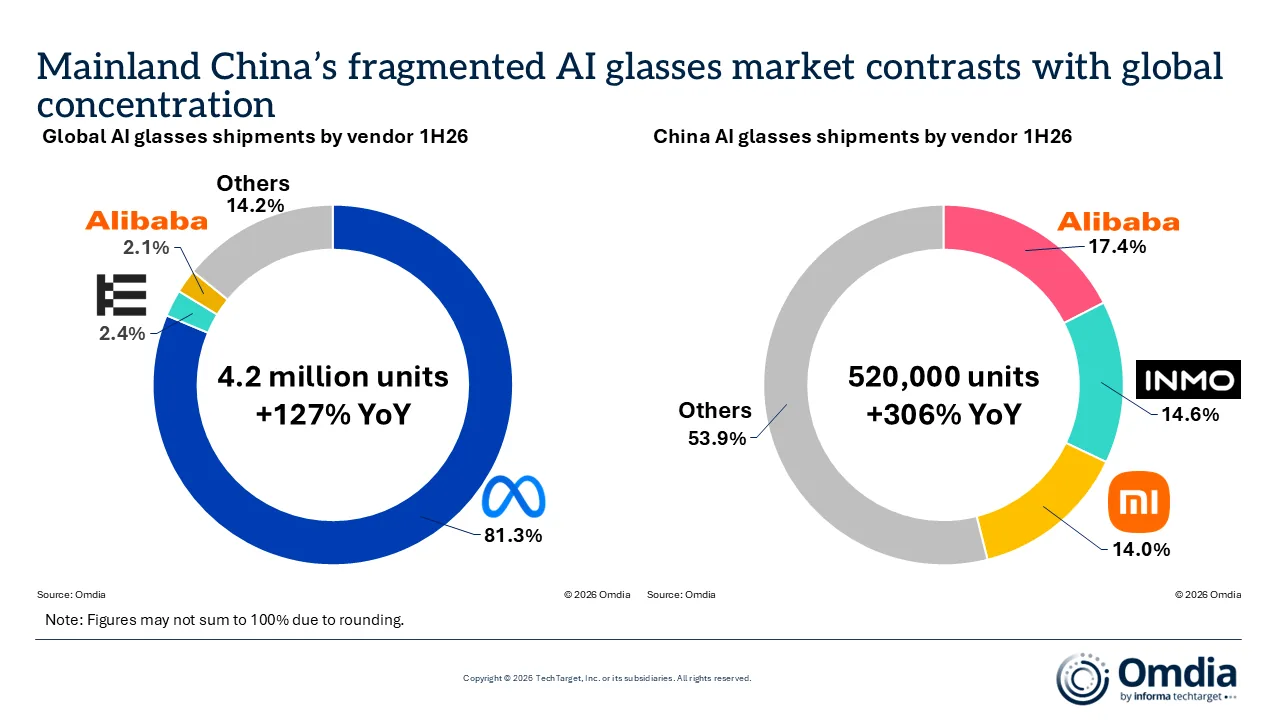
- China Performance: Shipments surged 306% YoY, serving as a large-scale testbed for diverse hardware configurations
- Market Structure: Meta dominates (81.3% share); top 3 globally account for under 90%; China remains highly fragmented (top 3: 46.1%)
Market Structure: Concentration vs. Fragmentation
The global market exhibits high concentration. Meta holds 81.3% share with 3.4 million units shipped, far ahead of competitors. Even Realities claims 2.4% global share (second place), followed by Alibaba at 2.1%. This confirms Meta’s dominant market position.
Contrasting sharply with the global picture, China’s market shows “high-growth + low-concentration” dynamics. Though shipments rose 306% YoY, Alibaba, Yinmu, and Xiaomi collectively hold just 46.1% share—no clear domestic leader has emerged. This combination of rapid growth without market consolidation is uncommon in hardware markets, where typical scalability leads to winner-takes-most outcomes.
Omdia characterizes China’s AI glasses landscape as a “large testbed for diverse hardware configurations,” reflecting active experimentation across technical approaches. No Chinese vendor currently possesses global ecosystem leverage or pricing power.
Technical Crossroads: Global Standards vs. Local Experimentation
Most current AI glasses feature perpetually active cameras, drawing heightened regulatory scrutiny. Omdia Research Director Jason Low emphasizes: consistent privacy settings and clearer disclosures are no longer sufficient.
The core challenge for vendors now lies in:
- Clearly defining what content the always-on camera captures
- Explicitly communicating usage purposes to users
- Providing technical assurances that data does not reach third parties
This requirement spans both hardware-level privacy design and backend data processing architecture.
China’s market growth coincides with vendors’ differential responses: multiple technical approaches coexist, including on-device processing solutions and edge-computing-plus-cloud collaboration models. Market fragmentation inadvertently accelerates variant validation.
Product Considerations: Price & Specification Data
No product pricing, storage specs, or chip parameters are disclosed in the source material, precluding a comparison table. Market positioning today hinges primarily on brand ecosystem strength, channel coverage, and early adopter base—not hardware specifications.
Buyer Recommendations
- Buy NOW if you are: Enterprise developers and early-stage tech explorers. AI glasses remain in the hardware-first phase, best suited for users comfortable with technical iteration and eager to contribute feedback to ecosystem development.
- Wait if you are: Privacy-sensitive consumers or those seeking only lightweight assistive features. The industry lacks standardized privacy controls; users should consider waiting for mature regulatory frameworks before adoption.
Final Thoughts
AI glasses have entered the “scale validation” phase after early concept testing. Meta’s dominance has accelerated hardware adoption, but China’s explosive growth reveals an emerging trend: new markets may serve as “stress-test arenas” for real-world application, where high-frequency usage exposes product boundaries faster than mature markets. The next inflection point likely hinges on regional alignment around privacy governance and data compliance frameworks.