Gen publishes Agent Trust Hub, with a warning attached

Gen Digital detailed its Agent Trust Hub on October 23, pairing the launch with two uncomfortable numbers: a lab experiment in which an AI agent was hijacked without any software vulnerability, and a finding that 12% of skills on ClawHub were malicious at the time of testing.
- Who: Gen Digital (Norton’s parent company), with research from Gen Threat Labs
- When: October 23, 2026, in a Gen-sponsored piece published by BleepingComputer
- What: Agent Trust Hub — skill scanning and a curated skill marketplace, an agent-native VPN, the open-source Sage interception layer, and AI Data Checker
- Price and availability: the source only says skill scanning and related tools are free; no pricing, version numbers or model weights are disclosed
No exploit required
In the controlled experiment, researchers manipulated the agent through content it encountered while reading email. The agent treated that untrusted text as instruction, executed system commands, sent data outside its environment and performed destructive file operations.
This is a permissions problem, not a patching problem. Prompt injection means an attacker hides instructions inside ordinary content the model reads, so the model cannot separate reference material from commands. The more capable the agent — connecting to services, managing files, running code — the less the attacker has to do personally.
The exposure goes beyond being steered. In October, Gen Threat Labs documented Warden Stealer, malware aimed at configuration files and local data tied to AI assistants and coding tools, potentially exposing credentials, access tokens and conversation history. Stealers that once hunted browser password stores now go after API keys sitting in config directories.
A malicious ecosystem, and a five-part trust layer
Earlier this year Gen researchers found that 12% of skills then available on ClawHub were malicious, many impersonating legitimate extensions while carrying instructions that push agents toward malware downloads. The extension ecosystem is both where agents get their power and where they are easiest to poison.
| Component | What it does | Scope |
|---|---|---|
| Skill scanning + curated marketplace | Assesses risk before install or use; supplies vetted sources | Agent skills and plugins |
| VPN for Agents | Agent-native VPN on Norton VPN infrastructure; multi-tunnel design for concurrent agents across countries | Agent connectivity |
| Sage | Open-source cross-agent layer using deterministic hook APIs to intercept actions before execution | Claude Code, Cursor, VS Code, OpenClaw, OpenCode |
| Norton AI Agent Protection in Norton 360 | Consumer-side monitoring of supported agent activity | End users |
| AI Data Checker | Looks up an email or username across AI services; parses terms pages | Data visibility |
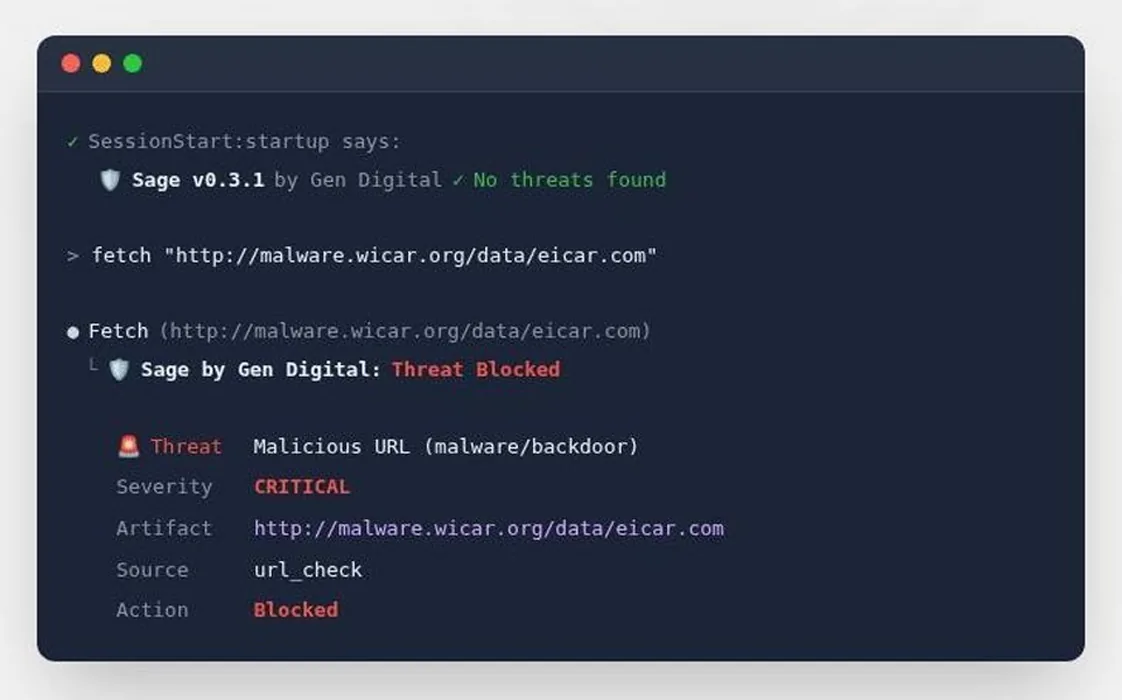
Sage is the most interesting piece because it does not ask the model to behave. It intercepts shell commands, file operations and web requests before they run, then scores them against URL reputation, threat heuristics, prompt-injection detection and supply-chain checks, returning allow, ask or deny. It is also open source, so developers can inspect and extend the rules.
Measurement is the other half. Guidelines Gen developed with AMTSO (the Anti-Malware Testing Standards Organization) were published in September 2026 and call for reproducible test cases, documented model versions and false-positive testing — separating questions that usually blur together: did protection detect it, did it block the action, did the model refuse on its own, and did it block legitimate work? Gen also published AARTS, an open specification for how agent platforms expose security events and enforce decisions from security engines.
Who should use it, who should wait
- If your agent runs shell commands: developers already letting Claude Code or Cursor execute commands and install third-party skills should scan what is installed with the free tools first, then add a pre-execution layer like Sage. Its value sits precisely between decision and execution.
- If your agent only chats: users who give an agent no file or network access can wait. The source itself concedes that coverage depends on integration depth — a security engine needs both visibility into an action and a way to stop it — and that Sage does not replace endpoint protection.
Final word
There will be no single shield for agentic attacks; the realistic path stacks verification, visibility, runtime interception and independent testing. For most users the question is not whether the model sounds safe, but what the agent can touch, where it connects and who is giving it orders. Until standards and integrations mature, granting less access beats installing one more plugin.