Core Release Information
Google officially launched its next-generation flagship large model, Gemini 4 Argon, on October 2, 2026.
Key facts are as follows:
- Release date: October 2, 2026
- New version name: Gemini 4 Argon (first release in the Gemini 4 family)
- Pricing: $2 per million input tokens, $10 per million output tokens; during the promotional period, per-task cost is about 40% lower than Astra
- Availability: initially available only to selected cybersecurity teams (through Google’s Fairwind program); not yet available to general users, who must wait for a later rollout
- Weight availability: no mention of whether it will be open-sourced or have public API access
Performance and Benchmark Comparison
Gemini 4 Argon leads in multiple authoritative evaluations:
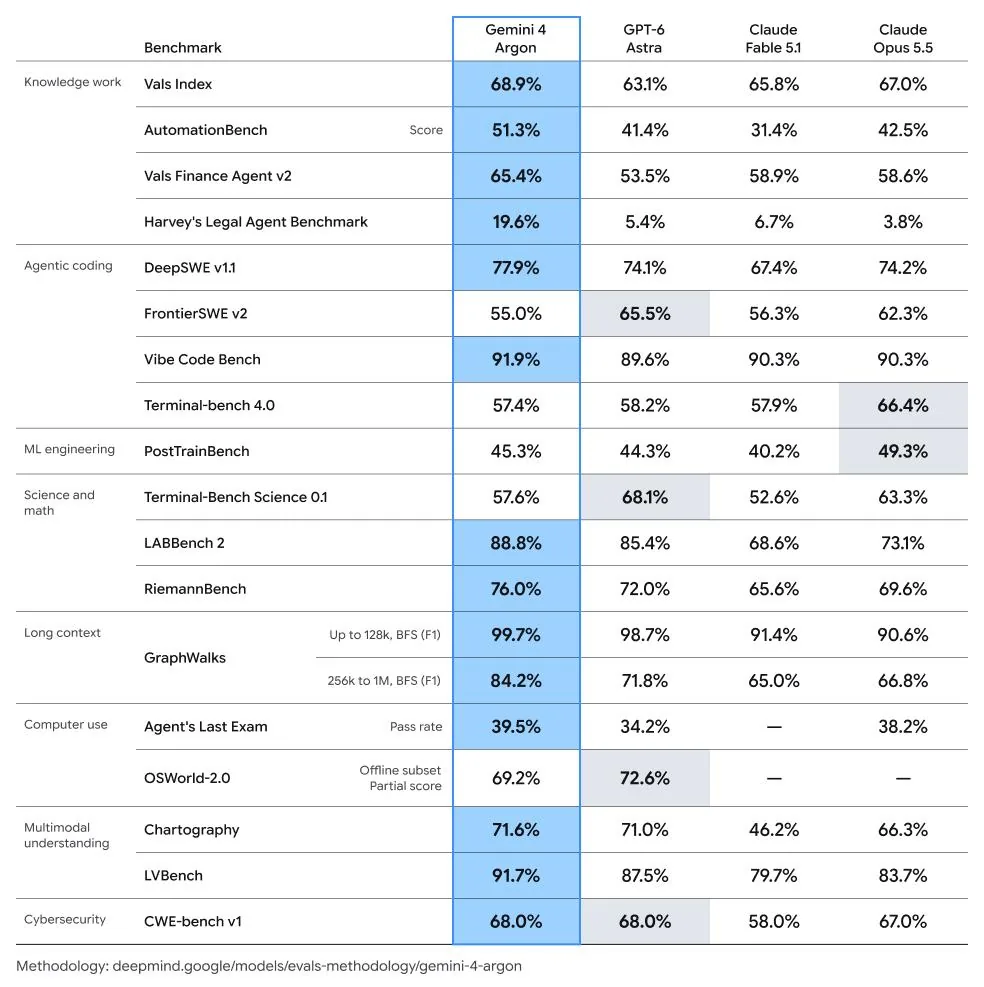
- DeepSWE v1.1 (long-horizon software engineering tasks): 77.9%, higher than Claude Opus 5.5’s 74.2% and GPT-6 Astra’s 74.1%
- CWE-bench v1 (cybersecurity vulnerability remediation test): 68%, tied for first with GPT-6 Astra
- Vals Index: 68.90%, far surpassing Gemini 3.8 Flash
- RSI Index improved significantly, entering the industry’s top ranks
- Text Arena (text capabilities): 1525 points, ranked first
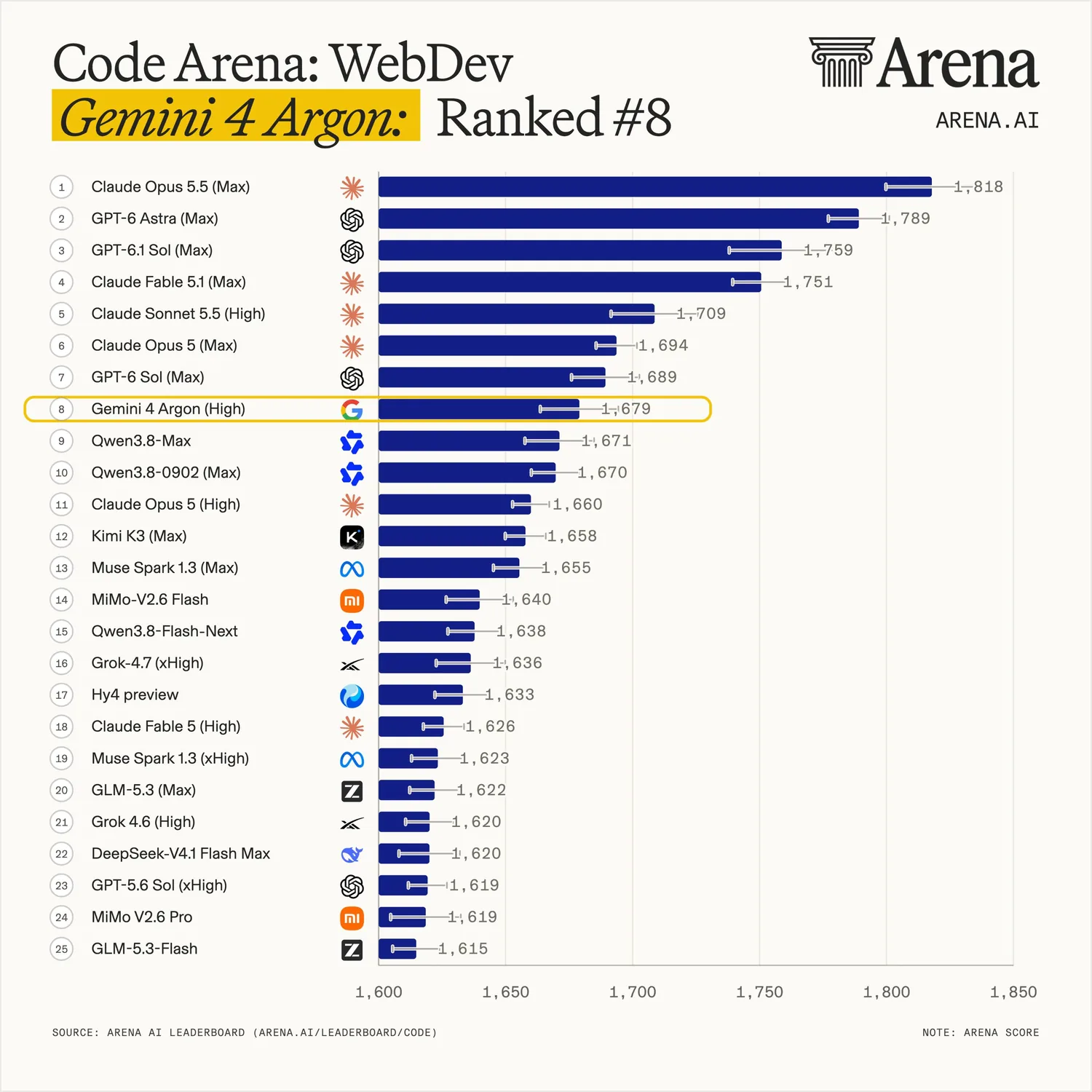
- Code Arena (web development): ranked 8th, up 21 places from Gemini 3.8 Flash High, but still slightly behind the latest Claude and GPT models
In the Artificial Analysis comprehensive evaluation, the gap between Argon and GPT-6 Astra is extremely small (only about 1 point above GPT-6.1 Sol), with its main advantages being reduced hallucinations and enhanced agentic capabilities.
Model Capabilities and Parameters Comparison Table
| Item | Gemini 4 Argon | GPT-6 Astra | Claude Opus 5.5 | Gemini 3.8 Flash High |
|---|---|---|---|---|
| DeepSWE v1.1 | 77.9% | 74.1% | 74.2% | — |
| CWE-bench v1 | 68% | 68% | — | — |
| Vals Index | 68.90% | — | — | — |
| RSI Index | Significantly improved | — | — | — |
| Text Arena | 1525 points (1st) | — | — | — |
| Code Arena | 8th | — | — | — (up 21 places) |
| Input token cost | $2/million | — | — | — |
| Output token cost | $10/million | — | — | — |
Application Scenarios and Real-World Cases
Gemini 4 Argon is positioned for complex and long-horizon reasoning tasks, especially for professional workflows such as programming, finance, and law:
- Maximum output length: one million tokens, designed for long tasks and supporting ample continuous reasoning
- Google internal use case 1: autonomously identified and implemented memory optimization solutions in data centers; once deployed, expected to free over 300 TiB of memory
- Case 2: in a Rust video decoder project, the Argon Agent repeatedly experimented and replaced 32,000 lines of SIMD code; the final version ran at 2.7x the speed of the original Rust port
Security Defense Capabilities
Argon performs outstandingly in cybersecurity:
- Can autonomously discover, verify, and patch critical software vulnerabilities in more than 20 programming languages
- In Wiz black-box penetration testing, the model can analyze network systems in real time without source code, identify attack surfaces and vulnerabilities, and generate Proof-of-Concept evidence
- Therefore, initial deployments are focused on cybersecurity defenders, helping them patch vulnerabilities and detect attack entry points
Practical Recommendations for Readers
- Those who should try it immediately: cybersecurity teams (enterprise security operations, Red Team/Blue Team members), who can apply for access through Google’s Fairwind program
- Those advised to wait and see: general office/creative users and front-end web developers: the model remains weak in front-end interface design; general users need to wait for subsequent access plans
Final Thoughts
Although there is minor internal controversy over Gemini 4 (some employees believe its actual programming performance is slightly below the leaderboard data), Google emphasizes that it has reached the industry frontier. Regardless of the assessment, the release of Gemini 4 Argon marks Google’s official return to the main battlefield of large model competition.