
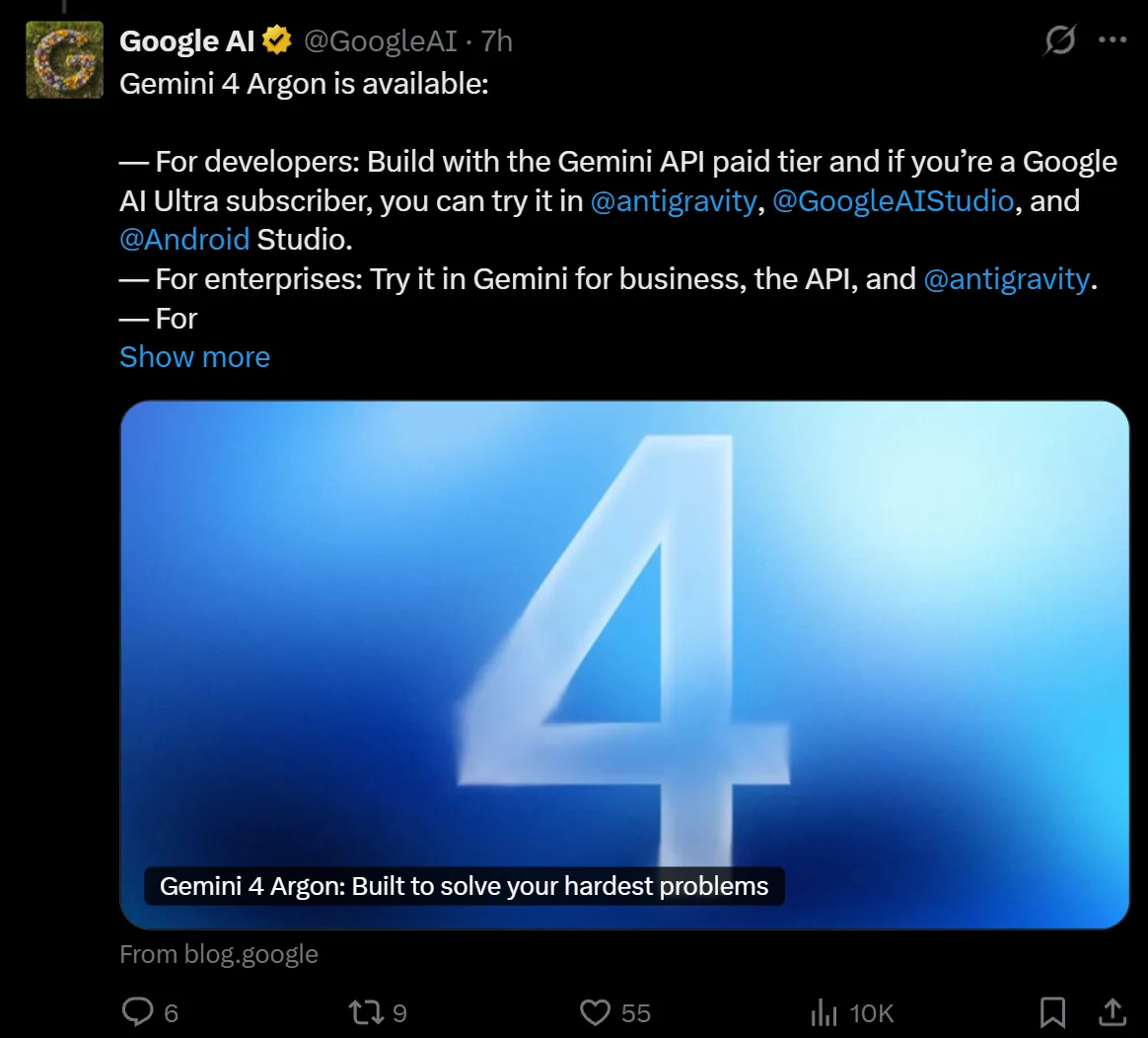
Gemini 4 Argon is now officially available worldwide, and Google is simultaneously rolling out a 50%-off launch price for its API, using price and use cases as two levers to push the flagship model into developers’ and enterprises’ daily workflows.
The hard facts are as follows:
- Release and availability: The model was released on October 1, and on October 14 Google announced it is available worldwide starting now.
- Available channels: Developers and enterprises can call it through APIs in Google AI Studio and Gemini platform; Google AI Ultra subscribers can use it in Google’s AI development tool Antigravity; Google AI Ultra and Pro subscribers can access it through the Gemini app and Google Search AI Mode.
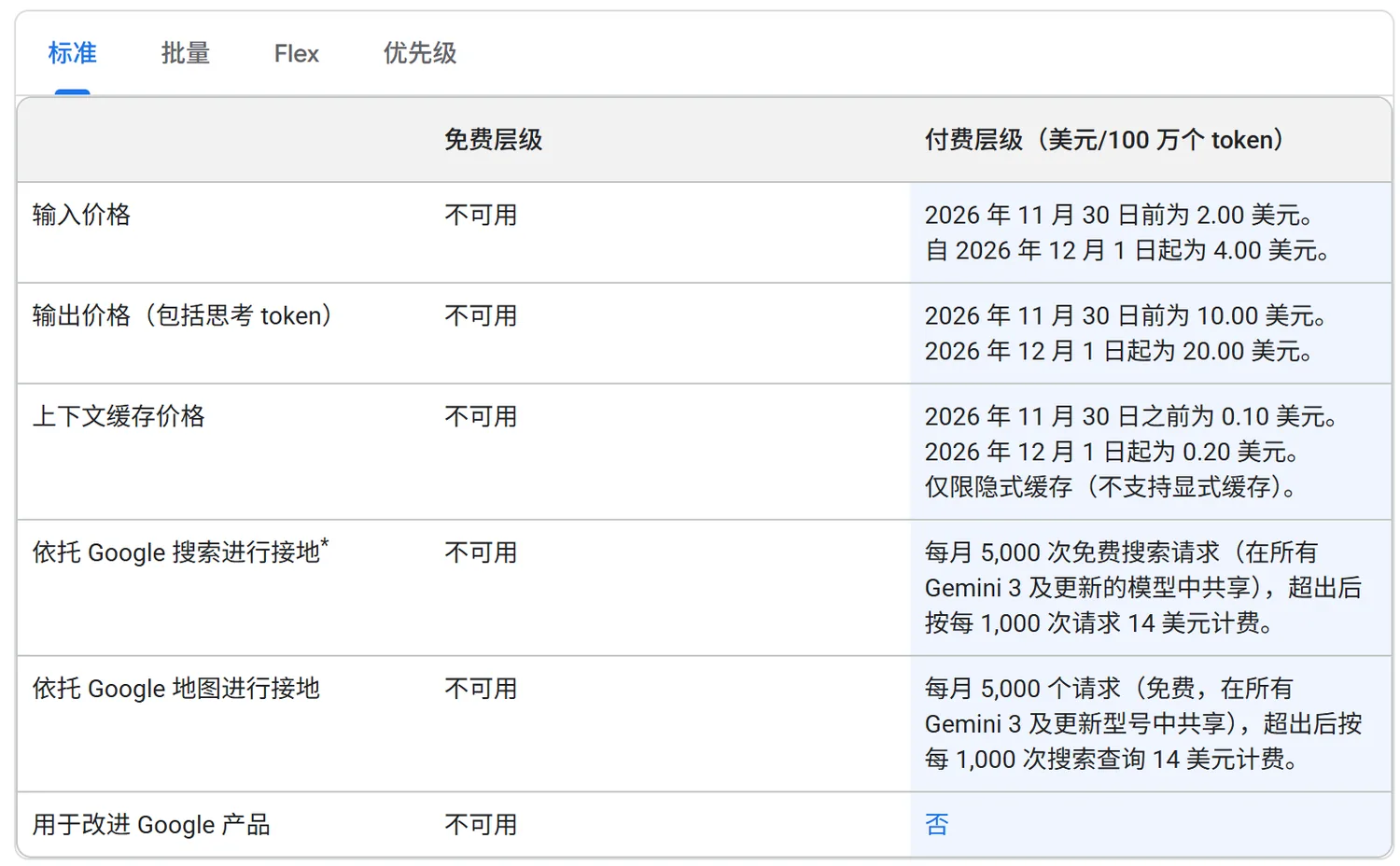
- Price: Half-price launch pricing: $2 per million input tokens (about RMB 13.4), $10 per million output tokens (about RMB 66.9), and a 95% discount on cached input tokens.
- Discount period: Through November 30.
- Whether weights are open: The source material does not mention weight availability or open-source plans.
(A token is the smallest billing unit for text processed by a model, roughly understandable as a “word fragment”; input refers to what the model reads, and output refers to what it writes.)
What’s on display isn’t parameters—it’s the loop of “keep revising until it’s right”

Google says Argon excels at complex real-world tasks in programming, finance, law, cybersecurity, and science. It can maintain deep reasoning and high execution accuracy across multistep work and ranks first on the Vals Index leaderboard covering key economic domains such as finance, programming, law, and tax.
The deployment examples Google provides are almost all centered on the loop of “call a tool—check the result—keep revising”:
- In Antigravity, Argon starts from a rough 2D sketch to design custom hardware and calculate mechanical fits, part clearances, and snap-fit structures. Google says this demo compresses industrial computer-aided design (CAD) work that would otherwise take days by hand into minutes.
- In a case shared by Google and Alphabet CEO Sundar Pichai, Argon starts with a raw Pixel device CAD file and, in Antigravity, uses Blender MCP to call the 3D creation software Blender to produce an animation with exploded views, lighting, camera sequencing, and audio. Pichai says Argon ran 1,000 iterative loops, continually checking its own rendered results and repeatedly modifying code. MCP can be understood as an interface protocol that lets a model call external software.
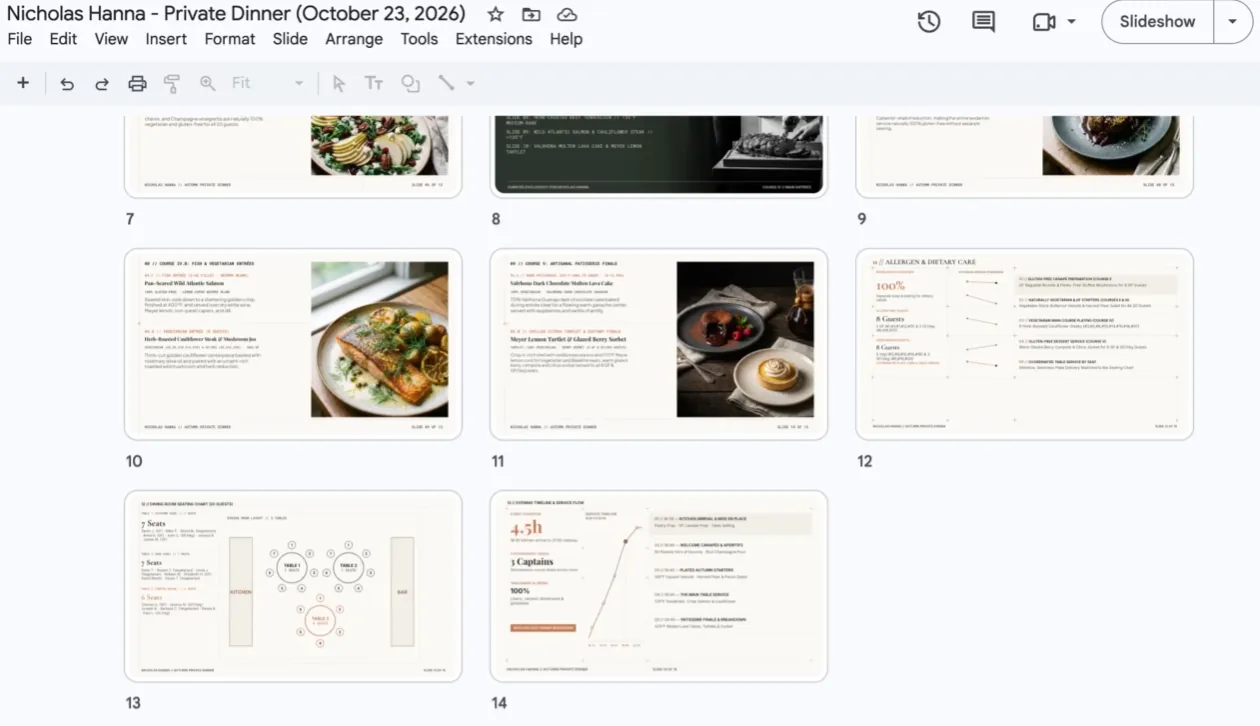
- In a catering scenario, Argon in the Gemini app reads scattered recipes and seating arrangement sheets from a folder and turns this unstructured material into a customer-facing presentation; combined with custom skills and scheduled tasks, it can also produce and send catering service proposals by email and bring subsequent catering requests into an automated workflow.
- In game development, Google demonstrated using the Gemini API and Managed Agents to have Argon build a playable pixel-art retro arcade game from a user’s idea and deliver it to the user’s screen.
- In scientific data processing, Google gave Argon more than 80,000 raw NASA Mars weather logs and telemetry files from the Ingenuity helicopter. The model distilled flight mechanics information under atmospheric conditions from the messy scientific archive and organized it into a presentation.
Google also says its internal teams, enterprise customers, and researchers have already used Argon to refactor and optimize large codebases, improve business processes in legal, financial, and scientific fields, discover and fix critical cybersecurity vulnerabilities, and help research in quantum computing, nuclear fusion, and life sciences achieve new breakthroughs.
Who can use it, and who has to pay
| Access channel | Required subscription tier |
|---|---|
| Google AI Studio, Gemini platform API | Developers and enterprises, billed by token |
| Google Antigravity | Google AI Ultra subscription |
| Gemini app, Google Search AI Mode | Google AI Ultra and Pro subscriptions |
Table content comes from the source material.
Adoption recommendations
Who should try it now: Teams that need multistep tool-calling chains, especially developers and business teams handing “repeated revision” workflows such as CAD, 3D animation, and document organization to the model for drafting. The half-price offer before November 30 is also suited to cost-controlled side-by-side testing.
Who should wait: Production systems with high requirements for output stability and auditability. What Google showed are demos and internal cases; the source material does not provide latency, stability, or error-rate data under large-scale third-party use. It is more prudent to validate with small-scale tasks first before deciding whether to migrate.
Final thoughts
Argon’s selling point this time is not any single capability, but stringing reasoning, tool calling, and result verification into a pipeline that can actually run end to end. Whether it can truly return to the top tier depends on whether this pipeline can deliver reliably in enterprise environments and bring down the time and cost required for tasks.