Price Cut Right After Launch: The Hard Facts on Gemini 4 Argon
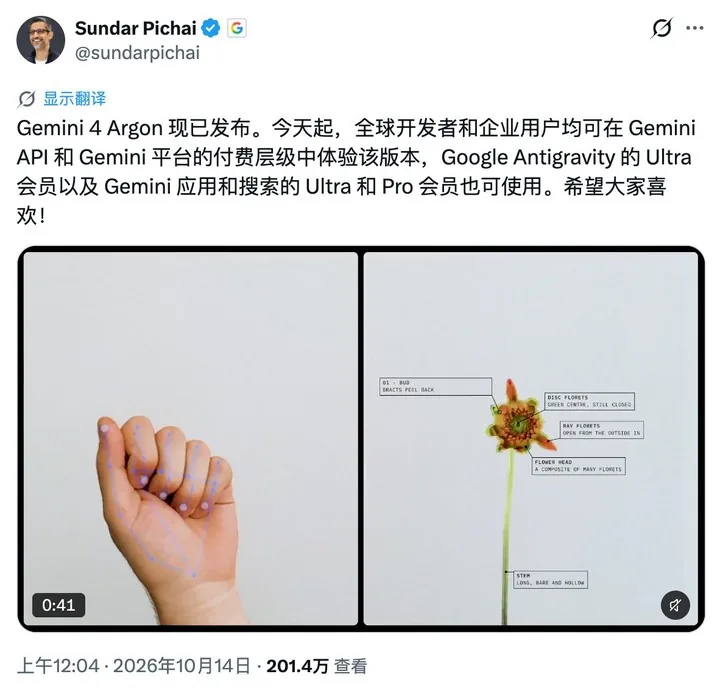
Just now, Google officially launched Gemini 4 Argon, the first flagship of the Gemini 4 generation, worldwide. Previously, Google had rolled out successive Flash updates from 3.5 to 3.8 but kept delaying the flagship Pro release; this launch is meant to steady market expectations. The codename Argon refers to argon, a stable noble gas often used as a protective shield in welding and semiconductor manufacturing.
- Version: Gemini 4 Argon; tested in a limited rollout two weeks ago, refined over six months, and battle-tested by more than 100,000 internal Google users
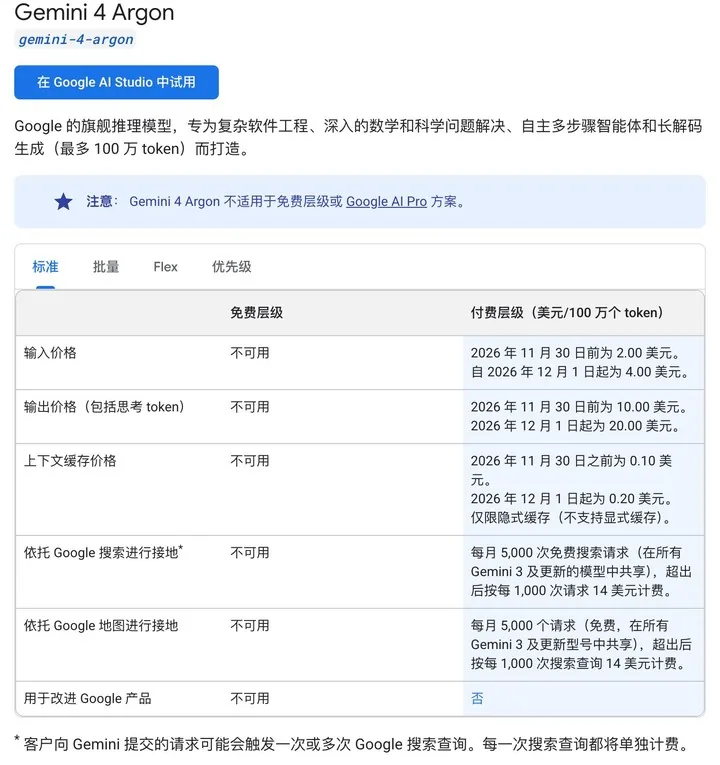
- Pricing: $2 per million input tokens, $10 per million output tokens, with cached input discounts of up to 95%
- Context: The API offers a unified 1 million input/output token limit, paired with a new continuation protocol
- Availability: AI Studio, Android Studio, Gemini API; Google AI Pro and Ultra subscribers can use it in the Gemini app, AI Mode in Search, and Google Antigravity
- Weights: Not open; it remains a closed-source model
Logan Kilpatrick, Google’s AI product lead, said this is only the beginning of the Gemini 4 era, and the new model was designed to help people tackle thorny problems they previously wouldn’t have dared to imagine.
Strong Internal Numbers, Real-World Tests Expose Weak Spots
Argon is focused entirely on complex, multi-step, real-world deep tasks spanning coding, finance, law, cybersecurity, and frontier science, and it took first place outright on the Vals Index, which measures performance in key economic sectors.
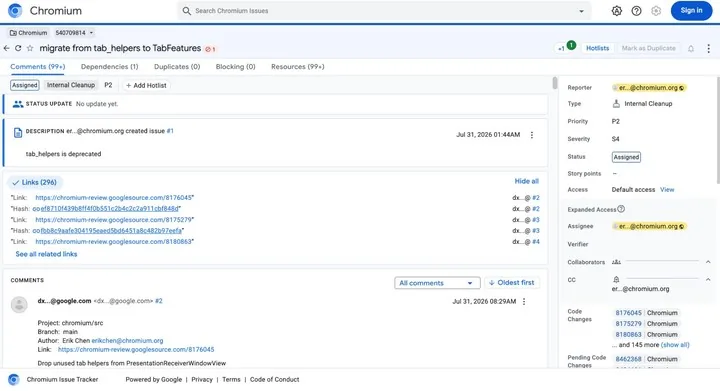
Start with internal engineering data: over the past few weeks, with Argon on the Antigravity platform, agentic code commits by Google engineers rose by more than 35%, while code rollback rates fell by nearly a third. It helped the Chrome team refactor 6 million lines of legacy code in a 40-million-line codebase within weeks, eliminating a class of browser crashes. Given only a brief goal and rules, it autonomously optimized Google’s agent framework ADK overnight, cutting long-session memory preparation time by 40%. Within days, it boosted the end-to-end inference speed of the open model Gemma 4 E2B by 2.85x with zero quality loss.
External evaluations also produced highlights: Deloitte measured a 100% completion rate on long-horizon, cross-tool tasks; Kepler found that the multi-year financial statements it generated matched human analyst models with over 99% agreement; and legal tech company MinutaIA used it to uncover case details that human experts had missed. It also accelerated quantum chemistry calculations and quantum error-correction decoding, completed the design of five novel enzymes within hours, and helped identify new counterexamples to the “Glad conjecture” in nuclear fusion. In embodied intelligence tests, simply by watching videos of humans playing sandbag toss, it autonomously calculated joint trajectories and wrote simulation code; deployed on the Apollo humanoid robot, it sank seven consecutive real-world throws. Google also announced free six-month access to Antigravity’s highest usage tier for 10,000 scientists worldwide. On security, a real-time reasoning-step monitor reduced unauthorized shortcuts in coding tests to 2%, cut the success rate of indirect prompt injection attacks to 0.7%, and worked with security firm Wiz to help federal agencies and healthcare systems patch multiple high-risk vulnerabilities ahead of time.
The most surprising contrast comes from image quality: In a comparison using a “Godzilla vs. Kong” 3D scene, testing organization AI/ML API noted that Argon’s cost per call ($4.22) was far lower than GPT-6 Astra’s ($23.82), but it still has clear room to improve in image quality and shape fidelity for certain complex biological models. Cheap doesn’t mean it wins on every dimension.
Price vs. Real-World Costs: One Table Makes the Gap Clear
Put official pricing alongside third-party real-world tests, and Argon’s value-for-money advantage becomes clearer:
| Comparison dimension | Gemini 4 Argon | GPT-6 Astra | Claude Opus 5.5 |
|---|---|---|---|
| Official API pricing | $2 input / $10 output (per million tokens) | Not disclosed | Not disclosed |
| Pixel-art ancient architecture night scene generation (AIHubmix) | 3 minutes / $0.50 | 25 minutes / $11 | — |
| Tesla motor 3D animation (Rubens Soto) | $3.83 | — | $16.36 |
| Godzilla vs. Kong 3D scene (AI/ML API) | $4.22 | $23.82 | — |
(Items marked “Not disclosed” were not provided in the source material.)
On spatial reasoning, blogger Bhavy called Argon a beast, showcasing a sunlit study built in a single browser file with no external 3D assets or game engine, purely with mathematical code, with lifelike light and reflections and detailed mountains outside the window. In a four-way blind test of a “3D whale breaching the water,” its photorealism was on par with Claude Opus 5.5, GPT-6 Astra, and Kimi K3. Investor Justine Moore asked it to make an interactive Apple computer museum without providing any image or text data; the model autonomously scraped Mac photos from archives, wrote its own tools to clean the images, pulled hardware spec data spanning 50 years, and ultimately built a 3D cover-flow webpage whose UI automatically morphs as the timeline slider moves. In ifanr’s own tests, it used Three.js and TypeScript to produce a fairly polished prototype of an Eastern paper-style ancient battlefield action game, and its Chinese writing also moved away from the old habit of piling on grandiose vocabulary.
Who Should Use It Now, and Who Should Wait

- Start using it now: developers who need high-frequency API calls, multi-step agents, code refactoring, or spatial-physical reasoning prototypes. Based on official pricing and real-world costs, batch calls for long tasks can save real money; Pro and Ultra subscribers can try it directly in the Gemini app and Antigravity.
- Better to wait: ordinary users who just want to get the full-powered flagship for free. Non-paying users are currently assigned models automatically by default, with the vast majority of requests handled by the lightest Flash-Lite; once auto-selection is turned off, you can only use Flash-Lite. The Gemini app has also switched to a dynamic compute quota that refreshes every 5 hours and is tied to a weekly cap; raising the thinking level, using Deep Research, or calling the flagship model will use up that quota faster. If you have hard requirements for image quality on specific complex biological models, it’s also worth running a small-scale side-by-side test first.
Final Thoughts
From official engineering data to real-world tests spreading across the internet, it’s clear that Google’s playbook for this generation has changed: it’s no longer fixated on chat conversation tricks, but instead driving down inference costs, extending context, strengthening code and spatial-physical reasoning, and truly embedding the model into industrial-grade codebases, labs, and production pipelines. Argon is, after all, a protective shield; Argon’s launch lets Google build a new line of defense at the table of top-tier models. But for users, whether they can freely experience its full-power capabilities still ultimately comes down to the tiered-payment barrier.