
At the 2026 CIOE (China International Optoelectronic Exposition), AI interconnects emerged as the hottest topic. Astera Labs, as a prime example, has seen its product value per accelerator surge from less than $100 in the early days to several thousand dollars. Behind this shift lies the reshaping of underlying interconnect architecture driven by AI compute expansion.
The Triple Leap in Interconnect Product Value

Founded in 2017, Astera Labs initially entered the high-speed interconnect market with PCIe Retimers. As AI evolved, its product line expanded to cover copper interconnects, optical interconnects, and rack-level connectivity systems. The value growth trajectory is clear:
- Early stage (Aries series): Product value per accelerator was under $100
- Mid stage (adding switch chips and memory): Value rose to several hundred dollars
- Current (scale-up switching phase): Value per accelerator has reached several thousand dollars
The company originally expected the Scorpio series to become a primary revenue source by Q4 2026, but this milestone has been pulled forward to Q3.
Redrawing the Copper-Optical Boundary: Speed and Scale Become Key Variables
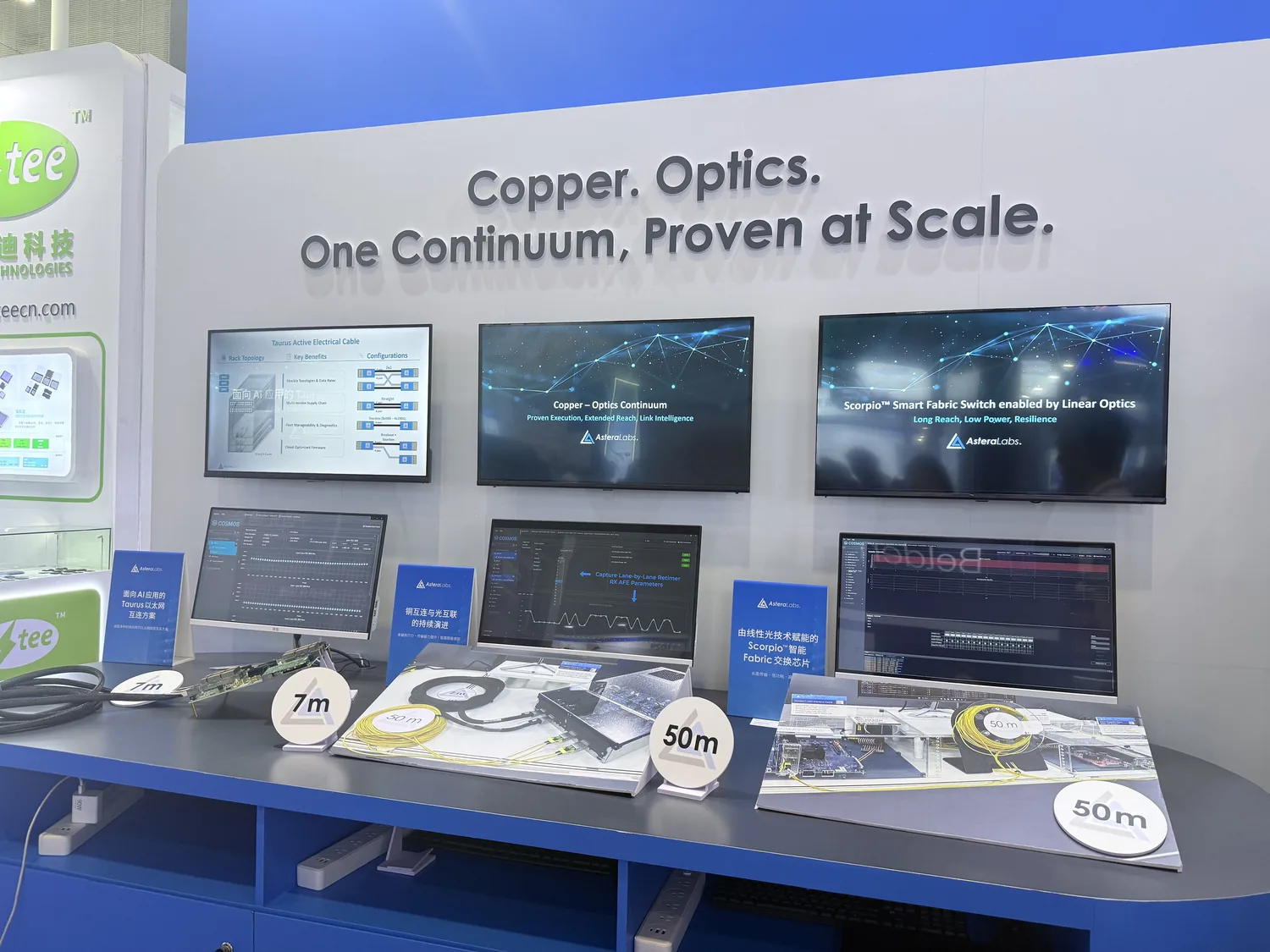
In conventional thinking, copper handles short distances and optics handle long ones. But in the AI era, distance is no longer the decisive factor. Astera Labs President and COO Sanjay Gajendra points out that when optical interconnects transition into the rack depends primarily on transmission speed and GPU scale.
Specifically:
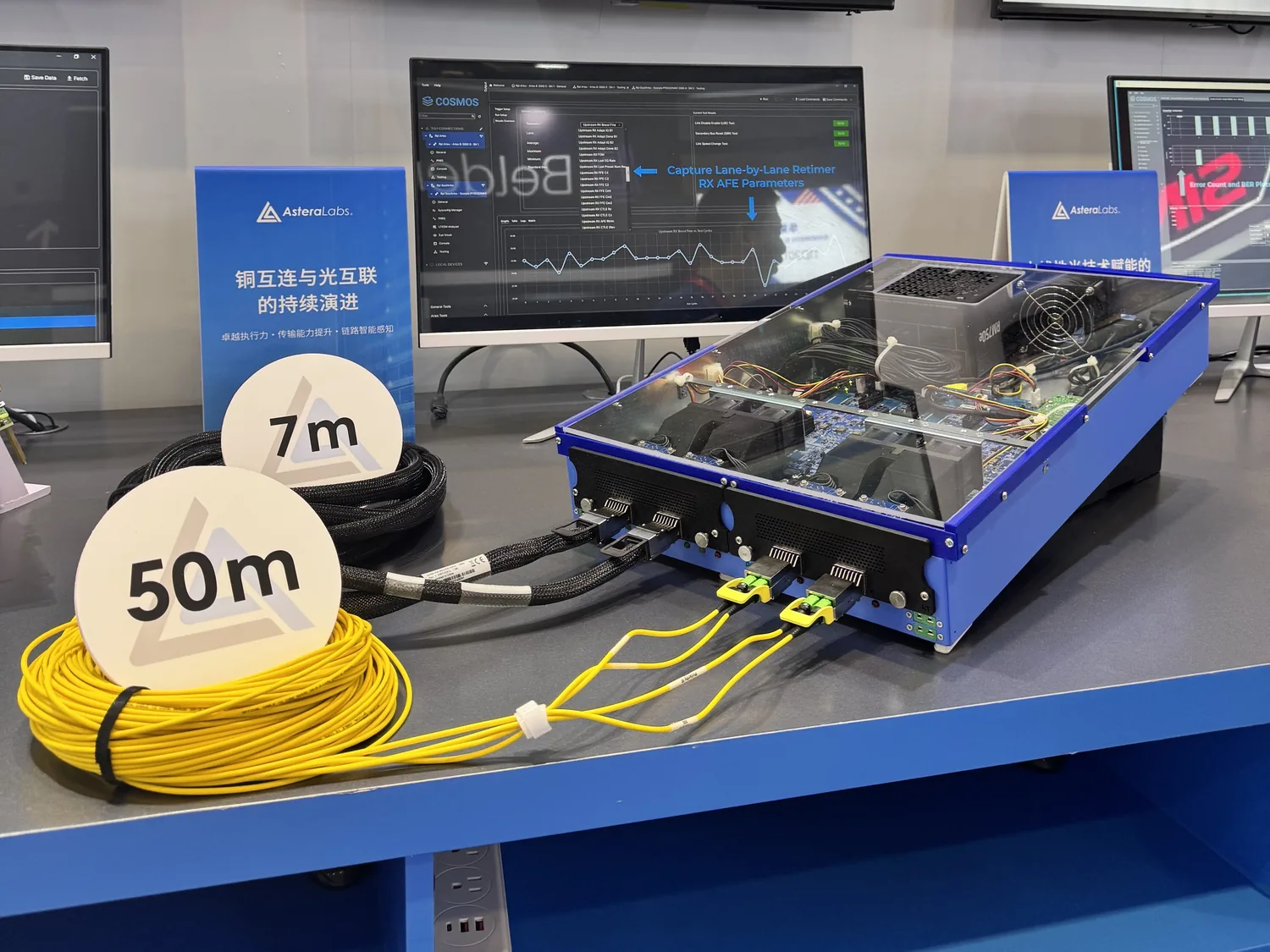
- At 200G/lane: Copper interconnects remain sufficient
- At 400G/lane and above: Optical interconnects accelerate penetration into the rack
Scale effects further amplify this shift. When systems expand to thousands of GPUs across racks, the customer’s key metric upgrades to per-token cost of the entire system. Taking NVIDIA’s NVL72 (a 72-GPU scale-up domain) as a reference, a larger scale-up domain reduces the need for data to frequently traverse the scale-out network, avoiding extra latency and complexity. This gives optical interconnects a cost advantage as scale-up scope expands.
On the technology timeline, Gajendra predicts that NPO (Near-Package Optics) will enter scale-up deployment around 2027; CPO (Co-Packaged Optics) is currently limited to small-scale applications, with broader deployment potentially deferred until 2029–2030.
Divergence Between Chinese and U.S. Markets Becomes Pronounced
System customization is intensifying, yet external interfaces remain anchored to open standards. Gajendra’s comparison of the Chinese and U.S. markets reveals:
- North American market: Dominated by four hyperscale cloud providers — Amazon, Microsoft, Google, and Meta — with emphasis on standardization, supply chain reuse, and cross-generational compatibility
- Chinese market: Beyond ByteDance and Alibaba, a large influx of startups means higher demands on supplier responsiveness and deployment speed
Japanese companies increasingly customize internal systems while keeping external connectivity interfaces unified. ByteDance’s infrastructure, for instance, focuses on its own business needs, while Alibaba serves both internal applications and external cloud services, leading to divergent processor and server design paths.
Inference Market: Fragmentation Brings New Opportunities
Gajendra emphasizes that while the inference market shares training’s demands for high bandwidth, low latency, and low power consumption, the priorities differ: training prioritizes compute power, while inference prioritizes memory and low latency. More importantly, inference market participants and system configurations are far more fragmented than the training market.
This means connectivity demand no longer depends solely on the expansion of training clusters at a handful of top-tier cloud providers. More systems of varying scales and deployment forms will emerge, and interconnect vendors must address an increasingly diverse array of demand combinations.
Practical Recommendations
- If you are building large-scale GPU training clusters (hundreds of cards or more), a scale-up architecture paired with optical interconnect solutions can optimize token costs and is worth evaluating in advance
- If you are in early-stage inference deployment or small-to-medium-scale scenarios, copper interconnect solutions still offer cost advantages — there is no need to chase cutting-edge optical technology just yet
Final Thoughts
Interconnects have evolved from a supporting component into a core variable in AI infrastructure design. When the interconnect approach directly impacts GPU scale, system latency, and token cost, its value lies no longer merely in data transmission, but in determining whether compute power can truly translate into usable performance.