
The Core Event: enterprises are undergoing intelligent productivity replacement

A profound structural adjustment in productivity is quietly unfolding in Chinese enterprises. The core differentiator is no longer “whether to use AI,” but rather “how much of the business is truly managed by AI.” The hard metric for digital transformation is now clear:
- Timeline: The 2024 Cloud Valley Conference’s “AI-Native Reshapes Enterprise Productivity” forum marks the industry watershed
- New paradigm: AI-Native organizational value is determined by AgentCount (number of agents managed), not headcount
- Key data: Alibaba Cloud’s MaaS business ARR reached 1.6 billion RMB, AI cloud business exceeding 4 billion RMB; Qwen 3.8 Flash costs 0.8 RMB per million tokens
- Availability: Enterprise-grade AI capabilities are in production deployment phase, no waiting required
Three pathways to AI-Native transformation
Startups: Born with “small beats big” advantage
Chengdu-based PAZI Interconnection exemplifies this. This dozens-person electronic design team deployed a multi-agent collaborative system on the cloud, achieving breakthrough in EDA software—a field dominated by international giants through thousands of engineers and decades of accumulated IP. Results: 95%+ accuracy in component library creation and document recognition, 100x speedup in grouped processing, 90% rule layer merging resolution rate. A team that would normally require thousands for R&D maintenance has been compressed to dozens.
Mature enterprises: Precisely shedding mechanical burdens
Xinyouzhonghe Certified Public Accountants adopted pragmatic smart upgrade. With 10,000+ professionals, it did not dismantle its 7-8 year old legacy systems but layered an AI work platform on top: high-frequency data via MCP calls, analytical data via API imports. Staff issue one goal command at unified entry point, while Agents autonomously cross-database and draft reports.
The surprising contrast: Legacy model required specialists to manually switch among 5-6 systems (Tianyancha, Tonghuashun, etc.) for data gathering; now mechanical data handling is fully automated, freeing humans for high-value judgment tasks.
Cross-border e-commerce: Redefining time-to-market
Yixiang Technology (Feixiang Agent) completely rebuilt its cross-border content production line. With Qwen and Wanxiang multimodal models, tasks taking days for cross-language image/video materials are now completed in 1 minute, cost reduced from hundreds to 5 RMB per set. This eliminates the time-to-market penalty that caused sellers to miss organic traffic windows.
The key inflection point: two trajectories
Alibaba Cloud’s “usability line” and “kill line” clearly chart the turning point:
| Dimension | Past | Current (Qwen 3.8 series) | Impact |
|---|---|---|---|
| Capability | Requires step-by-step instruction | Autonomous long-chain task decomposition | Production-grade闭环 |
| Cost per call | 50-60 RMB (overseas models) | Below 0.2 RMB comprehensive | Marginal tasks achieve excessive ROI |
| System requirement | Single-point demo | Full-stack (model + compute + high concurrency) | Usability for real revenue |
Enterprise decision threshold: Enterprise decision-making hinges on the delta between efficiency gains and replacement costs. Alibaba Cloud’s Chen Yuchen notes only 3-5x efficiency improvement justifies automation investment.
The future of human-agent collaboration
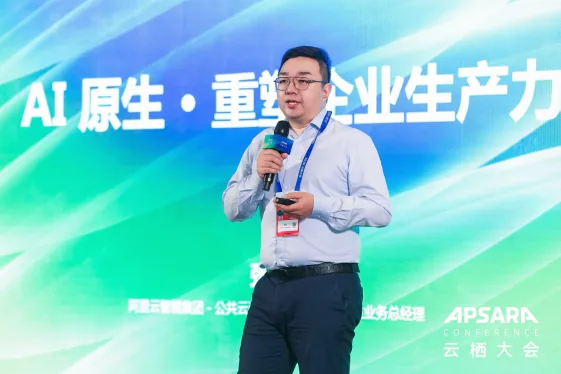
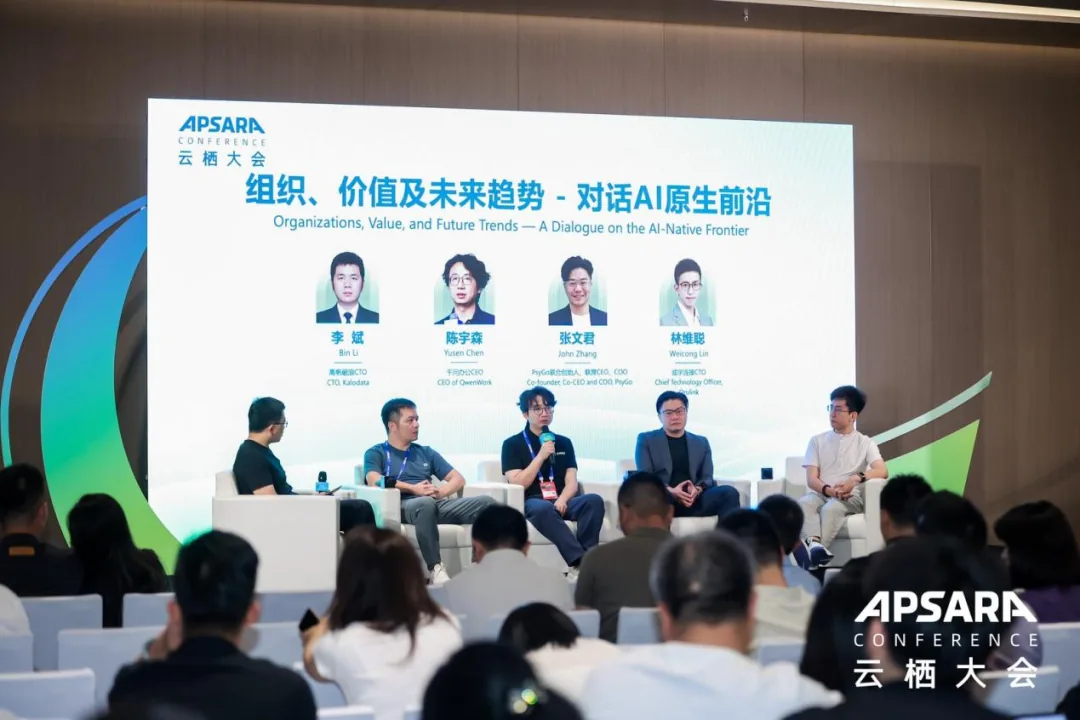
Gao Fan PoLang CTO Li Bin notes Agent协同 networks are penetratind traditional pyramids. Humans are now “responsibility nodes”—specific execution handled by Agent squads. A product owner with nested Agent teams can drive from PRD to supply chain.
Deeper change: organizational knowledge asset form. Employee expertise is now automatically extracted and stored as cloud-based Skill libraries. When senior staff leave, only physical assets depart; digital assets continue generating value.
Implementation recommendations
- Act now: If your business involves frequent data handling, cross-system switching, or multi-step approvals, evaluate Agent integration immediately. Cross-border e-commerce, accounting, industrial design have mature solutions
- Wait: Current AI requires 4-5x efficiency to offset costs; enterprises with isolated legacy systems need digital infrastructure first
Final thoughts
True AI-Native organizations have no room for buzzwords—only measurable Agent management proportion. The productivity revolution’s core is whether enterprises dare entrust real business processes to AI—determining who gets a ticket and who watches from the sidelines.